
WHAT IS CLIMATE & ENVIRONMENTAL TECHNOLOGY?
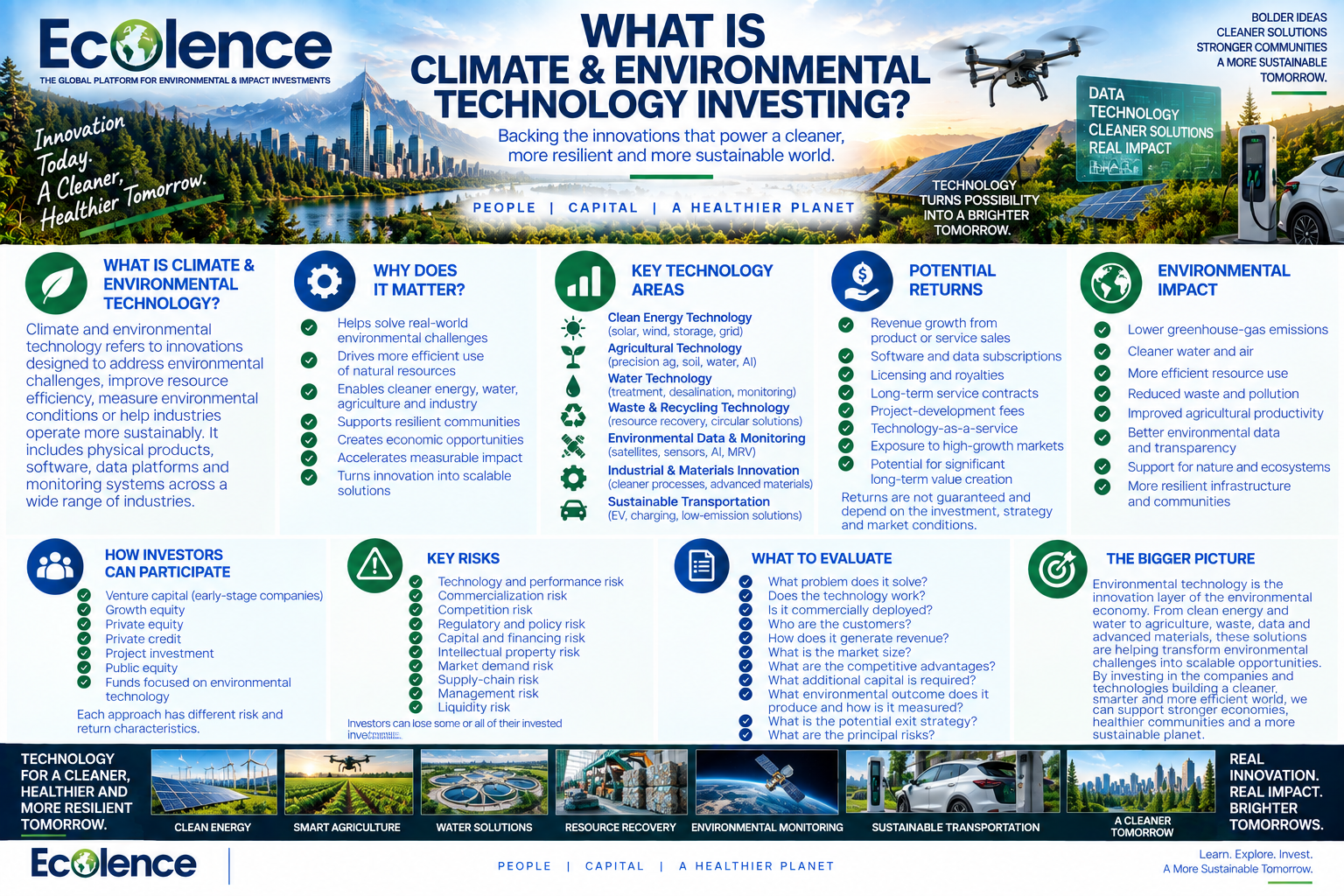
Climate and environmental technology refers to technologies designed to address environmental challenges, improve resource efficiency, measure environmental conditions or help industries operate more sustainably.
The sector can include technologies related to:
Clean energy
Energy storage
Water
Agriculture
Waste and recycling
Environmental monitoring
Carbon measurement
Natural capital
Industrial efficiency
Advanced materials
Transportation
Environmental data and software
Some technologies are physical products.
Others are software, data platforms or monitoring systems.
Many combine the two.
Environmental technology is therefore not one industry. It is a collection of technologies being applied across much of the global economy.
WHY DOES ENVIRONMENTAL TECHNOLOGY MATTER?
Many environmental challenges are ultimately engineering, measurement or efficiency problems.
How can farmers produce more while using water more efficiently?
How can renewable electricity be stored when it is produced and used when it is needed?
How can aging water systems detect leaks?
How can recycling facilities recover more valuable material?
How can investors determine whether an environmental project is actually producing the outcomes it claims?
Technology can help answer these questions.
The investment opportunity can therefore extend beyond financing environmental assets themselves to financing the companies providing the technologies that make those assets more efficient, measurable and scalable.
WHERE ARE THE OPPORTUNITIES?
Environmental technology spans numerous markets.
CLEAN ENERGY TECHNOLOGY
This can include:
Solar technology
Wind technology
Battery storage
Grid-management systems
Energy-efficiency technology
Distributed energy
Power electronics
Energy-management software
Innovation can occur throughout the energy system—from generating electricity to storing, distributing and managing it.
AGRICULTURAL TECHNOLOGY
Agricultural technology can help farmers improve productivity while managing land, water and other resources.
Examples include:
Precision agriculture
Satellite monitoring
Soil sensors
Automated irrigation
Farm-management software
Robotics
Artificial intelligence
Crop monitoring
Biological agricultural products
These technologies can potentially improve both agricultural economics and environmental performance.
WATER TECHNOLOGY
Technology is increasingly important throughout the water economy.
Potential areas include:
Water treatment
Filtration
Desalination
Wastewater treatment
Leak detection
Smart meters
Water-quality monitoring
Industrial water reuse
Irrigation technology
Water technology can address both scarcity and infrastructure efficiency.
WASTE & RECYCLING TECHNOLOGY
Technology can improve how materials are identified, sorted, processed and recovered.
Examples include:
Automated sorting
Artificial-intelligence vision systems
Advanced recycling
Material recovery
Organic-waste processing
Battery recycling
Waste tracking
The objective is often to recover greater economic value from materials that might otherwise become waste.
ENVIRONMENTAL DATA & INTELLIGENCE
One of the fastest-developing areas of environmental technology involves data.
Satellites, sensors, artificial intelligence and geospatial systems can produce increasingly detailed information about the physical world.
Technology can potentially monitor:
Forests
Agricultural land
Water
Emissions
Weather
Soil
Biodiversity
Infrastructure
Energy use
Environmental projects
This information can be valuable to businesses, governments, investors, insurers and environmental markets.
SATELLITE TECHNOLOGY
Satellite imagery has dramatically expanded the ability to observe environmental conditions at scale.
Satellites can potentially help monitor:
Deforestation
Crop conditions
Water availability
Land-use changes
Wildfire
Infrastructure
Vegetation
Environmental projects
Rather than relying exclusively on periodic physical inspections, organizations can increasingly monitor large geographic areas remotely.
ARTIFICIAL INTELLIGENCE
Artificial intelligence is becoming another important environmental technology.
AI systems can potentially analyze large quantities of environmental data and identify patterns that would be difficult to detect manually.
Applications may include:
Energy forecasting
Crop analysis
Water-system optimization
Waste sorting
Environmental-risk modeling
Satellite-image analysis
Predictive maintenance
Biodiversity monitoring
AI itself does not make an investment environmentally beneficial.
Its value depends on the problem it solves and whether customers are willing to pay for that solution.
SENSORS & THE CONNECTED ENVIRONMENT
Sensors allow physical assets and environmental conditions to be monitored continuously.
Examples include sensors measuring:
Water quality
Soil moisture
Energy consumption
Air quality
Equipment performance
Temperature
Emissions
Weather conditions
When combined with communications networks and software, sensors can turn physical infrastructure into increasingly measurable and manageable systems.
TECHNOLOGY AND ENVIRONMENTAL MARKETS
Environmental markets depend heavily on measurement.
Carbon projects need to quantify environmental outcomes.
Biodiversity projects need ways to observe ecosystem conditions.
Agricultural projects may need to document changes in soil or land management.
This has created opportunities for technologies supporting:
Measurement
Reporting
Verification
often referred to as MRV.
Environmental technology can therefore become part of the infrastructure supporting emerging environmental markets.
HOW CAN INVESTORS PARTICIPATE?
Investors can potentially access environmental technology through several structures.
VENTURE CAPITAL
Early-stage companies may raise capital to develop and commercialize new technologies.
GROWTH EQUITY
More established companies may raise capital to expand manufacturing, sales or geographic reach.
PRIVATE EQUITY
Investors may acquire or invest in established environmental-technology businesses.
PRIVATE CREDIT
Companies may use debt financing for equipment, expansion or working capital.
PROJECT INVESTMENT
Certain technologies may be financed as part of an underlying infrastructure or environmental project.
PUBLIC EQUITY
Some environmental-technology companies eventually become publicly traded.
The risk profile can differ significantly depending on the stage of the company and investment structure.
HOW DO ENVIRONMENTAL TECHNOLOGY COMPANIES MAKE MONEY?
Business models can include:
Equipment sales
Software subscriptions
Licensing
Data subscriptions
Monitoring services
Maintenance contracts
Transaction fees
Project-development fees
Technology-as-a-service
Long-term service contracts
Investors should understand whether revenue is recurring, project-based or dependent on continued capital spending by customers.
TECHNOLOGY IS NOT THE SAME AS A PROJECT
This distinction is particularly useful within Ecolence.
Consider a solar facility.
The solar project is the physical investment.
The solar panels, inverters, monitoring software and storage systems are technologies supporting that project.
An investor could invest in the project itself—or in a company producing technology used across thousands of projects.
Those are very different investment strategies.
FROM INVENTION TO COMMERCIAL SCALE
One of the greatest challenges for environmental technology is moving from a promising idea to a commercially successful business.
A technology may progress through stages such as:
Research
↓
Prototype
↓
Pilot project
↓
Commercial demonstration
↓
Initial customers
↓
Manufacturing scale
↓
Wider adoption
Each stage can require additional capital.
The earlier the technology, the greater the possibility that it may never achieve commercial scale.
WHAT IS THE “VALLEY OF DEATH”?
Investors may hear this term in connection with emerging technologies.
A company may successfully develop a technology but still struggle to obtain enough capital to build its first commercial-scale facility or reach widespread adoption.
This financing gap is sometimes described as the valley of death.
Environmental technologies can be particularly exposed because some require significant physical infrastructure and capital before generating substantial revenue.
WHAT ARE THE MAJOR RISKS?
Environmental-technology investments can involve substantial risks.
TECHNOLOGY RISK
The technology may not perform as expected.
COMMERCIALIZATION RISK
A technically successful product may fail to attract enough customers.
COMPETITION RISK
A competing technology may prove cheaper or more effective.
SCALE-UP RISK
A technology that works in a pilot may encounter problems at commercial scale.
CAPITAL RISK
Companies may require significantly more financing than originally expected.
REGULATORY RISK
Government rules and incentives can change.
SUPPLY-CHAIN RISK
Equipment manufacturers may depend on specialized materials or suppliers.
INTELLECTUAL-PROPERTY RISK
Technology companies may depend heavily on patents and proprietary knowledge.
MANAGEMENT RISK
Early-stage businesses can depend heavily on a small management team.
VALUATION RISK
Emerging companies can be difficult to value.
LIQUIDITY RISK
Private investments may be difficult or impossible to sell before an exit.
Investors can lose some or all of their invested capital.
TECHNOLOGY DOES NOT AUTOMATICALLY CREATE IMPACT
A technology can be marketed as environmental without necessarily producing meaningful environmental results.
Investors should distinguish between:
What the technology claims to do
and
What measurable results it actually produces.
Questions might include:
How much water does it save?
How much energy does it reduce?
How much material does it recover?
How much does it improve productivity?
What is the environmental outcome compared with the existing alternative?
This is particularly important as environmental claims become increasingly common.
WHAT SHOULD AN INVESTOR EVALUATE?
Before considering an environmental-technology investment, investors should understand:
What problem does the technology solve?
How large is the potential market?
Does the technology actually work?
Has it been independently tested?
Is it commercially deployed or still experimental?
Who are the customers?
How does the company generate revenue?
Does it have recurring revenue?
Who are its competitors?
What makes the technology difficult to replicate?
Does it have intellectual-property protection?
How much additional capital will be required?
Can the technology be manufactured or deployed economically at scale?
What environmental outcome does it produce?
How is that outcome measured?
What is the potential investor exit?
What are the principal risks?
A powerful technology does not necessarily make a successful company—and a successful company does not necessarily make an attractive investment at every valuation.
THE BIGGER PICTURE
Environmental investing is not only about financing forests, farms, solar projects and water infrastructure.
Behind those assets is an expanding technology ecosystem.
Satellites can observe the land.
Sensors can measure the water.
Artificial intelligence can analyze environmental data.
Software can optimize energy systems.
Robotics can improve recycling.
Precision agriculture can help manage farms.
Advanced technologies can recover resources once considered waste.
These innovations are helping transform environmental challenges into engineering problems that entrepreneurs, scientists and investors can attempt to solve.
For Ecolence, Climate & Environmental Technology represents the innovation layer of the environmental investment universe:
the companies and technologies building the tools that can make the physical economy cleaner, smarter, more measurable and more efficient.