
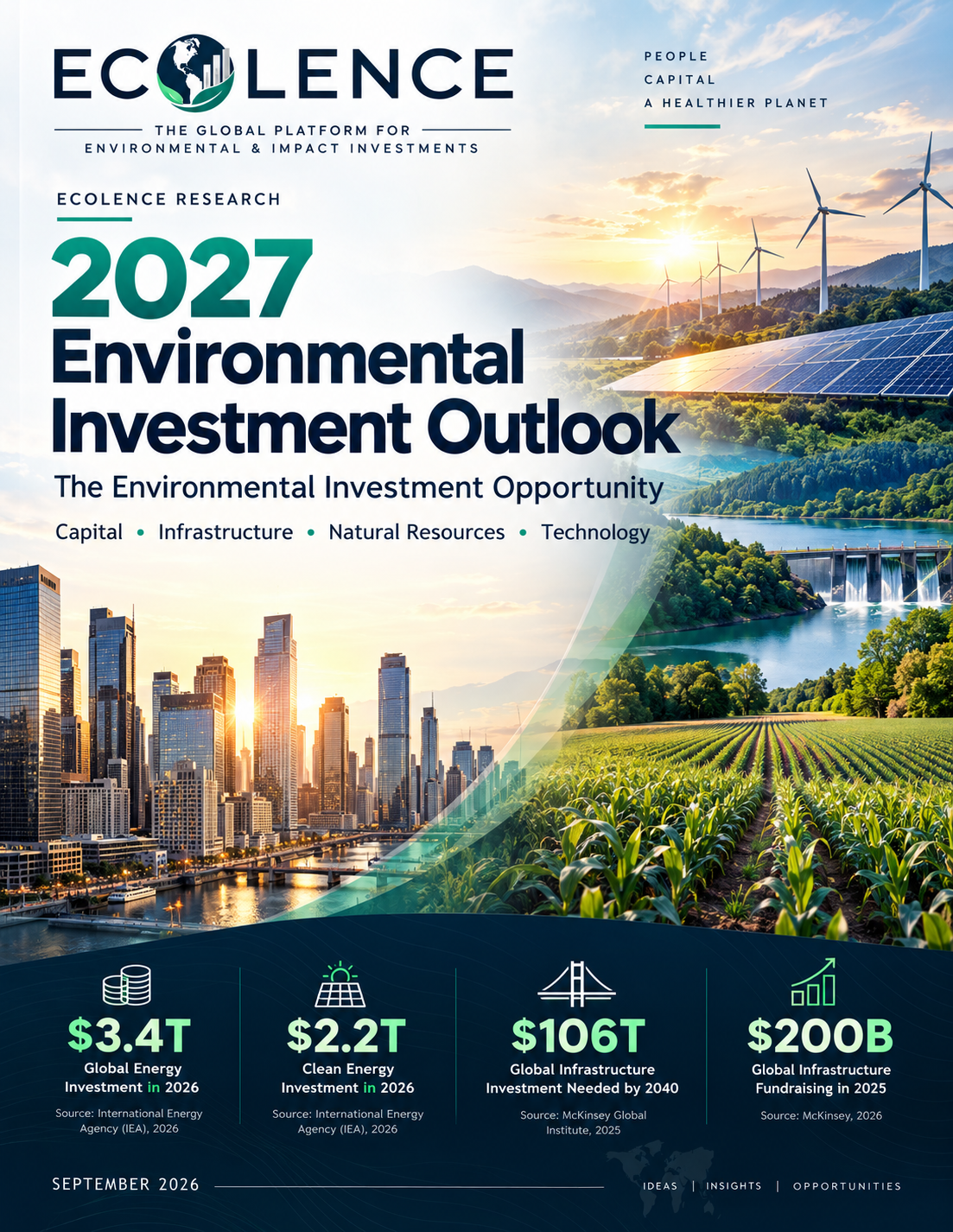
ECOLENCE RESEARCH
2027 Environmental Investment Outlook
The Environmental Investment Opportunity
Environmental investment is increasingly moving beyond traditional public-market themes and into the physical economy—energy infrastructure, farmland, water, natural resources, environmental markets and emerging technologies. The Ecolence 2027 Environmental Investment Outlook examines where environmental need, economic activity and capital formation are beginning to intersect..
SEPTEMBER 2026 • ECOLENCE RESEARCH • 104 PAGES
FROM THE FOUNDER
John E. Collins Jr.
Founder, Ecolence
“Environmental investing is evolving beyond a theme and becoming part of the real economy. The opportunities we see today extend across farmland, energy, water, infrastructure, natural resources and emerging technologies—and increasingly across both public and private markets.
We created this Outlook to look beyond the environmental story and examine where real economic value, investment opportunity and measurable environmental outcomes intersect. My hope is that it helps investors better understand this growing investment universe, ask better questions and ultimately make more informed decisions about where they choose to put their capital.”
EXECUTIVE SUMMARY
A Capital-Intensive Transformation
Environmental investing is entering a period in which the investment story increasingly extends beyond publicly traded companies and traditional ESG strategies.
Across energy, infrastructure, agriculture, water, natural resources and environmental technology, substantial amounts of capital are required to build, modernize and operate the physical systems that support the global economy.
For investors, this is expanding the environmental investment universe. Opportunities can increasingly be found not only in public equities, but across private equity, private credit, infrastructure, real assets, farmland, venture capital, private funds and individual projects.
Environmental investing is increasingly becoming an investment in the physical economy.
Solar facilities must be constructed. Electrical grids must be expanded. Water systems must be modernized. Farmland must remain productive. Waste must be processed. Natural resources must be managed. New environmental technologies must be financed and commercialized.
Each requires capital.
$3.4T
Global Energy Investment in 2026
$2.2T
Clean-Energy-Related Investment in 2026
$106T
Estimated Global Infrastructure Investment Needed Through 2040
~$200B
Global Infrastructure Fundraising in 2025
Sources: International Energy Agency; McKinsey & Company. See full report for methodology, context and source references.
INSIDE THE REPORT
Explore the Environmental Investment Economy
Explore the major markets, investment structures and themes examined in the Ecolence 2027 Environmental Investment Outlook.
01 — Investment Landscape
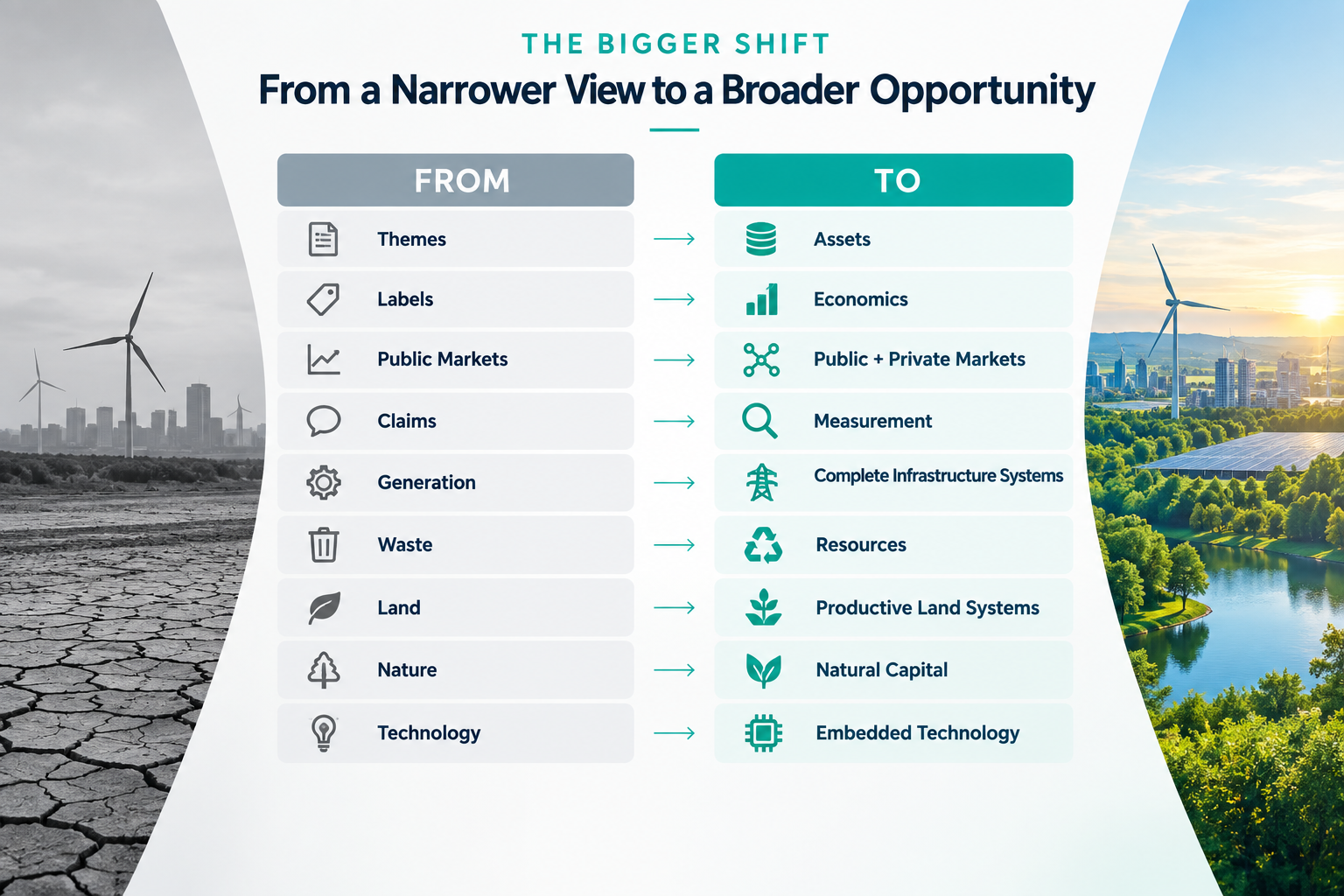
From environmental themes to investable assets.
02 — Infrastructure
Why the environmental economy is increasingly becoming an infrastructure story.
03 — Clean Energy & Power
From generation to grid—and the expanding capital needs of the electricity system.
04 — Sustainable Agriculture & Farmland
Investing in productive land, agriculture and the systems supporting the food economy.
05 — Water
Investment opportunities across one of the world’s most essential resources.
06 — Natural Capital
Forestry, biodiversity and the emerging economics of nature.
07 — Carbon & Environmental Markets
How environmental outcomes are increasingly being measured, priced and financed.
08 — Circular Economy
Turning waste, materials and resource efficiency into economic value.
09 — Environmental Technology
The technology layer transforming environmental assets and infrastructure.
10 — Accessing the Environmental Economy
How investors are gaining exposure through public markets, private markets and real assets.
11 — Risk, Return & Due Diligence
Evaluating environmental investments beyond the environmental story.
12 — 2027 Outlook
The environmental investment themes Ecolence Research is watching entering 2027.
CAPITAL & INFRASTRUCTURE
Capital Is Moving Toward Infrastructure
The Environmental Economy Is Becoming an Infrastructure Story
Environmental investment is increasingly converging with infrastructure investment.
Energy generation must be constructed. Electrical grids must be expanded and modernized. Water systems require investment. Agricultural infrastructure must become more productive and efficient. Waste and resource-recovery facilities must be built. Environmental technologies increasingly need to be integrated into physical assets.
This means the environmental investment opportunity is becoming less about simply identifying an environmental theme and increasingly about understanding the assets, infrastructure and capital structures required to finance the physical economy.
THE SCALE OF THE INFRASTRUCTURE OPPORTUNITY
$106T
Global infrastructure investment estimated through 2040
$23T
Energy & power
$6T
Waste & water
$5T
Agriculture
“The sector tells you where you are investing. The structure tells you how you are taking the risk.”
THE ENVIRONMENTAL INVESTMENT UNIVERSE
Seven Markets Shaping the Environmental Economy
Environmental investing is not a single market or asset class. It spans a diverse collection of real assets, infrastructure, operating businesses, technologies and environmental markets.
Across the 2027 Outlook, Ecolence Research examines seven major areas where environmental need, economic activity and capital investment are increasingly intersecting.
CLEAN ENERGY & POWER
Renewable generation is increasingly becoming part of a broader electricity-system investment story encompassing grids, storage, transmission and digital infrastructure.
2027 Theme: From generation to grid.
SUSTAINABLE AGRICULTURE & FARMLAND
Farmland is evolving from a traditional real-asset investment toward a technology-enabled productive system incorporating water, soil, infrastructure and environmental value.
2027 Theme: Investing in the productive landscape.
WATER
Investment needs span supply, treatment, distribution, wastewater, reuse, irrigation and the technologies required to manage an increasingly valuable resource.
2027 Theme: Essential infrastructure.
NATURAL CAPITAL
Forests, biodiversity and ecosystem restoration are creating new approaches to valuing and financing natural resources while raising important questions about measurement and investability.
2027 Theme: When nature becomes an economic asset.
CARBON & ENVIRONMENTAL MARKETS
Environmental outcomes are increasingly being measured, verified and monetized, but credibility, transparency and quality remain central to long-term market development.
2027 Theme: From quantity toward quality.
CIRCULAR ECONOMY
Recycling, recovery and resource-efficiency businesses seek to capture economic value from materials that the traditional linear economy routinely discards.
2027 Theme: Turning waste into economic value.
ENVIRONMENTAL TECHNOLOGY
Data, sensors, artificial intelligence, automation and measurement technologies are increasingly becoming an operating layer across environmental assets and infrastructure.
2027 Theme: Technology meets the physical economy.
INVESTMENT STRUCTURES
How Investors Are Accessing the Environmental Economy
From Real Assets to Private Markets
Environmental investing is not one asset class. The same environmental sector can contain investments with very different ownership structures, return profiles, liquidity characteristics and levels of risk.
Investors may gain exposure through publicly traded companies, private businesses, infrastructure, real assets, private credit, venture capital, project finance and investment funds.
Understanding the environmental sector is therefore only part of the analysis. Investors must also understand how they are investing in it.
PUBLIC EQUITY
Ownership in publicly traded companies.
PRIVATE EQUITY
Ownership in privately held businesses and operating companies.
INFRASTRUCTURE FUNDS
Exposure to physical assets and essential systems.
PRIVATE CREDIT
Debt financing to businesses, projects and real assets.
REAL ASSETS
Direct or fund-based exposure to farmland, forests, property and other physical assets.
VENTURE CAPITAL
Early-stage investment in emerging environmental technologies and businesses.
PROJECT FINANCE
Capital structured around the economics and cash flows of individual projects.
ECOLENCE RESEARCH PERSPECTIVE
“Environmental investing is not an asset class. It is an investment universe.”
The environmental theme identifies what an investment is exposed to. The investment structure helps determine how the investor participates in the opportunity—and the risks assumed in doing so.
RISK, RETURN & DUE DILIGENCE
Evaluating Environmental Investments Beyond the Story
Environmental Need Does Not Automatically Equal Investment Opportunity
Environmental investments can address important economic and environmental needs while still carrying substantial investment risk.
A compelling environmental story does not eliminate questions about valuation, management, leverage, liquidity, technology, execution or the economics of the underlying asset.
Investors should therefore evaluate environmental opportunities with the same financial discipline applied to any other investment.
01 — UNDERSTAND THE INVESTMENT
What does the investor actually own, finance or participate in? Understand the asset, structure, revenue model and expected sources of return’s.
02 — IDENTIFY THE KEY RISKS
Evaluate market, operating, development, technology, financing, counterparty, regulatory, environmental, valuation and liquidity risks.
03 — EVALUATE THE MANAGER
Examine experience, governance, incentives, track record, conflicts of interest and the manager’s ability to execute the stated strategy.
04 — ANALYZE THE FINANCIALS
Understand projected returns, cash flows, leverage, fees, assumptions, valuations and how the investment performs under less favorable scenarios.
05 — VERIFY THE ENVIRONMENTAL CASE
Understand what environmental outcome is actually being claimed, how it is measured and whether environmental revenues or benefits are material to the investment thesis.
06 — MONITOR ONGOING PERFORMANCE
Due diligence should continue after the investment. Monitor financial performance, operating results, material risks and environmental outcomes over time.
A CORE PRINCIPLE OF ECOLENCE RESEARCH
“Never allow the importance of the environmental mission to replace analysis of the investment itself.”
Environmental impact and financial performance are related considerations, but they are not the same thing. An investment should be evaluated on its economics, structure, risks and execution as well as its environmental objectives.
Questions Investors Should Ask..........................................
- What exactly am I investing in?
- How is the investment expected to generate returns?
- What assumptions drive those projections?
- What could cause the investment to underperform?
- How experienced is the sponsor or manager?
- What fees and incentives exist?
- How liquid or illiquid is the investment?
- What role does leverage play?
- How are environmental outcomes measured?
- What happens if projected environmental revenues do not materialize?
2027 OUTLOOK
The Environmental Investment Themes to Watch
The environmental investment landscape entering 2027 looks different from the one that existed only a few years ago.
The conversation is broadening beyond ESG screens and publicly traded clean-energy companies. Increasingly, capital is encountering the environmental economy through infrastructure, real assets, private credit, private equity, technology, natural resources and individual projects.
The common thread is increasingly clear: environmental investing is becoming less about investing in an environmental label and more about financing the physical systems, resources and technologies that the global economy depends upon.
01 — INFRASTRUCTURE
Environmental investment increasingly converges with infrastructure, real assets, project finance and private capital.
02 — ELECTRICITY
The investment story expands beyond renewable generation toward grids, storage, transmission and the systems supporting electrification.
03 — ENERGY SECURITY
Energy resilience and security increasingly reinforce investment in domestic generation and critical energy infrastructure.
04 — GRID MODERNIZATION
Interconnection, transmission, distribution and storage become increasingly important as electricity demand and renewable generation expand.
05 — AI & ENVIRONMENTAL TECHNOLOGY
AI creates new tools for optimization and measurement while simultaneously increasing demand for power, data centers and infrastructure
06 — SUSTAINABLE AGRICULTURE
Farmland increasingly becomes a technology-enabled productive system incorporating water, soil, infrastructure and environmental value.
07 — WATER
Aging infrastructure, scarcity and growing demand bring water closer to the environmental investment conversation.
08 — NATURAL CAPITAL
Forests, biodiversity and ecosystems continue developing new financing mechanisms and approaches to economic valuation.
09 — CARBON MARKETS
The emphasis increasingly shifts from the quantity of environmental credits toward integrity, measurement and quality.
10 — CIRCULAR ECONOMY
Waste and discarded materials increasingly become viewed as potential economic resources rather than simply disposal problems.
THE QUESTION FOR 2027
Where do environmental necessity and economic opportunity genuinely intersect?
That question sits at the center of the Ecolence 2027 Environmental Investment Outlook—and may become increasingly important as environmental investing moves deeper into infrastructure, real assets, technology and private markets.
METHODOLOGY & SOURCES
How to Read the Ecolence 2027 Environmental Investment Outlook
The Ecolence 2027 Environmental Investment Outlook is designed to provide a broad research perspective on the forces shaping the environmental investment economy. It is not intended to provide precise predictions about individual markets, investments or future outcomes.
Ecolence Research evaluates environmental investment themes through five primary lenses: market scale, capital formation, investment structures, technology and market development, and risk and investability.
Throughout the report, environmental importance and investment opportunity are treated as separate considerations. A market may address an important environmental need without necessarily representing an attractive or appropriate investment.
Environmental importance does not automatically equal investment opportunity.
01 — MARKET SCALE
Size, economic significance and capital requirements.
02 — CAPITAL FORMATION
Where capital is flowing and how markets are being finance
03 — INVESTMENT STRUCTURES
How investors can gain exposure and participate economically.
04 — TECHNOLOGY & MARKET DEVELOPMENT
How innovation and market evolution are changing the opportunity set.
05 — RISK & INVESTABILITY
Whether environmental need can translate into a credible investment proposition.
Research Sources
Ecolence Research draws upon publicly available information from governmental agencies, multilateral institutions, industry organizations and other research sources. Sources used throughout the 2027 Outlook include organizations such as:
International Energy Agency (IEA)
International Renewable Energy Agency (IRENA)
World Bank
United Nations Environment Programme (UNEP)
Food and Agriculture Organization (FAO)
U.S. Department of Agriculture (USDA)
U.S. Environmental Protection Agency (EPA)
McKinsey & Company
Ecosystem Marketplace
Integrity Council for the Voluntary Carbon Market (ICVCM)
Berkeley Carbon Trading Project
Ellen MacArthur Foundation
Data presented in the report may include historical data, estimates, forecasts and Ecolence Research analysis. Readers should refer to the full report and original sources for additional context, methodology and limitations.
IMPORTANT DISCLOSURE
Research and Educational Material Only
The Ecolence 2027 Environmental Investment Outlook is provided for informational and educational purposes only. Nothing contained in the report or on this webpage constitutes investment, securities, legal, tax or accounting advice, or an offer, solicitation or recommendation to purchase or sell any security or investment.
Private investments and environmental investments may involve substantial risks, including loss of principal, illiquidity, valuation uncertainty, regulatory risk, technology risk and operating risk. Targeted or projected returns are not guaranteed, and past performance does not guarantee future results.
Investors should conduct their own independent investigation and consult appropriate financial, legal, tax and other professional advisers before making an investment decision.
ECOLENCE RESEARCH
Continue With the Full Report
Explore the complete 2027 Environmental Investment Outlook for the full analysis of environmental infrastructure, clean energy, sustainable agriculture, water, natural capital, carbon markets, circular economy, environmental technology, investment structures, risk and the themes shaping 2027.