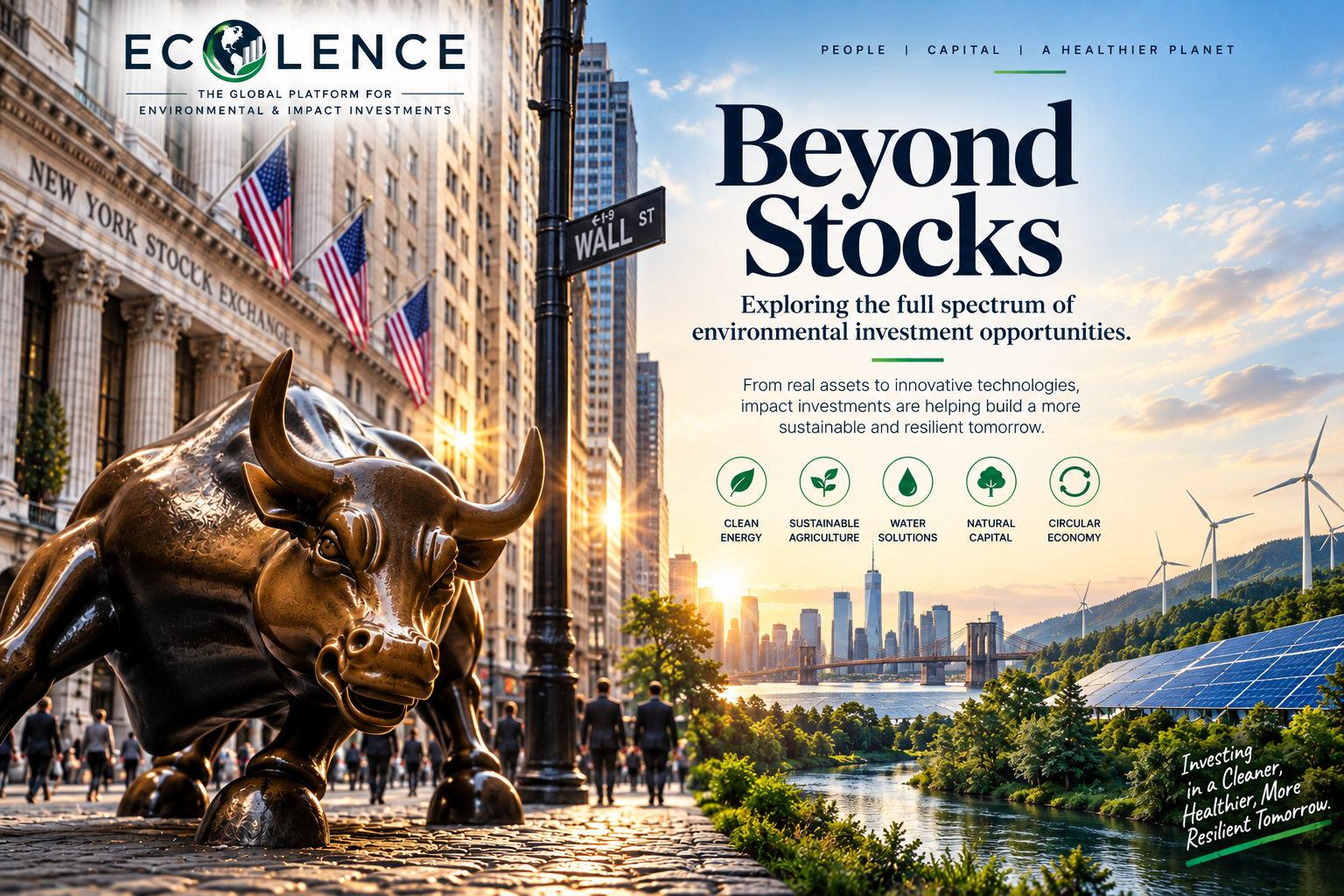
BEYOND STOCKS: INVESTING IN REAL-WORLD ENVIRONMENTAL SOLUTIONS
The environmental investment universe extends far beyond publicly traded companies. Across farmland, energy, water, natural capital, infrastructure and technology, private capital is increasingly financing the physical assets and businesses behind the environmental economy.
When people hear the words environmental investing, they often think about the stock market.
Perhaps they think about buying shares in a renewable-energy company, an electric-vehicle manufacturer or a clean-technology business.
Those companies are certainly part of the environmental investment universe.
But they represent only one part of it.
Beyond the public markets exists a much broader world of farmland, energy projects, water infrastructure, forests, recycling facilities, environmental technologies and private businesses that require capital to develop, operate and grow.
This is the real-world environmental economy.
And increasingly, investors are being introduced to opportunities to participate in it.
FROM INVESTING IN COMPANIES TO INVESTING IN THE PHYSICAL ECONOMY
Traditional investing often begins with securities.
Stocks.
Bonds.
Mutual funds.
Exchange-traded funds.
But much of the environmental economy exists in the physical world.
A solar facility must be constructed.
A farm must be acquired and operated.
A water-treatment facility requires infrastructure.
A recycling facility needs equipment.
A forest-restoration project requires land, management and long-term capital.
A technology company needs funding to develop and commercialize new solutions.
Before many of these assets or businesses could ever become part of the public markets, they may depend on private investment capital.
That creates a fundamentally different way of thinking about environmental investing.
Instead of asking only:
“Which environmental stocks should I own?”
investors can begin asking:
“What real-world environmental assets, businesses and projects are being financed?”
That question opens a much larger investment universe.
THE ENVIRONMENTAL INVESTMENT UNIVERSE
Environmental investment opportunities can exist across interconnected sectors of the economy.
SUSTAINABLE AGRICULTURE & FARMLAND
Farmland is one of the oldest real assets in the world.
Investment capital can support the acquisition and operation of productive agricultural land while also financing improvements such as:
Precision agriculture
Efficient irrigation
Soil management
Regenerative agricultural practices
Water conservation
Farm infrastructure
Agricultural technology
The underlying investment may generate revenue from farming, leasing arrangements, crop production or other agricultural activities.
At the same time, environmental considerations such as soil health, water availability, biodiversity and land management can affect the long-term productivity and value of the asset.
This makes farmland an example of how financial performance and environmental stewardship can intersect within a real-world asset.
CLEAN ENERGY
The transition of energy systems requires enormous amounts of physical infrastructure.
Capital may be required for:
Solar facilities
Wind projects
Battery storage
Transmission
Grid modernization
Distributed energy
Charging infrastructure
These are not simply environmental concepts.
They are physical assets that must be engineered, financed, constructed, connected and operated.
Some may generate revenue through long-term contracts. Others may depend on energy markets, project economics or infrastructure agreements.
Clean energy therefore demonstrates an important principle:
Environmental investment frequently means infrastructure investment.
WATER
Few resources are more fundamental to economic activity than water.
Agriculture needs it.
Manufacturing needs it.
Food production needs it.
Cities need it.
Natural ecosystems depend upon it.
Investment opportunities can exist throughout the water system, including:
Drinking-water infrastructure
Wastewater treatment
Water recycling
Desalination
Irrigation
Leak detection
Water-quality monitoring
Industrial water management
Water technology
Many water systems also require significant modernization.
That creates opportunities not only in new infrastructure, but in technologies and businesses designed to make existing systems more efficient.
FORESTS & NATURAL CAPITAL
Nature itself is increasingly being considered through an investment lens.
Forests, wetlands, agricultural land, watersheds and ecosystems can provide both economic resources and environmental services.
Investment strategies may involve:
Sustainable forestry
Forest restoration
Habitat conservation
Biodiversity
Watershed management
Land restoration
Environmental commodities
This has contributed to the development of the concept of natural capital—the recognition that natural resources and ecosystems can have economic significance alongside their environmental importance.
However, environmental value does not automatically equal investment value.
Investors still need to understand how a particular asset or project generates revenue, what risks it faces and how environmental outcomes are measured.
ENVIRONMENTAL INFRASTRUCTURE
Much of the environmental economy ultimately depends on infrastructure.
Water must be transported and treated.
Electricity must be generated, stored and distributed.
Waste must be collected and processed.
Materials must be recovered.
Environmental infrastructure can include:
Water-treatment facilities
Wastewater systems
Recycling facilities
Energy infrastructure
Battery storage
Stormwater systems
Waste-management infrastructure
Resource-recovery facilities
These investments can be particularly capital intensive, which creates a potentially significant role for private investment.
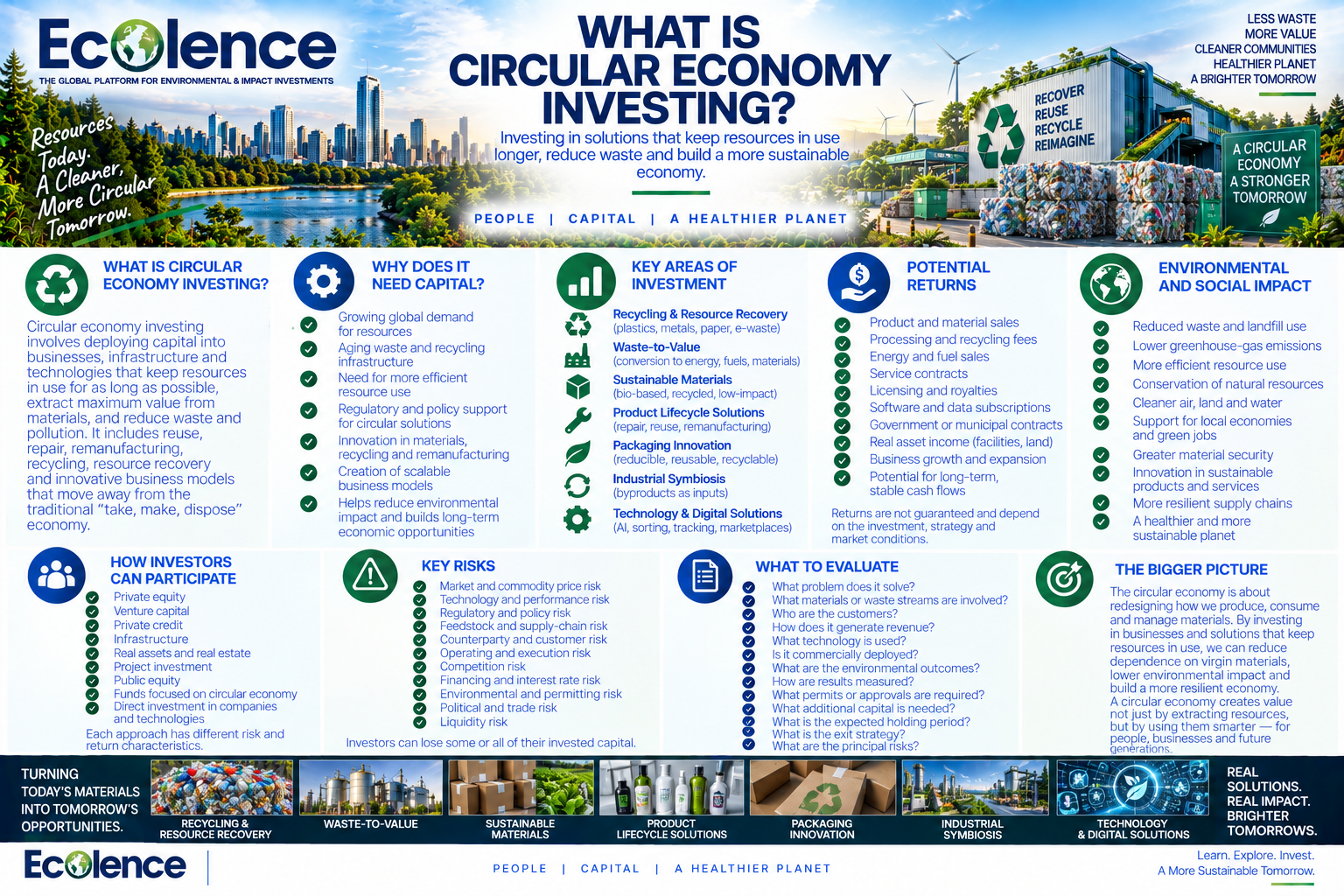
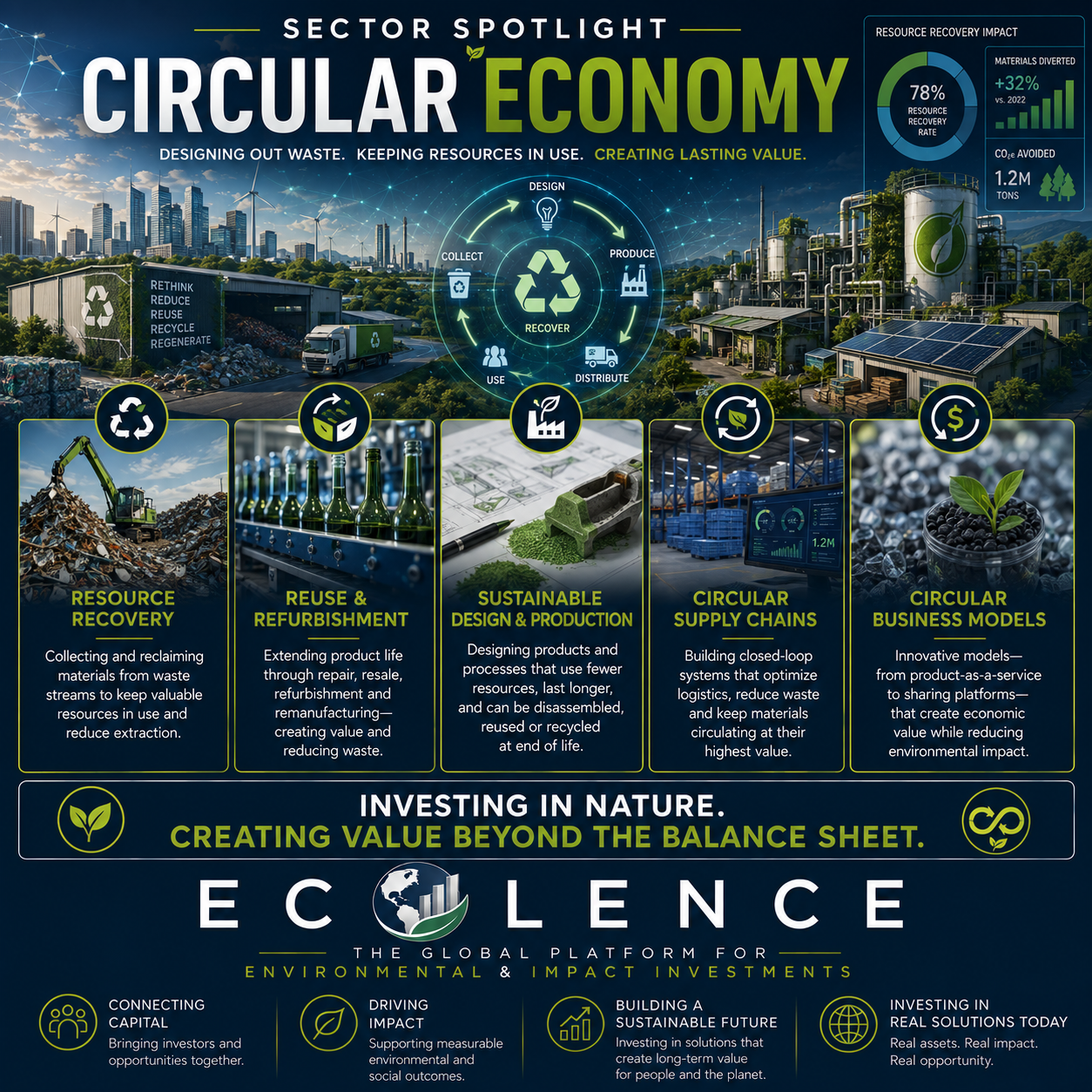
THE CIRCULAR ECONOMY
The traditional economy has often followed a relatively simple model:
Extract → Produce → Use → Discard
The circular economy asks whether more economic value can be retained from the resources already moving through the economy.
That can create investment opportunities in:
Recycling
Resource recovery
Waste-to-value
Battery recycling
Advanced materials
Reuse
Remanufacturing
Packaging
Waste technology
Material tracking
Instead of viewing discarded materials only as waste, circular-economy businesses may attempt to transform them into useful economic inputs.
That can create both environmental benefits and new business models.
CLIMATE & ENVIRONMENTAL TECHNOLOGY
Not every environmental investment is a physical asset.
Behind the environmental economy is a growing technology ecosystem.
Entrepreneurs are developing technologies involving:
Artificial intelligence
Satellite monitoring
Environmental sensors
Precision agriculture
Water technology
Energy-management software
Recycling technology
Carbon measurement
Biodiversity monitoring
Environmental data
These companies can provide the tools that allow physical assets to become more efficient, measurable and productive.
Technology also creates an entirely different investment profile.
Instead of investing directly in a solar facility, for example, an investor might invest in a company developing technology used across thousands of energy projects.
ONE ENVIRONMENTAL ECONOMY. MANY INVESTMENT STRUCTURES.
The underlying environmental opportunity is only one part of an investment.
How the investment is structured matters just as much.
Investors may encounter environmental opportunities through:
Private Equity
Ownership interests in privately held businesses.
Private Credit
Loans or other debt financing provided to companies, assets or projects.
Infrastructure
Investment in physical assets providing essential economic services.
Real Estate & Real Assets
Ownership of land, facilities or other tangible assets.
Venture Capital
Investment in earlier-stage companies developing new technologies or business models.
Private Funds
Pooled investment vehicles investing across particular strategies or sectors.
Regulation D Offerings
Private securities offerings available subject to applicable securities regulations and investor eligibility requirements.
Regulation A Offerings
SEC-qualified offerings that may, depending on the offering, provide access to a broader investor audience.
The same environmental sector can therefore contain investments with very different economics, liquidity, time horizons and risks.
REAL ASSETS vs. OPERATING COMPANIES vs. PROJECTS
Another useful distinction is understanding what you are actually investing in.
Consider three examples.
REAL ASSET
An investor participates in a fund that owns farmland.
The underlying value is connected substantially to the land and its productive use.
OPERATING COMPANY
An investor owns equity in a company developing precision-agriculture technology.
The investment depends more heavily on the company’s growth, technology, management and commercial success.
PROJECT
An investor finances a particular solar facility.
Returns may depend on construction, financing, electricity production and contractual revenues associated with that specific project.
All three could be described as environmental investments.
But economically, they are very different investments.
This is why understanding the structure is as important as understanding the sector.
HOW DO REAL-WORLD ENVIRONMENTAL INVESTMENTS MAKE MONEY?
This is one of the most important questions investors should ask.
An environmental benefit by itself does not create an investment return.
Potential sources of revenue can include:
Lease income
Agricultural income
Energy sales
Infrastructure payments
Water-service fees
Waste-processing fees
Sale of recovered materials
Technology subscriptions
Licensing revenue
Business profits
Land appreciation
Project-development income
Environmental commodities
Different investments may combine several revenue sources.
Investors should understand precisely who pays the investment, why they pay and what assumptions are required for the investment to generate returns.
ENVIRONMENTAL IMPACT AND FINANCIAL RETURN ARE NOT THE SAME THING
This distinction is central to understanding environmental investing.
A project can create meaningful environmental benefits and still be a poor investment.
Likewise, a financially successful company operating within an environmental sector may produce less environmental impact than investors assume.
Investors should therefore evaluate two separate questions:
1. WHAT ARE THE INVESTMENT ECONOMICS?
How does the investment generate revenue?
What are its expenses?
What capital is required?
What is the expected holding period?
What are the risks?
How might investors eventually receive their capital back?
2. WHAT IS THE ENVIRONMENTAL OUTCOME?
What environmental problem is being addressed?
What outcome is expected?
How is it measured?
Who reports or verifies the results?
Separating these questions can help investors evaluate environmental opportunities more clearly.
THE ROLE OF PRIVATE CAPITAL
Many environmental solutions require substantial capital before they can operate at scale.
A solar facility must be constructed before it generates electricity.
A recycling facility must be financed before it processes materials.
A farm may require investment before productivity improvements are realized.
An emerging technology company may require years of development before reaching commercial scale.
Government programs, public markets and corporate investment all play important roles.
But private capital can also help finance the period between idea and implementation.
That is one reason private markets are becoming an important part of the environmental investment landscape.
WHAT SHOULD INVESTORS LOOK FOR?
The environmental story should never replace investment due diligence.
Before evaluating an opportunity, investors should understand questions such as:
What exactly am I investing in?
Who owns and controls the underlying asset or company?
How does the investment generate revenue?
What assumptions support the target return?
What fees are charged?
How much debt is being used?
How long is the expected holding period?
Can I sell or redeem the investment?
What are the major risks?
Who manages the investment?
What is their relevant experience?
What environmental outcome is being claimed?
How is that outcome measured?
What could cause the investment to fail?
How is the investor expected to eventually exit?
A compelling environmental theme should be the beginning of the investigation—not the end of it.
FROM WALL STREET TO THE REAL WORLD
For generations, investing has often been associated visually with Wall Street.
Stock exchanges.
Trading screens.
Public companies.
Market indexes.
Those remain fundamental parts of the investment world.
But private markets allow investors to look beyond the ticker symbol and toward the assets operating throughout the physical economy.
The farm.
The solar facility.
The forest.
The water-treatment plant.
The recycling facility.
The environmental technology company.
The infrastructure project.
These are the assets, businesses and technologies that collectively form the environmental economy.
And many require capital.
THE CHALLENGE: DISCOVERY
As this investment universe expands, another problem becomes increasingly apparent.
Environmental opportunities are often fragmented.
One sponsor may offer a farmland investment.
Another may develop renewable-energy projects.
Another may manage natural-capital assets.
Another may be raising capital for an environmental technology company.
Investors may have to search across dozens—or eventually hundreds—of unrelated websites and platforms simply to discover what exists.
There has historically been no obvious central destination dedicated specifically to bringing the broader environmental investment universe together.
That is the problem Ecolence is being built to address.
THE ECOLENCE VISION
Ecolence is designed to create a centralized marketplace where investors can discover and learn about environmental and impact investment opportunities across multiple sectors and investment structures.
Not to tell investors what to invest in.
Not to rate investments.
Not to replace offering documents or independent due diligence.
But to make the environmental investment universe easier to discover, understand and navigate.
Because before investors can evaluate an opportunity, they first need to know that opportunity exists.
And before capital can potentially reach environmental businesses, projects and assets, those opportunities need a place where investors can find them.
That is where discovery becomes important.
BEYOND STOCKS. BEYOND TRADITIONAL MARKETS.
The environmental investment universe is expanding beyond the conventional idea of buying shares in companies considered “green.”
It increasingly encompasses:
Land.
Infrastructure.
Energy.
Water.
Nature.
Technology.
Businesses.
Projects.
Real-world assets.
Together, they represent a much broader way of thinking about the relationship between capital and the environmental economy.
And that is the universe Ecolence intends to bring together.
Beyond stocks. Beyond traditional markets.
Discover the environmental investment universe.
Ecolence
The Global Platform for Environmental & Impact Investments