WHAT ARE CARBON MARKETS?
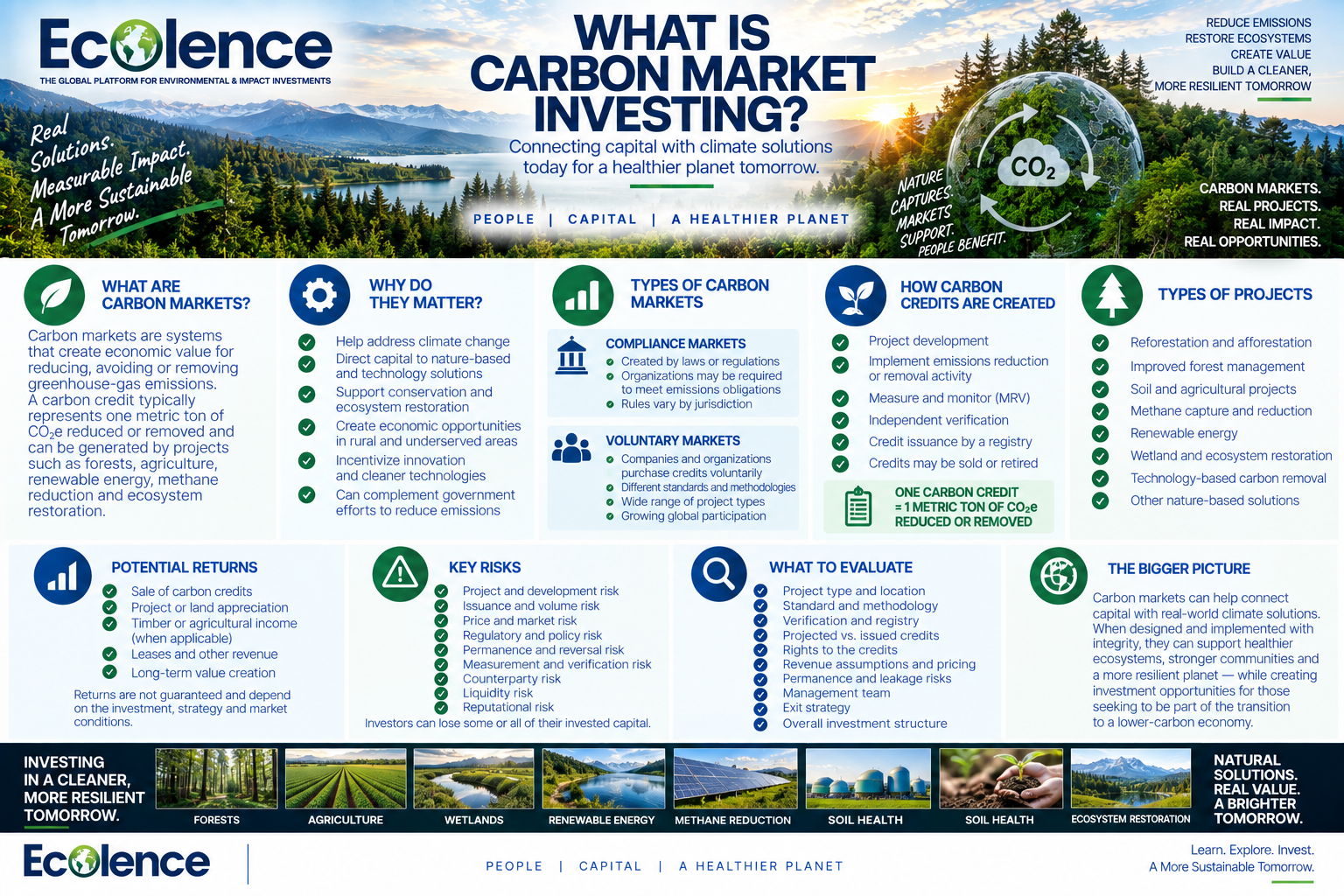
Carbon markets are systems that create an economic value around reducing, avoiding or removing greenhouse-gas emissions.
At the center of many carbon markets is the carbon credit.
A carbon credit generally represents a quantified amount of greenhouse-gas emissions reduction or removal, commonly expressed as one metric ton of carbon-dioxide equivalent (CO₂e).
Credits can potentially be generated by projects involving forests, agriculture, renewable energy, methane reduction, ecosystem restoration, carbon-removal technologies and other activities—depending on the particular market, methodology and eligibility requirements.
Carbon markets attempt to connect an environmental outcome with an economic instrument that can be measured, verified and transferred.
WHY DO CARBON MARKETS EXIST?
Reducing or removing emissions can require significant capital.
A forest-restoration project needs land, labor, management and monitoring.
A methane-capture project requires equipment and infrastructure.
A carbon-removal technology may require years of development and substantial investment before reaching commercial scale.
Carbon markets can potentially provide an additional source of revenue for activities that produce qualifying environmental outcomes.
In simple terms:
Environmental activity → Measured outcome → Verification → Carbon credit → Potential economic value
The actual process is considerably more complex, but this illustrates the basic concept.
COMPLIANCE vs. VOLUNTARY CARBON MARKETS
Not all carbon markets operate the same way.
COMPLIANCE MARKETS
Compliance markets are created through laws or regulatory systems.
Covered organizations may be required to meet specified emissions obligations and, depending on the particular program, may be able to use certain allowances or credits toward those obligations.
Rules vary substantially between jurisdictions and programs.
VOLUNTARY CARBON MARKETS
Voluntary carbon markets generally involve organizations purchasing eligible carbon credits outside a mandatory compliance obligation.
Companies may purchase credits as part of environmental or emissions-related strategies.
The voluntary market includes different project types, standards, registries and methodologies.
Investors should understand which market a project intends to serve, because the rules, buyers and economics can differ significantly.
WHAT IS A CARBON CREDIT?
A carbon credit is not simply a claim that a project is environmentally beneficial.
To create a recognized credit, a project generally needs to operate within an applicable program or standard and satisfy specified requirements.
Depending on the program, this can involve:
Project documentation
Baseline calculations
Approved methodologies
Monitoring
Measurement
Independent validation or verification
Registry procedures
Issuance
Once issued, eligible credits may potentially be transferred or sold.
When a credit is used for its intended emissions-related purpose, it may be retired, generally preventing that same credit from being used again.
WHAT TYPES OF PROJECTS CAN GENERATE CARBON CREDITS?
Eligibility depends on the applicable carbon program and methodology, but projects can potentially include areas such as:
FORESTRY
Reforestation, afforestation and certain forest-management or conservation activities.
AGRICULTURE
Certain soil-management, methane-reduction or agricultural practices.
METHANE
Capturing or reducing methane from landfills, agriculture or other sources.
ECOSYSTEM RESTORATION
Certain wetland, peatland, mangrove or other ecosystem projects.
TECHNOLOGY-BASED REMOVAL
Technologies intended to remove carbon dioxide from the atmosphere and store it.
Other project categories may also qualify under particular programs.
A project being environmentally beneficial does not automatically mean it can generate carbon credits.
WHAT IS ADDITIONALITY?
One important concept investors may encounter is additionality.
Broadly, additionality asks whether the claimed emissions reduction or removal would have occurred without the carbon-credit mechanism or project intervention.
The exact tests vary among programs and methodologies.
The concept matters because carbon markets seek to assign value to environmental outcomes attributable to a qualifying activity rather than outcomes that would have happened anyway.
WHAT IS A BASELINE?
A carbon project typically needs some method of determining what would likely have happened without the project.
That reference scenario is often called a baseline.
The project’s measured performance may then be evaluated against the applicable baseline under the relevant methodology.
Baseline assumptions can materially influence the number of credits a project may ultimately generate.
Investors should therefore understand that projected credit volumes are estimates, not guaranteed production.
WHAT IS MRV?
MRV commonly stands for:
Measurement
Reporting
Verification
These processes are fundamental to many environmental markets.
Projects may use:
Satellite imagery
Remote sensing
Field measurements
Sensors
Forest inventories
Soil sampling
Geospatial analysis
Independent verification
The methods depend on the project and applicable methodology.
Credible MRV helps support the integrity of claims associated with environmental outcomes.
WHAT IS A CARBON REGISTRY?
Registries can play an important role in carbon markets.
Depending on the particular program, a registry may maintain information concerning projects and credits, including issuance, ownership or retirement.
Investors should understand which standard or registry a project uses and what requirements apply.
A reference to a registry should not, by itself, be interpreted as a guarantee of project quality, investment performance or future credit prices.
HOW CAN INVESTORS PARTICIPATE?
There are several ways capital can potentially participate in carbon markets.
PROJECT FINANCING
Investors may provide capital to develop projects expected to generate credits.
PROJECT EQUITY
Investors may acquire an ownership interest in a company or project involved in carbon-credit generation.
PRIVATE CREDIT
Capital may be provided through loans or other financing arrangements.
CARBON-CREDIT PURCHASE AGREEMENTS
Buyers or investors may agree to purchase future credits under contractual arrangements.
CARBON-MARKET BUSINESSES
Investors may finance companies providing technology, project development, measurement, verification, data, marketplaces or other carbon-market services.
These approaches involve very different risks.
HOW CAN A CARBON PROJECT GENERATE REVENUE?
A carbon project may potentially generate revenue by selling qualifying credits after they have been successfully issued.
A simplified model might look like:
Project development
↓
Environmental activity
↓
Measurement and monitoring
↓
Verification
↓
Credit issuance
↓
Credit sale
↓
Project revenue
However, there is no guarantee that every projected credit will be issued or sold.
WHAT DETERMINES THE VALUE OF A CARBON CREDIT?
Carbon credits do not necessarily have one universal price.
Pricing can be influenced by factors including:
Project type
Project location
Methodology
Credit vintage
Perceived project quality
Environmental and social attributes
Buyer demand
Market conditions
Supply
Applicable standards
Credits from different projects can therefore trade at materially different prices.
WHAT IS PERMANENCE?
For projects involving stored carbon, investors may encounter the concept of permanence.
For example, a forest may store carbon in trees and vegetation.
But fires, disease, land-use changes or other events could potentially reverse some of that storage.
Carbon programs may address reversal risk through different mechanisms.
Understanding how a project manages permanence risk is particularly important for nature-based carbon projects.
WHAT IS LEAKAGE?
Another concept is leakage.
Leakage generally refers to circumstances where an activity intended to reduce emissions in one location causes emissions to increase elsewhere.
For example, protecting one forest area could have limited environmental benefit if the activity that caused deforestation simply moves to another location.
Applicable methodologies may contain procedures intended to account for leakage.
WHAT IS DOUBLE COUNTING?
Environmental markets depend heavily on credible accounting.
Double counting can arise when the same emissions reduction or removal is counted more than once in a way that is inconsistent with applicable accounting rules.
Market standards, registries and accounting systems seek to address this issue, but investors should understand how a particular project handles ownership and accounting of its environmental claims.
WHAT ARE THE MAJOR RISKS?
Carbon-market investments can involve significant risks.
PROJECT RISK
The underlying project may not perform as expected.
ISSUANCE RISK
Projected credits may not ultimately be issued.
PRICE RISK
Carbon-credit prices can rise or fall substantially.
METHODOLOGY RISK
Standards or methodologies may change.
REGULATORY RISK
Government policies and carbon-market rules may evolve.
VERIFICATION RISK
A project may fail to satisfy verification requirements.
PERMANENCE RISK
Stored carbon may be reversed.
COUNTERPARTY RISK
Project developers, buyers or other contractual parties may fail to perform.
REPUTATIONAL RISK
Questions about project integrity can affect marketability and value.
LIQUIDITY RISK
Certain credits or private carbon investments may be difficult to sell.
Investors can lose some or all of their invested capital.
CARBON CREDITS ARE NOT THE SAME AS CARBON INVESTMENTS
This distinction is particularly important for Ecolence.
A carbon credit is an environmental commodity or instrument created under a particular program.
A carbon project is the underlying activity intended to produce an environmental outcome.
A carbon investment is the financial structure through which capital participates in the project, company, credits or related business.
Those are three different things.
An investor should understand exactly what they are purchasing or financing.
WHAT SHOULD AN INVESTOR EVALUATE?
Before considering a carbon-market investment, investors should understand:
What is the underlying project?
Where is it located?
Who is the project developer?
What carbon standard or program applies?
What methodology is being used?
Has the project been validated or verified?
Have credits already been issued, or are they only projected?
How are emissions reductions or removals measured?
Who performs verification?
What assumptions determine projected credit volumes?
Who owns the credits?
How are credits expected to be sold?
What assumptions are being made about future prices?
How are permanence, leakage and accounting risks addressed?
What happens if fewer credits are issued than expected?
What are the principal investment risks?
These questions can help separate projected environmental value from demonstrated environmental value.
THE BIGGER PICTURE
Carbon markets attempt to do something unusual:
Translate a measured environmental outcome into something that can have economic value.
When functioning as intended, that mechanism can potentially direct capital toward projects that reduce or remove emissions.
But carbon markets are complex.
Project quality matters.
Measurement matters.
Methodology matters.
Verification matters.
And the economics matter.
For Ecolence, carbon markets represent an important part of the environmental investment universe because they demonstrate how capital, environmental science, technology and markets can intersect.
The opportunity is not simply to purchase something called a carbon credit.
It is to understand the real project behind the credit, how the environmental outcome is measured, how economic value is created and what risks stand between the projected outcome and the actual result.