WHAT IS SUSTAINABLE AGRICULTURE INVESTING?
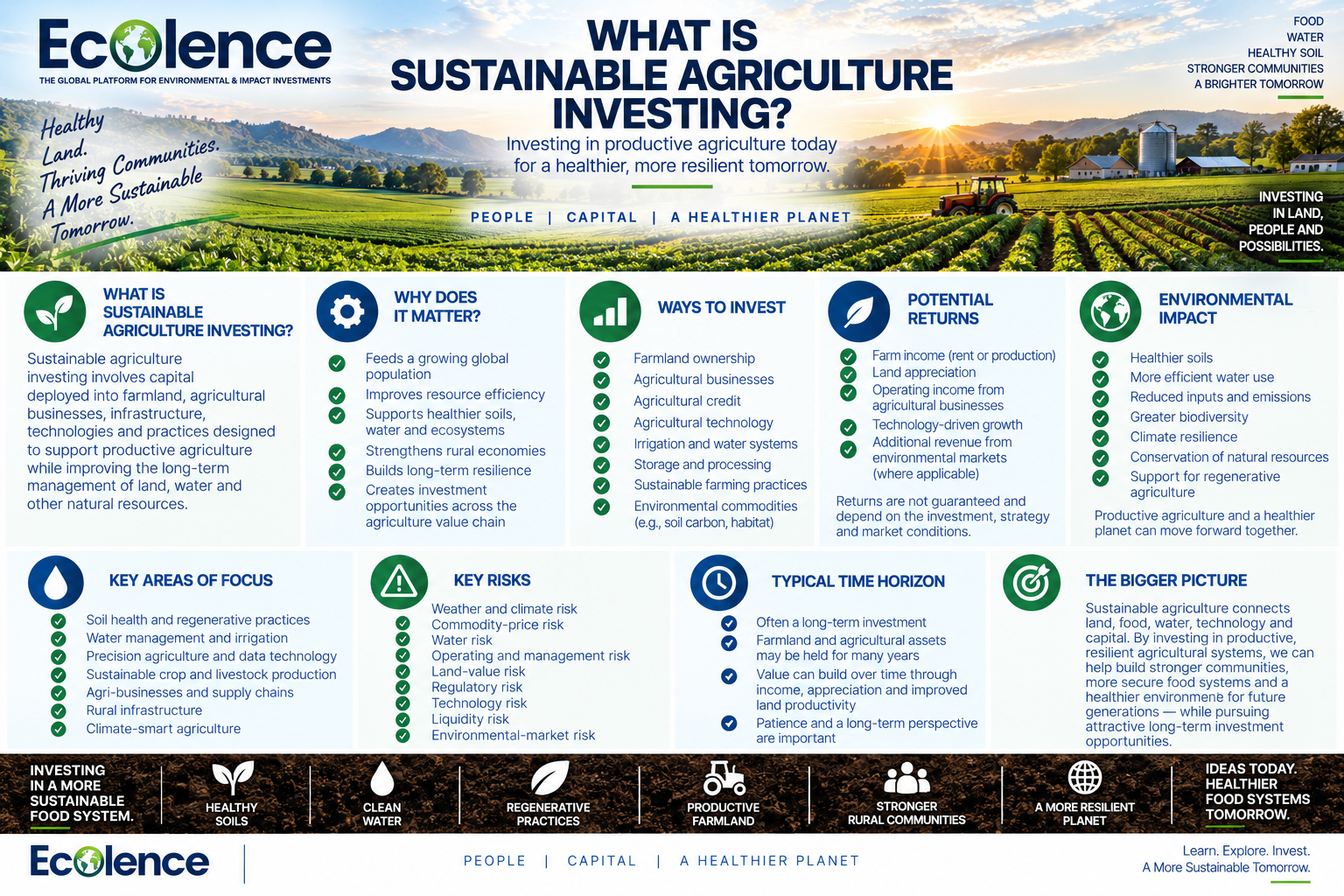
Sustainable agriculture investing involves deploying capital into farmland, agricultural businesses, infrastructure, technologies and practices designed to support productive agriculture while improving the long-term management of land, water and other natural resources.
Agriculture is one of the world’s most fundamental economic activities.
It requires land, water, equipment, energy, technology, infrastructure and significant amounts of capital.
For investors, that creates an investment universe extending far beyond simply owning a farm.
Sustainable agriculture can include farmland ownership, agricultural operations, irrigation, precision agriculture, agricultural technology, soil management, food production and supporting infrastructure.
WHY DOES AGRICULTURE NEED INVESTMENT CAPITAL?
Operating and improving agricultural assets can require substantial capital.
Farmers and agricultural businesses may need financing for:
Land acquisition
Farm equipment
Irrigation systems
Water-management improvements
Soil improvements
Precision-agriculture technology
Storage and processing facilities
Renewable energy
Expansion of agricultural operations
Transition to new farming practices
Investment capital can help finance these needs while investors seek an economic return.
HOW CAN INVESTORS PARTICIPATE?
There are several ways investors may gain exposure to agriculture.
FARMLAND
Investors may acquire agricultural land directly or participate through a fund or other investment vehicle that owns farmland.
The land may then be leased to farmers or operated under other arrangements.
AGRICULTURAL BUSINESSES
Private equity or other investment capital can finance companies involved in agricultural production, processing, equipment, services or technology.
AGRICULTURAL CREDIT
Private lenders can provide financing to farmers, agricultural businesses or projects.
AGRICULTURAL TECHNOLOGY
Venture capital and private equity may finance companies developing technologies intended to improve agricultural productivity or resource efficiency.
AGRICULTURAL INFRASTRUCTURE
Investment opportunities can also exist in irrigation, storage, processing, transportation and other infrastructure supporting the agricultural economy.
These approaches have very different investment structures and risk profiles.
HOW CAN FARMLAND GENERATE RETURNS?
Farmland investments can potentially generate returns from several sources.
FARM INCOME
Land may generate rental or lease income from agricultural operators.
Other structures may provide investors with participation in farm revenues or crop production.
LAND APPRECIATION
Agricultural land may increase or decrease in value over time.
OPERATING INCOME
Where the investment participates directly in agricultural operations, returns may depend partly on crop production, commodity prices and operating costs.
OTHER LAND-BASED REVENUE
Depending on the property and applicable agreements, agricultural land may potentially support additional sources of economic value.
The specific return model should always be understood before investing.
WHAT IS REGENERATIVE AGRICULTURE?
Regenerative agriculture generally refers to farming approaches intended to improve or restore aspects of the agricultural ecosystem while maintaining productive use of the land.
Practices may include:
Cover crops
Crop rotation
Reduced soil disturbance
Improved nutrient management
Managed grazing
Water-management practices
Increasing plant diversity
The specific practices appropriate for a farm depend on its crops, geography, soil, climate and operating conditions.
For investors, the important question is not simply whether an investment uses the word regenerative, but what practices are actually being implemented and how their results are measured.
WHY DOES SOIL MATTER?
Soil is one of agriculture’s most important productive assets.
Healthy soil can influence:
Crop productivity
Water retention
Nutrient availability
Erosion
Farm resilience
Long-term land productivity
Investment in soil management can therefore have both agricultural and environmental implications.
But improvements can take time, and outcomes can vary considerably by property and farming practice.
WATER AND AGRICULTURE
Agriculture and water are closely connected.
Investment in agricultural water systems may include:
Efficient irrigation
Water storage
Drainage
Moisture monitoring
Precision irrigation
Water recycling
Drought-management technology
Improving how water is measured and used can potentially reduce costs, improve productivity and make agricultural operations more resilient.
Water availability can also be a major investment risk.
TECHNOLOGY IS CHANGING AGRICULTURE
Modern agriculture increasingly uses technology to help farmers understand and manage their land.
This can include:
Satellite imagery
Artificial intelligence
Drones
Soil sensors
GPS-guided equipment
Precision irrigation
Crop-monitoring systems
Farm-management software
Environmental measurement
These technologies can provide farmers and investors with more information about crop health, water use, soil conditions and agricultural performance.
Agricultural technology therefore represents its own investment opportunity while also potentially improving the performance of agricultural assets.
WHAT ARE ENVIRONMENTAL COMMODITIES?
Some agricultural properties may have characteristics that could support environmental markets or conservation-related programs.
Depending on the project, location, methodology and applicable rules, these might involve areas such as:
Soil carbon
Water quality
Biodiversity
Habitat conservation
Ecosystem restoration
These potential revenue sources should generally be treated separately from the farm’s core agricultural economics.
They may depend on verification standards, regulation, market demand, measurement requirements and long-term contractual obligations.
Potential environmental value should not be assumed simply because land is being managed sustainably.
WHAT ARE THE MAJOR RISKS?
Agricultural investments can involve substantial risks.
WEATHER RISK
Drought, flooding, storms, extreme temperatures and other weather events can affect production.
COMMODITY-PRICE RISK
Crop and agricultural-product prices can fluctuate significantly.
WATER RISK
Water availability, rights, infrastructure or costs can affect agricultural productivity.
OPERATING RISK
Farming requires effective management, equipment, labor and agricultural expertise.
TENANT OR OPERATOR RISK
Where farmland is leased or managed by another party, results may depend on that operator.
LAND-VALUE RISK
Farmland values can decline.
REGULATORY RISK
Agricultural, environmental, water and land-use regulations can change.
LIQUIDITY RISK
Farmland and private agricultural investments may take substantial time to sell.
TECHNOLOGY RISK
New technologies may not produce the expected results.
ENVIRONMENTAL-MARKET RISK
Potential environmental credits or other environmental revenue may fail to materialize.
Investors can lose some or all of their invested capital.
IS FARMLAND LIQUID?
Generally, farmland should be considered a long-term real asset.
Unlike publicly traded securities, agricultural property cannot normally be sold immediately.
Private farmland funds may also impose multi-year holding periods or restrictions on withdrawals and transfers.
Investors should understand both the expected investment term and how the underlying land would ultimately be sold.
SUSTAINABILITY DOES NOT REPLACE ECONOMICS
This is an important principle for Ecolence.
An agricultural investment may pursue meaningful environmental objectives and still be a poor investment.
Investors should evaluate the underlying economics independently.
That includes:
Acquisition price
Farm productivity
Water availability
Operating costs
Lease economics
Management quality
Debt
Expected income
Capital expenditures
Exit assumptions
Environmental benefits can be an important part of an investment strategy, but they do not eliminate financial risk.
WHAT SHOULD AN INVESTOR EVALUATE?
Before considering a sustainable-agriculture investment, investors should understand:
What exactly is being purchased or financed?
Where is the land or agricultural operation located?
What crops or agricultural activities are involved?
Who operates the farm?
How will the investment generate revenue?
What is the property’s water situation?
What improvements are planned?
How much additional capital will be required?
Will debt be used?
What environmental practices are actually being implemented?
How are environmental outcomes measured?
Are environmental revenues assumed in the financial projections?
What is the expected holding period?
How is the investment expected to exit?
What are the principal risks?
These questions help distinguish the environmental story from the underlying investment fundamentals.
THE BIGGER PICTURE
Sustainable agriculture sits at the intersection of land, food, water, technology and capital.
Investment can help acquire and improve productive farmland.
It can provide farmers with better technology.
It can finance more efficient irrigation.
It can support agricultural businesses and infrastructure.
And it can help develop farming practices intended to protect the productive capacity of the land over the long term.
For Ecolence, that makes sustainable agriculture an important part of the environmental investment universe.
The objective is not simply to make agriculture “greener.”
It is to explore how capital can support productive, economically viable agricultural systems while improving the long-term stewardship of the natural resources upon which agriculture depends.