WHAT IS WATER INVESTING?
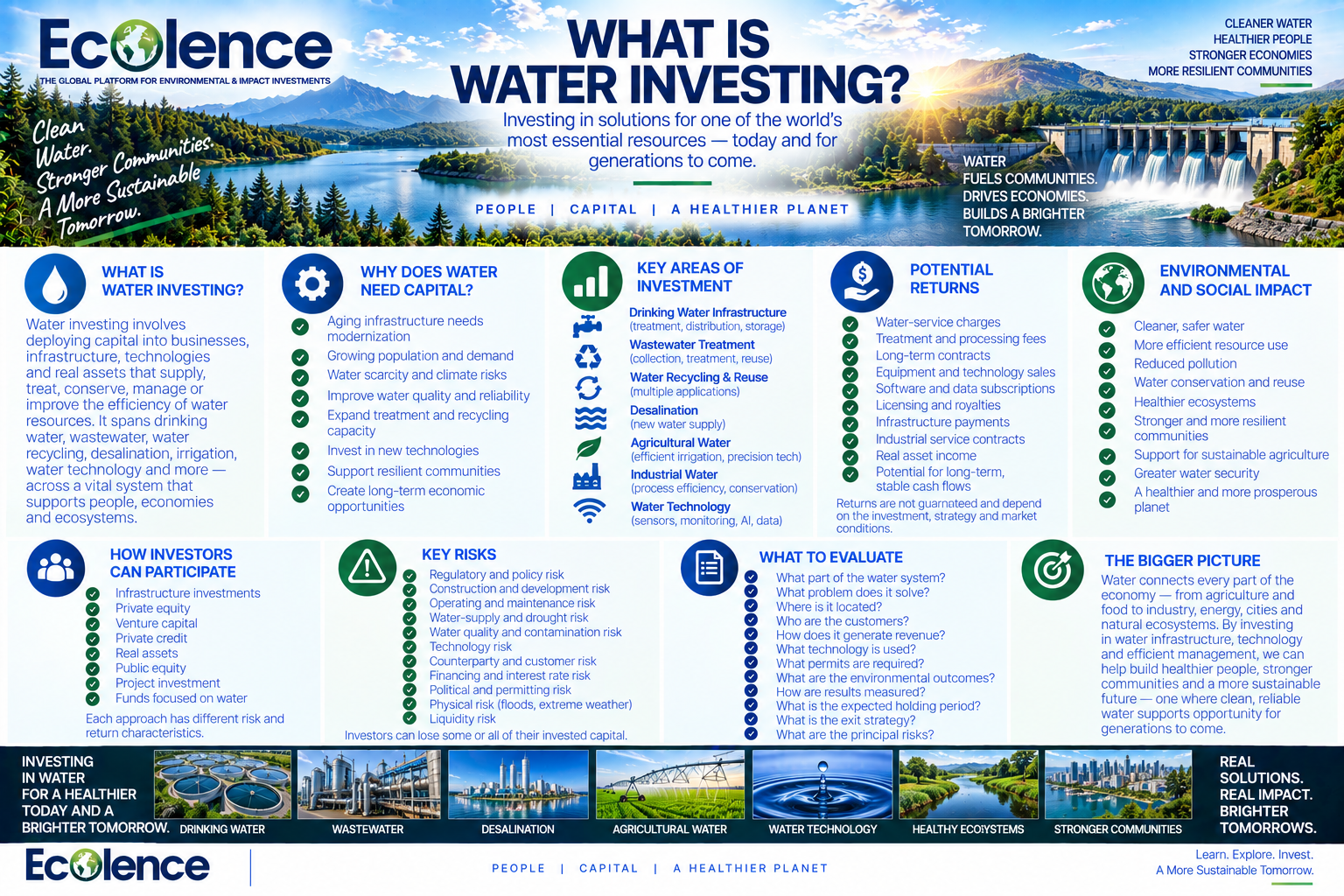
Water investing involves deploying capital into businesses, infrastructure, technologies and real assets involved in supplying, treating, conserving, managing or improving the efficiency of water resources.
Water touches virtually every part of the economy.
It is essential for:
Drinking water
Agriculture
Manufacturing
Energy production
Food processing
Healthcare
Real estate
Technology
Natural ecosystems
Because water is both an essential resource and a critical economic input, investment opportunities can extend far beyond traditional water utilities.
WHY DOES WATER NEED CAPITAL?
Water requires enormous physical infrastructure to move from its source to the people and businesses that use it—and often additional infrastructure to treat it afterward.
Capital may be needed for:
Treatment plants
Pipelines
Pumping systems
Wastewater facilities
Storage
Irrigation
Desalination
Stormwater systems
Water recycling
Monitoring technology
Aging-system modernization
Many water systems also require continuous maintenance and replacement.
This creates investment needs in both new infrastructure and modernization of existing systems.
WHERE ARE THE INVESTMENT OPPORTUNITIES?
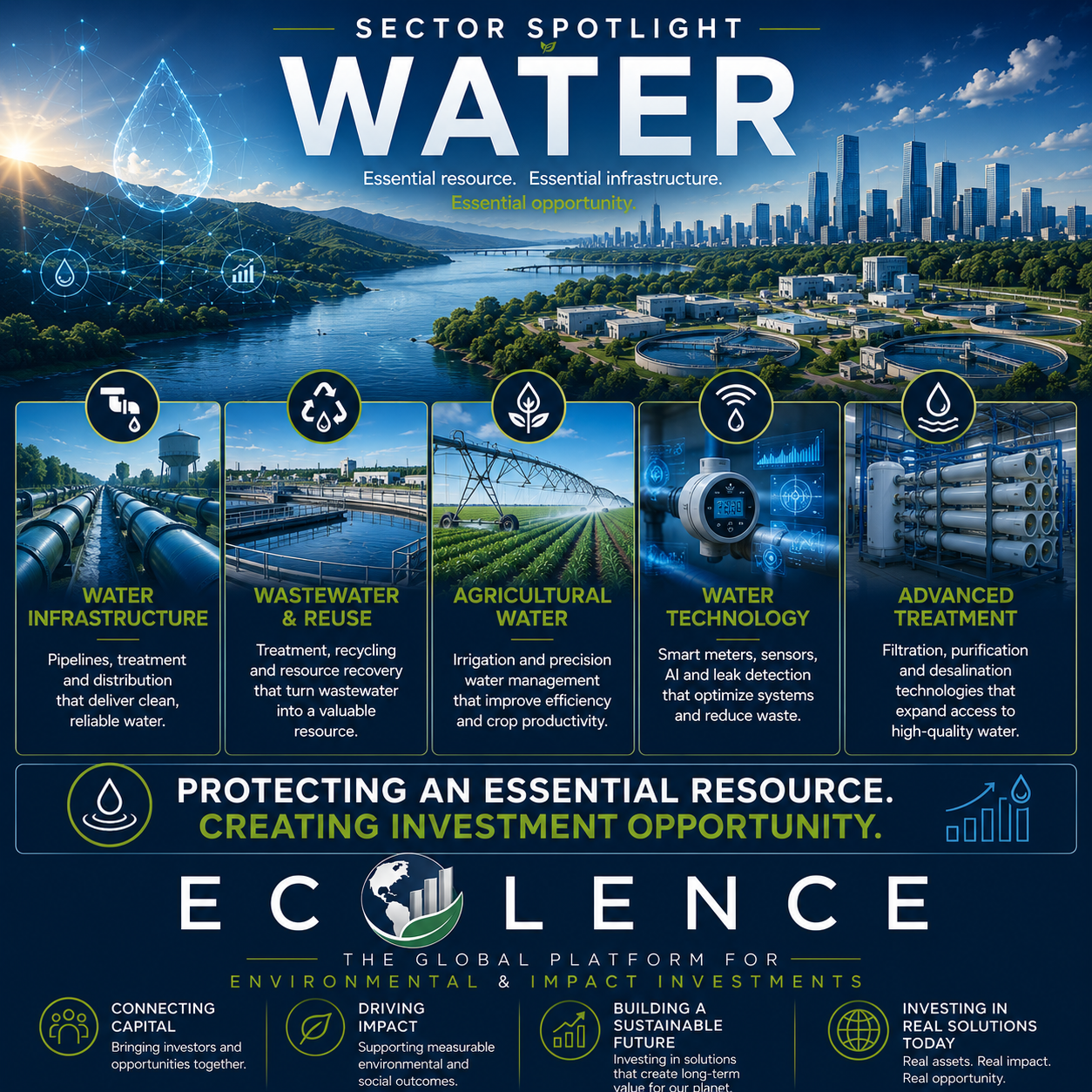
Water investing spans several major areas.
DRINKING-WATER INFRASTRUCTURE
Providing reliable drinking water requires networks of physical assets.
These can include:
Treatment facilities
Pipes
Pumps
Reservoirs
Storage systems
Distribution networks
Monitoring equipment
Investment can support construction, replacement and modernization of these systems.
WASTEWATER
Water used by homes, businesses and industries often needs to be treated before being discharged or reused.
Investment opportunities can include:
Wastewater-treatment plants
Collection systems
Industrial wastewater treatment
Water-reuse facilities
Treatment technology
Resource recovery
Modern wastewater facilities may increasingly seek to recover water, energy or useful materials rather than simply treating waste.
WATER RECYCLING & REUSE
Water does not necessarily have to be used only once.
Treatment technology can allow certain wastewater to be processed for additional uses.
Potential applications include:
Agriculture
Industrial processes
Landscaping
Cooling
Groundwater recharge
Certain municipal uses
Water reuse can become increasingly valuable where freshwater supplies are constrained.
DESALINATION
Desalination removes salts and other materials from seawater or brackish water to produce usable water.
Projects can require significant investment in:
Treatment facilities
Membranes
Pumps
Energy systems
Intake and discharge infrastructure
Desalination can provide additional water supplies, but investors should understand its energy requirements, operating costs and environmental considerations.
AGRICULTURAL WATER
Agriculture is closely connected to water availability and management.
Investment opportunities can include:
Efficient irrigation
Drip irrigation
Soil-moisture monitoring
Water-storage systems
Precision agriculture
Irrigation automation
Water-management software
Better water management can potentially improve farm productivity while reducing unnecessary water use.
This creates significant overlap between the Water and Sustainable Agriculture sectors.
INDUSTRIAL WATER
Factories, data centers, food processors, energy facilities and other businesses can require substantial amounts of water.
Companies may invest in technologies that:
Reduce water consumption
Treat process water
Recycle water
Monitor water quality
Detect leaks
Manage wastewater
For businesses, water efficiency can represent both an environmental objective and an operating-cost issue.
WATER TECHNOLOGY
Technology is increasingly changing how water systems are managed.
Potential investment areas include:
Advanced filtration
Membrane technology
Smart meters
Leak detection
Water-quality sensors
Artificial intelligence
Remote monitoring
Treatment technology
Desalination technology
Water-management software
Technology can potentially allow infrastructure operators to identify problems earlier and use resources more efficiently.
THE DIGITAL WATER SYSTEM
Traditional water infrastructure is becoming increasingly connected.
Sensors can monitor:
Pressure
Flow
Water quality
Consumption
Equipment performance
Leaks
Software and artificial intelligence can then analyze that information.
This can help operators move from reacting to failures toward predicting and preventing them.
HOW CAN INVESTORS PARTICIPATE?
Water investments can take several forms.
INFRASTRUCTURE
Capital can finance treatment plants, distribution systems, storage and other physical assets.
PRIVATE EQUITY
Investors may acquire or invest in established water businesses.
VENTURE CAPITAL
Early-stage companies may develop new water technologies.
PRIVATE CREDIT
Debt can finance equipment, facilities, acquisitions or expansion.
REAL ASSETS
Certain investments may involve water-related land, agricultural or infrastructure assets.
PRIVATE FUNDS
Funds may invest across portfolios of water-related companies or projects.
Different structures can have very different risk and return characteristics.
HOW CAN WATER INVESTMENTS GENERATE REVENUE?
Potential revenue models include:
Water-service charges
Treatment fees
Wastewater-processing fees
Long-term contracts
Equipment sales
Technology licensing
Software subscriptions
Monitoring services
Infrastructure payments
Industrial-service contracts
A critical question is always:
Who pays for the water service—and why?
The importance of water does not automatically make every water-related project financially viable.
WATER SCARCITY AND INVESTMENT
Water availability differs substantially by geography.
Some regions experience persistent shortages.
Others face seasonal constraints, drought, aging infrastructure or growing demand.
Scarcity can increase the economic importance of technologies and infrastructure that improve:
Efficiency
Storage
Reuse
Treatment
Distribution
Alternative supply
But scarcity can also create significant investment risks.
An asset dependent on water may become less valuable if adequate water supplies are unavailable.
WATER QUALITY
Quantity is only one part of the water challenge.
Quality is equally important.
Water may require treatment for contaminants, industrial pollutants, microorganisms or naturally occurring substances.
Investment opportunities can therefore arise in:
Testing
Monitoring
Filtration
Treatment
Remediation
Industrial water management
Increasing measurement capabilities may create additional demand for technologies capable of detecting and treating contaminants.
WATER & ENVIRONMENTAL INFRASTRUCTURE
Water is one of the clearest examples of environmental infrastructure.
A water investment may combine:
Physical infrastructure
Technology
Long-term service demand
That combination can make water relevant to infrastructure funds, private equity, private credit, venture capital and other investment strategies.
WHAT ARE THE MAJOR RISKS?
Water investments can involve substantial risks.
REGULATORY RISK
Water services and infrastructure can be heavily regulated.
CONSTRUCTION RISK
Large projects may experience delays and cost overruns.
OPERATING RISK
Facilities may not perform as expected.
TECHNOLOGY RISK
New treatment technologies may fail to achieve expected results.
WATER-SUPPLY RISK
Available water may be lower than projected.
QUALITY RISK
Unexpected contamination may require additional treatment.
COUNTERPARTY RISK
Customers or contractual partners may fail to perform.
FINANCING RISK
Interest rates and capital availability can affect project economics.
POLITICAL RISK
Water pricing and access can be politically sensitive.
PHYSICAL RISK
Droughts, floods and other environmental events can affect water assets.
LIQUIDITY RISK
Private water investments may be difficult to sell.
Investors can lose some or all of their invested capital.
WATER IS ESSENTIAL—BUT THAT DOES NOT ELIMINATE INVESTMENT RISK
This is an important distinction.
Water is essential to society.
That does not mean every water investment will succeed.
An investment still requires:
A viable business model
Capable management
Adequate financing
Customers
Appropriate pricing
Reliable technology
Regulatory compliance
Sound project economics
Investors should evaluate the actual investment rather than relying solely on the importance of the underlying resource.
WHAT SHOULD AN INVESTOR EVALUATE?
Before considering a water-related investment, investors should understand:
What part of the water system is involved?
What problem does the investment address?
Where is the asset or business located?
Who owns the infrastructure?
Who operates it?
Who are the customers?
How does the investment generate revenue?
Are revenues contractual, regulated or market-based?
What permits are required?
What technology is being used?
How proven is that technology?
What are the project’s energy requirements?
What capital expenditures are required?
What water-supply assumptions are being made?
What environmental outcomes are expected?
How are those outcomes measured?
What is the expected holding period?
What is the potential exit strategy?
What are the principal risks?
These questions help distinguish the importance of water as a resource from the merits of a particular investment.
THE BIGGER PICTURE
Water connects almost every part of the environmental economy.
Agriculture needs water.
Food processing needs water.
Industry needs water.
Energy systems use water.
Cities require water infrastructure.
Natural ecosystems depend on healthy watersheds.
Technology increasingly helps measure and manage it.
And wastewater can increasingly become a resource capable of being treated, reused and recovered.
For Ecolence, Water represents more than a single investment sector.
It represents one of the fundamental systems supporting the physical economy and the natural environment.
Investing in water is ultimately about financing the infrastructure, technology and businesses responsible for managing one of the world’s most essential resources.