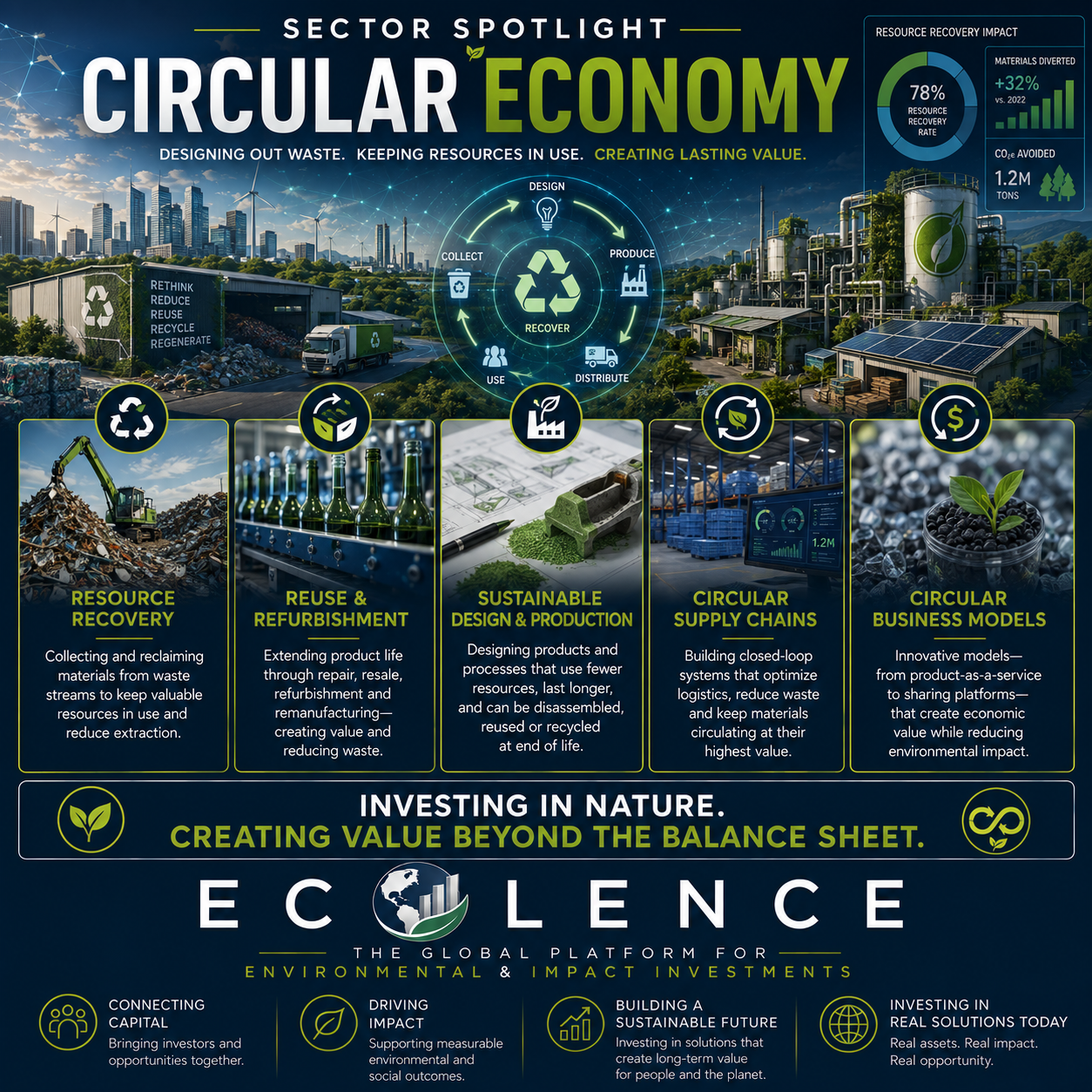
What if waste wasn’t the end of a product’s life—but the beginning of its next one?
For generations, much of the global economy has followed a relatively simple model:
Take resources. Make products. Use them. Discard them.
The circular economy challenges that model.
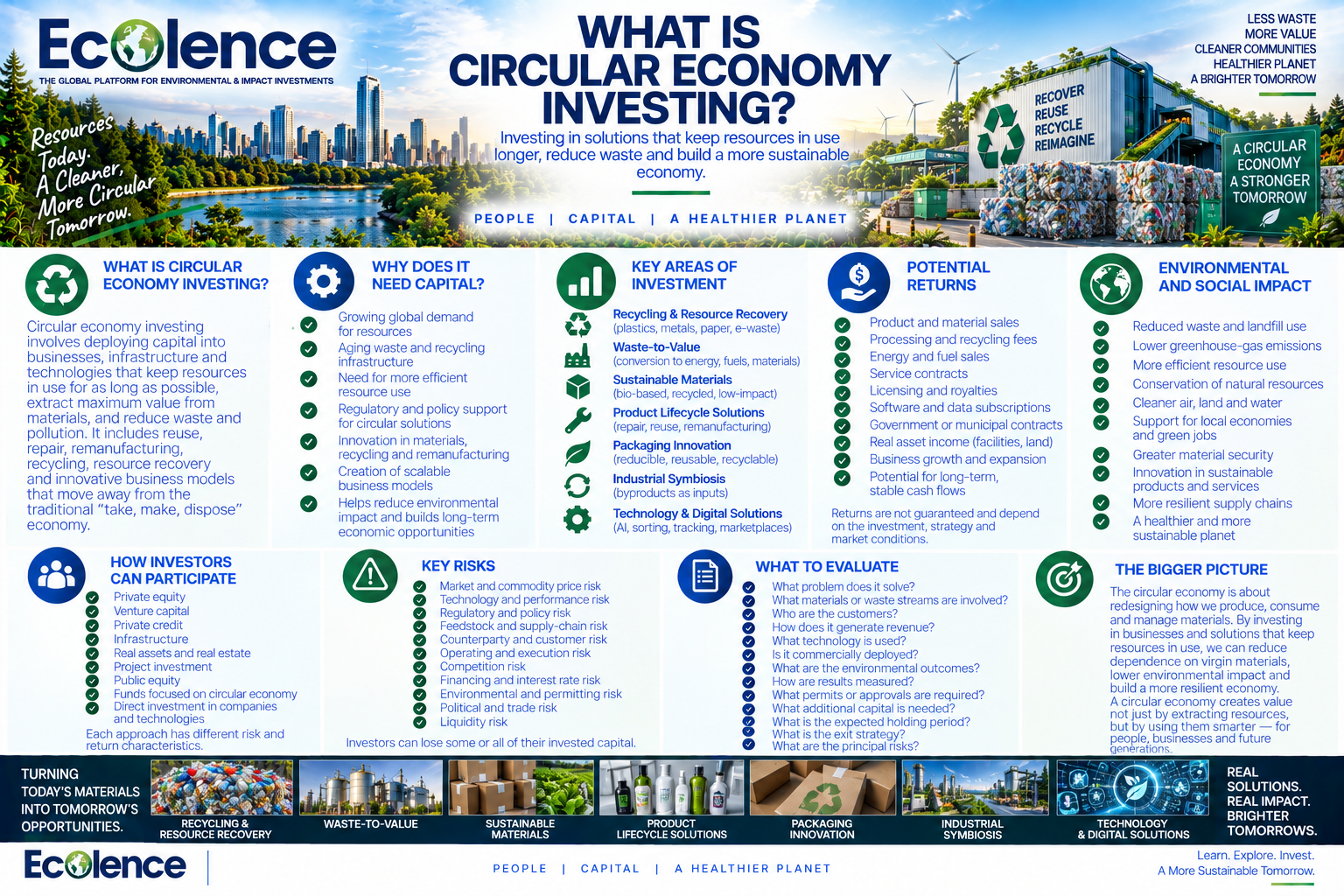
Instead of allowing valuable materials to become waste, circular systems seek to reuse, recover, repair, recycle and regenerate resources—keeping them productive for as long as possible.
And building that economy requires investment.
RESOURCE RECOVERY
Waste streams can contain valuable metals, plastics, organic materials, construction materials and other resources that can potentially be recovered, processed and returned to productive use.
RECYCLING & REPROCESSING
Modern recycling requires far more than collection bins. Sorting facilities, processing equipment, robotics, artificial intelligence and advanced material technologies are helping improve how resources are recovered.
REUSE & REMANUFACTURING
Repairing, refurbishing and remanufacturing products can extend their useful lives while creating new businesses and revenue streams.
WASTE-TO-VALUE
Agricultural waste, food waste, industrial byproducts and other discarded materials can sometimes become inputs for new products, fuels, materials, fertilizers or energy.
CIRCULAR TECHNOLOGY
AI-powered sorting, material tracking, digital marketplaces, advanced recycling technologies and supply-chain platforms are helping businesses understand where resources go—and how they can be used again.
SUSTAINABLE DESIGN & MANUFACTURING
Circularity can begin before a product is ever manufactured. Companies are increasingly exploring products designed to use fewer resources, last longer and be easier to repair, reuse or recycle.
The investment opportunity extends across the entire ecosystem.
Recycling facilities. Waste management. Manufacturing. Logistics. Technology. Infrastructure. Materials science. Resource recovery.
Capital can help build facilities, finance equipment, commercialize technologies and scale businesses capable of transforming what was once considered waste into something economically useful.
For investors, opportunities may exist through private equity, private credit, infrastructure, venture capital, real assets, private funds and individual projects.
The circular economy represents a different way of thinking about resources:
Waste can become feedstock.
Inefficiency can become opportunity.
And discarded materials can become economic value.
The future may not simply be about consuming fewer resources.
It may also be about becoming much smarter about the resources we already have.
Ecolence Sector Spotlight
Exploring the industries where capital, innovation and environmental progress intersect.
Ecolence
The Global Platform for Environmental & Impact Investments