WHAT IS NATURAL CAPITAL?
Natural capital refers to the natural resources and ecosystems that provide economic, environmental and societal value.
These can include:
Forests
Farmland and soil
Wetlands
Grasslands
Watersheds
Freshwater resources
Coastal ecosystems
Wildlife habitat
Biodiversity
Unlike manufactured assets such as buildings or equipment, natural-capital assets originate from the natural environment.
But they can still have significant economic value.
Forests can produce timber. Farmland can produce crops. Watersheds provide water. Wetlands can provide flood protection and habitat. Healthy ecosystems can support recreation, agriculture and other economic activity.
Natural-capital investing examines how investment capital can participate in these assets and the economic activities connected to them.
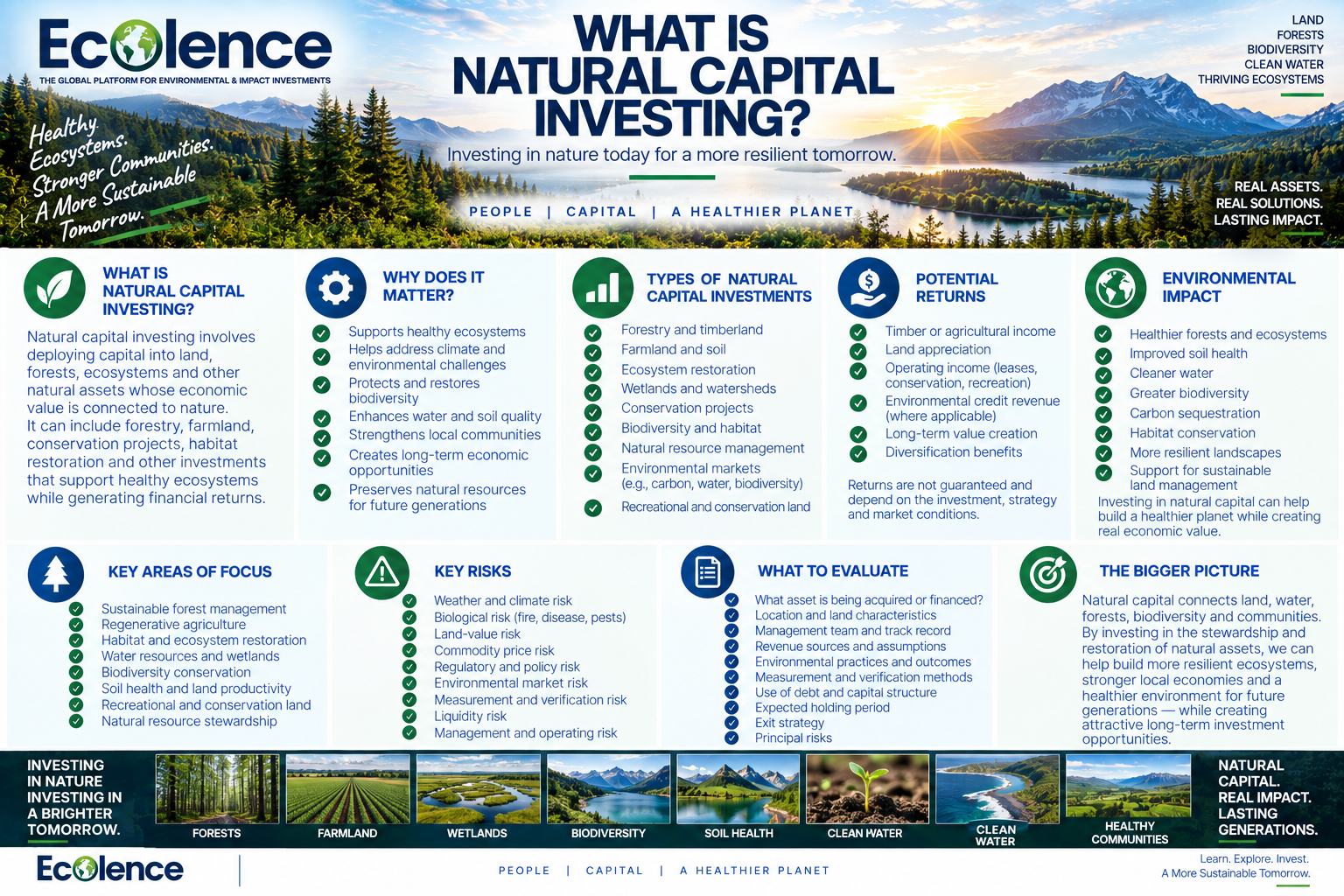
WHAT IS NATURAL CAPITAL INVESTING?
Natural capital investing involves allocating capital to land, ecosystems, natural resources, businesses or projects whose economic value is connected to nature.
An investment might involve acquiring a productive forest.
Another might finance restoration of degraded land.
A farmland investment could combine agricultural production with improvements to soil and habitat.
Other strategies may seek economic value associated with conservation, biodiversity, water or environmental markets.
The important distinction is that the investment is connected to an underlying natural asset or ecosystem.
WHY DOES NATURAL CAPITAL NEED INVESTMENT?
Maintaining and improving natural assets often requires significant capital.
Investment may be needed for:
Land acquisition
Forest management
Reforestation
Habitat restoration
Wetland restoration
Water management
Soil improvements
Conservation projects
Environmental monitoring
Project development
Historically, many of these activities depended heavily on governments, charities or conservation organizations.
Private capital can potentially provide another source of financing where an economically viable investment model exists.
FORESTRY AS A NATURAL-CAPITAL INVESTMENT
Forestry is one of the most established forms of natural-capital investing.
Investors may acquire forestland and manage it over long periods.
Potential sources of economic value can include:
Timber production
Land appreciation
Leasing
Recreation
Conservation arrangements
Environmental markets
Forests are unusual assets because the underlying biological resource—the trees—can continue growing while the investment is held.
However, forestry also involves risks related to timber prices, weather, fire, disease, management and changing land values.
FARMLAND AND SOIL
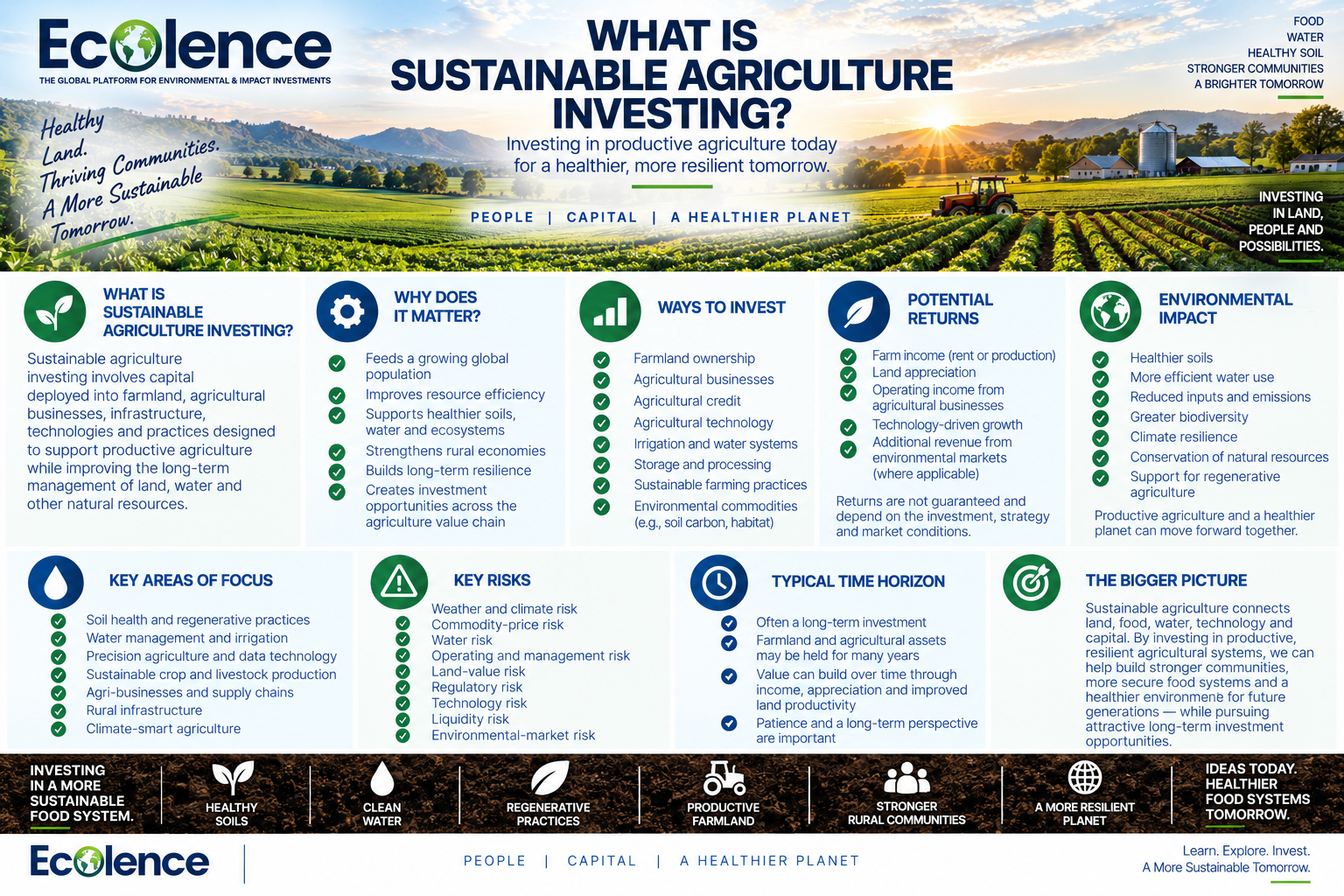
Farmland is another major natural asset.
Its economic value is connected not only to the land itself but also to:
Soil quality
Water availability
Agricultural productivity
Location
Infrastructure
Management
Investment in soil health, water management and other improvements may potentially increase agricultural productivity while also supporting the long-term condition of the underlying natural asset.
This creates significant overlap between natural capital and sustainable agriculture.
ECOSYSTEM RESTORATION
Some natural-capital strategies involve restoring degraded ecosystems.
Projects might include:
Reforestation
Wetland restoration
Habitat restoration
Watershed improvements
Soil restoration
Coastal restoration
Restoration may create environmental benefits, but investors also need to understand the economic model.
A project still needs a credible source of revenue or economic value if it is being presented as an investment rather than philanthropy.
WHERE CAN RETURNS COME FROM?
Natural-capital investments can potentially generate returns from several sources.
PRODUCTIVE ASSETS
Forests may produce timber.
Farmland may generate agricultural income.
LAND APPRECIATION
The underlying land may increase or decrease in value over time.
LEASES AND OPERATING INCOME
Natural assets may generate income through agricultural leases, recreational uses or other activities.
ENVIRONMENTAL MARKETS
Certain projects may potentially generate environmental commodities or payments associated with carbon, water, biodiversity or conservation.
SALE OF THE ASSET
Investors may ultimately realize value by selling the underlying land, project or investment interest.
Some natural-capital strategies combine several of these revenue sources.
WHAT ARE ENVIRONMENTAL MARKETS?
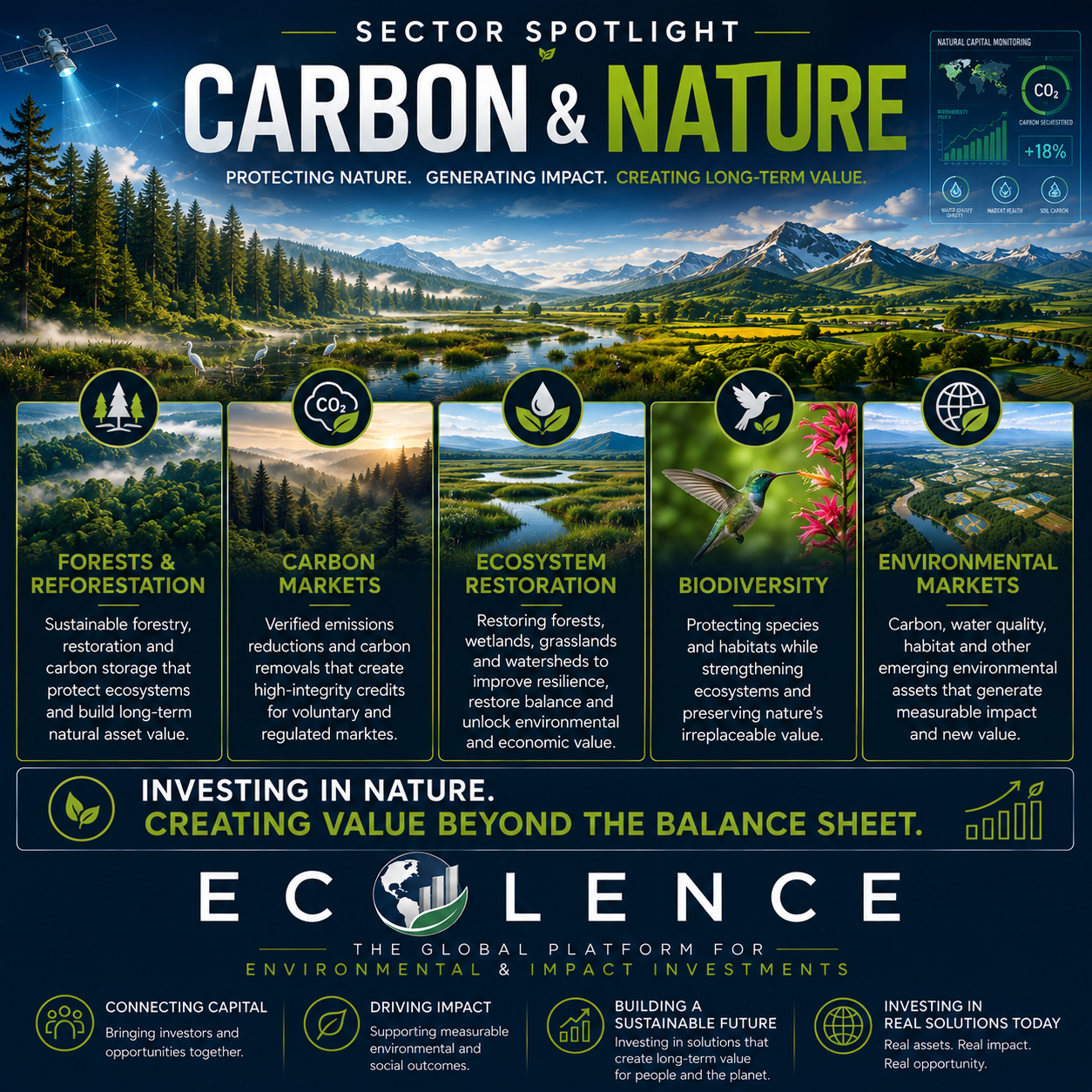
One developing area of natural-capital investing involves assigning economic value to certain environmental outcomes.
Depending on the project and applicable market, these could potentially involve:
Carbon credits
Biodiversity credits
Water-quality credits
Conservation payments
Habitat programs
These markets attempt to create financial mechanisms connected to environmental outcomes.
However, they can also introduce additional risks involving measurement, verification, regulation, pricing and market demand.
Investors should not assume that an environmental asset will automatically generate environmental credits or revenue.
HOW IS ENVIRONMENTAL VALUE MEASURED?
Measurement is particularly important in natural-capital investing.
Depending on the investment, monitoring may involve:
Satellite imagery
Remote sensing
Soil testing
Forest inventories
Water measurements
Biodiversity surveys
Sensors
Geospatial data
Independent verification
These systems are often described collectively as measurement, reporting and verification, or MRV.
Credible measurement becomes particularly important when financial value depends on claims about environmental outcomes.
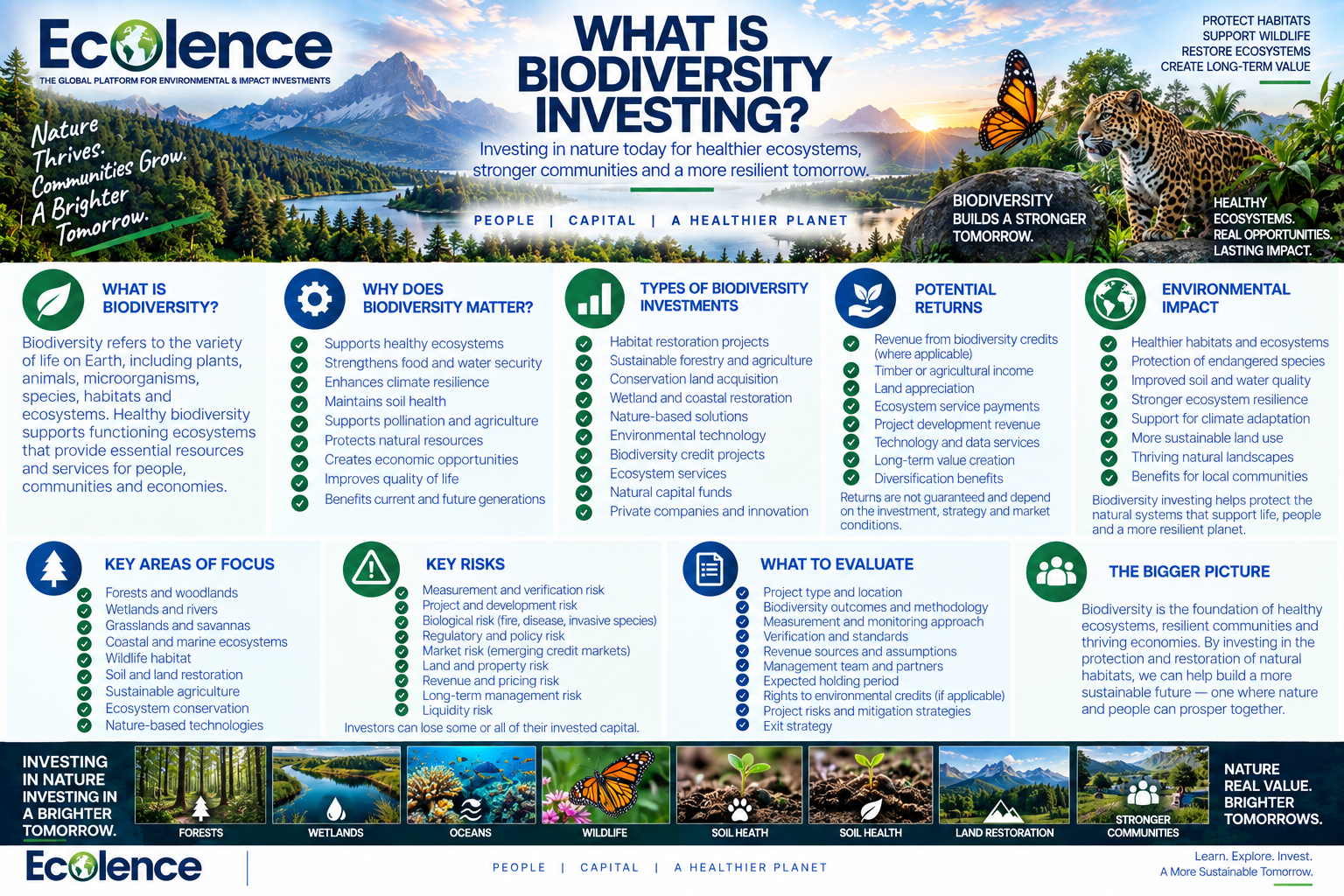
WHAT IS BIODIVERSITY?
Biodiversity refers broadly to the variety of living organisms and ecosystems.
It can include diversity among:
Plants
Animals
Habitats
Species
Ecosystems
Biodiversity can have economic importance because functioning ecosystems support agriculture, forestry, water systems and other human activities.
However, measuring biodiversity is complex.
There is no single universal metric that captures every aspect of ecosystem health.
We’ll explore biodiversity separately in the next dedicated Ecolence article.
WHAT ARE THE MAJOR RISKS?
Natural-capital investments can involve substantial risks.
LAND-VALUE RISK
The underlying property may decline in value.
BIOLOGICAL RISK
Fire, disease, pests or other natural events can damage biological assets.
WEATHER AND CLIMATE RISK
Drought, storms, flooding and changing environmental conditions can affect assets.
COMMODITY RISK
Timber, agricultural products and other commodities can experience price volatility.
REGULATORY RISK
Environmental, land-use and conservation rules can change.
MARKET RISK
Environmental-credit markets may develop differently than expected.
MEASUREMENT RISK
Environmental outcomes may be difficult to quantify or verify.
MANAGEMENT RISK
Natural assets require specialized management.
LIQUIDITY RISK
Land and private natural-capital investments may take considerable time to sell.
Investors can lose some or all of their invested capital.
NATURAL CAPITAL DOES NOT AUTOMATICALLY MEAN ENVIRONMENTAL IMPACT
This is an important distinction for Ecolence.
Simply owning land does not necessarily create a positive environmental outcome.
A natural-capital investment should be evaluated based on what is actually being done with the asset.
Investors should examine:
How the land is managed
What environmental objectives exist
How outcomes are measured
Whether independent verification is used
What economic activities occur on the property
How environmental claims relate to the investment strategy
The words natural capital should not substitute for due diligence.
WHAT SHOULD AN INVESTOR EVALUATE?
Before considering a natural-capital investment, investors should understand:
What natural asset is being acquired or financed?
Where is it located?
Who owns or controls the land?
How will the investment generate revenue?
Who manages the asset?
What environmental activities are planned?
How will environmental outcomes be measured?
Are environmental credits part of the financial projections?
What assumptions are being made about their value?
What operating expenses are required?
Will debt be used?
What is the expected holding period?
How is the investment expected to exit?
What are the principal risks?
These questions help investors distinguish the value of the underlying natural asset from assumptions about future environmental value.
THE BIGGER PICTURE
Traditional investing often focuses on companies, buildings and financial assets.
Natural-capital investing introduces another category:
Nature itself as an economically productive asset.
Forests grow timber.
Soils support agriculture.
Watersheds provide water.
Wetlands can protect surrounding areas.
Habitats support biodiversity and functioning ecosystems.
These natural systems have always had value, even when financial markets did not explicitly recognize it.
For Ecolence, natural capital represents an important expansion of the environmental investment universe—connecting land, ecosystems, conservation and private capital.
The investment opportunity is not simply about placing a financial value on nature.
It is about understanding how capital can help own, manage, restore and improve natural assets while building an economically sustainable model around their long-term stewardship.