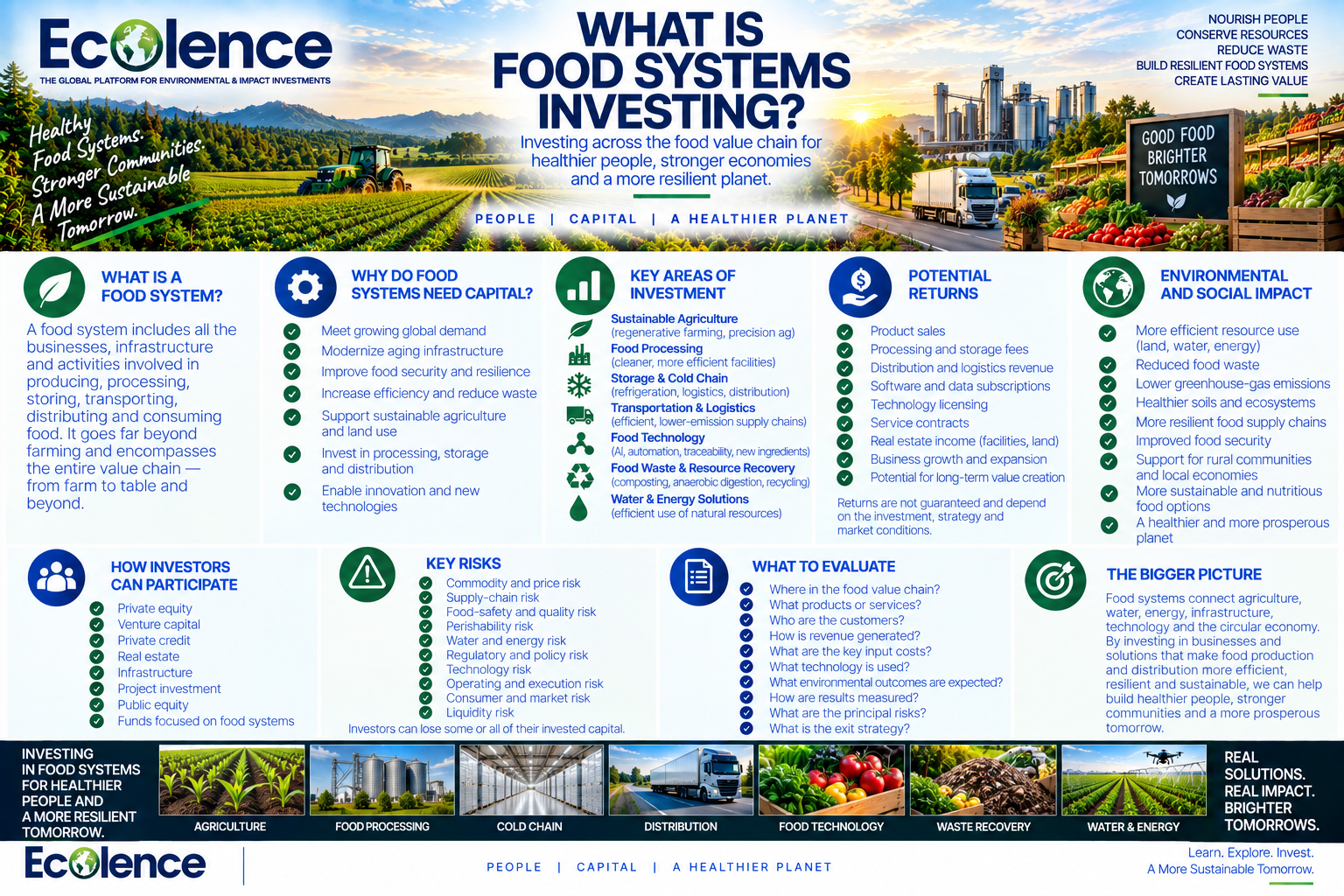
WHAT IS A FOOD SYSTEM?
A food system encompasses the interconnected businesses, infrastructure, resources and activities involved in getting food from its origin to the people who consume it.
It extends far beyond farming.
A modern food system can include:
Agriculture
Food processing
Storage
Cold-chain infrastructure
Transportation
Distribution
Packaging
Wholesale and retail
Food technology
Waste management
Resource recovery
Every step requires capital, infrastructure, energy, water, technology and people.
Food systems investing examines opportunities across this entire chain.
WHAT IS FOOD SYSTEMS INVESTING?
Food systems investing involves deploying capital into businesses, technologies, infrastructure and real assets involved in producing, processing, storing, transporting or improving the efficiency of food.
An investment could finance a food-processing facility.
Another might support cold-storage infrastructure.
A technology company could develop systems that help reduce food waste.
Other investments might focus on agricultural supply chains, alternative ingredients, packaging or resource recovery.
The common connection is participation in the broader system responsible for moving food through the economy.
WHY DO FOOD SYSTEMS NEED CAPITAL?
The global food economy requires enormous amounts of physical and financial infrastructure.
Capital may be needed for:
Production
Processing facilities
Storage
Refrigeration
Transportation
Distribution centers
Water systems
Energy systems
Technology
Packaging
Waste reduction
Modernization
Population growth, changing consumer preferences, resource constraints and technological innovation can create additional investment needs throughout the system.
FROM FARM TO CONSUMER
One useful way to understand food systems is to follow the value chain.
PRODUCTION
↓
HARVEST
↓
PROCESSING
↓
STORAGE
↓
TRANSPORTATION
↓
DISTRIBUTION
↓
RETAIL / FOOD SERVICE
↓
CONSUMER
↓
WASTE / RESOURCE RECOVERY
Investment opportunities can exist at virtually every stage.
This is what distinguishes food systems investing from simply investing in farmland.
FOOD PROCESSING
Agricultural products often need to be cleaned, processed, packaged or transformed before reaching consumers.
Processing infrastructure can include facilities handling:
Fruits and vegetables
Grains
Dairy
Meat and proteins
Specialty crops
Ingredients
Prepared foods
These facilities can require substantial capital for buildings, machinery, energy systems, water and technology.
STORAGE & COLD CHAIN
Food is perishable.
That makes storage one of the most important components of the food system.
Cold-chain infrastructure maintains controlled temperatures as food moves through production, storage, transportation and distribution.
Investment opportunities can include:
Refrigerated warehouses
Cold-storage facilities
Temperature-controlled transportation
Monitoring systems
Energy-efficient refrigeration
Distribution infrastructure
Effective storage can help preserve food quality and potentially reduce losses.
TRANSPORTATION & DISTRIBUTION
Food must move from where it is produced to where it is consumed.
That requires:
Trucks
Rail
Ports
Warehouses
Distribution centers
Logistics technology
Refrigerated transportation
Investment in logistics can potentially improve efficiency, reduce spoilage and strengthen supply chains.
FOOD TECHNOLOGY
Technology is increasingly changing how food is produced, processed and distributed.
Potential investment areas include:
Supply-chain software
Food-safety technology
Automation
Robotics
Artificial intelligence
Traceability systems
Sensors
Cold-chain monitoring
New ingredients
Processing technology
Waste-reduction technology
Some companies focus on improving existing food systems, while others seek to create entirely new products or production methods.
TRACEABILITY
Consumers, businesses and regulators increasingly want information about where food comes from and how it moves through the supply chain.
Traceability technologies can help organizations monitor:
Origin
Processing
Transportation
Temperature
Storage
Quality
Food safety
Inventory
Better information can potentially reduce waste, improve food safety and make supply chains more transparent.
FOOD WASTE AS AN INVESTMENT OPPORTUNITY
A significant amount of food can be lost or wasted between production and consumption.
That creates both an environmental challenge and a potential economic opportunity.
Investment can support:
Improved storage
Cold-chain infrastructure
Inventory-management systems
Waste-monitoring technology
Food redistribution
Composting
Anaerobic digestion
Organic-waste processing
Resource recovery
Some businesses seek to turn materials traditionally treated as waste into new products, energy or agricultural inputs.
This creates significant overlap between food systems and the circular economy.
WATER & FOOD
Food production and processing can require substantial amounts of water.
Investment opportunities may therefore involve:
Efficient irrigation
Water recycling
Wastewater treatment
Water monitoring
Processing efficiency
Leak detection
Water-quality technology
Water availability and cost can also represent major risks for food businesses.
Food systems therefore intersect directly with the Water sector of the Ecolence environmental economy.
ENERGY & FOOD
Food systems also require energy.
Energy is used for:
Irrigation
Processing
Refrigeration
Storage
Transportation
Heating and cooling
Manufacturing
Investment in energy efficiency, renewable energy and storage can potentially reduce operating costs while changing the environmental footprint of food production and distribution.
HOW CAN INVESTORS PARTICIPATE?
Investors can potentially participate through several structures.
PRIVATE EQUITY
Capital may be invested in established food, processing, logistics or technology businesses.
VENTURE CAPITAL
Early-stage companies may develop new food technologies, ingredients, software or production systems.
PRIVATE CREDIT
Debt capital can finance equipment, facilities, expansion or working capital.
REAL ESTATE
Investors may own food-processing, warehouse, distribution or cold-storage properties.
INFRASTRUCTURE
Capital can finance processing plants, storage facilities, logistics networks and related physical assets.
PRIVATE FUNDS
Funds may invest across several areas of agriculture and food systems.
The underlying investment structure can be just as important as the sector itself.
HOW CAN FOOD SYSTEM INVESTMENTS GENERATE RETURNS?
Potential sources of return depend on the investment.
They may include:
Product sales
Processing fees
Storage fees
Lease income
Distribution revenue
Software subscriptions
Technology licensing
Service contracts
Business growth
Asset appreciation
Investors should understand exactly what drives revenue and what costs are necessary to generate it.
WHAT ARE THE MAJOR RISKS?
Food systems investments can involve substantial risks.
COMMODITY RISK
Agricultural input and food prices can fluctuate.
SUPPLY-CHAIN RISK
Disruptions can affect production and distribution.
FOOD-SAFETY RISK
Contamination or quality problems can create significant financial and reputational consequences.
PERISHABILITY RISK
Many food products have limited useful lives.
WATER RISK
Water availability, quality and cost can affect production.
ENERGY RISK
Energy prices can materially affect processing, refrigeration and transportation.
TECHNOLOGY RISK
New technologies may fail to achieve commercial adoption.
REGULATORY RISK
Food-safety, environmental and other regulations can change.
CONSUMER RISK
Consumer preferences can change rapidly.
OPERATING RISK
Facilities and supply chains require effective management.
LIQUIDITY RISK
Private investments may be difficult to sell.
Investors can lose some or all of their invested capital.
FOOD SYSTEMS AND SUSTAINABILITY
The environmental characteristics of a food investment should be evaluated based on what the business or project actually does.
Potential areas of environmental improvement can include:
Reduced food waste
More efficient water use
Lower energy consumption
Improved packaging
Resource recovery
More efficient logistics
Improved agricultural practices
Reduced material use
But participation in the food sector does not automatically make an investment sustainable.
The specific environmental outcomes matter.
WHAT SHOULD AN INVESTOR EVALUATE?
Before considering a food-systems investment, investors should understand:
Where does the investment operate within the food value chain?
What product or service does it provide?
Who are its customers?
How does it generate revenue?
What are its major input costs?
How dependent is it on commodity prices?
What water and energy resources does it require?
How resilient is its supply chain?
What technology does it use?
What environmental problem is it addressing?
How are environmental outcomes measured?
What regulatory requirements apply?
How much additional capital may be required?
Who manages the business or asset?
What is the expected holding period?
What is the potential exit strategy?
What are the principal risks?
These questions help investors distinguish between a compelling food-sector theme and the economics of the actual investment.
THE BIGGER PICTURE
Food connects many parts of the environmental economy.
It begins with land, soil and water.
It depends on energy and infrastructure.
It increasingly uses technology and data.
It requires storage and transportation.
And when food or packaging reaches the end of its useful life, it intersects with the circular economy and resource recovery.
That makes food systems one of the clearest examples of how environmental sectors are interconnected.
For Ecolence, Food Systems represents the investment ecosystem surrounding one of society’s most essential needs:
producing, processing and delivering food while using capital, technology and infrastructure to make the system more productive, efficient and resilient.