WHAT IS CLEAN ENERGY INVESTING?
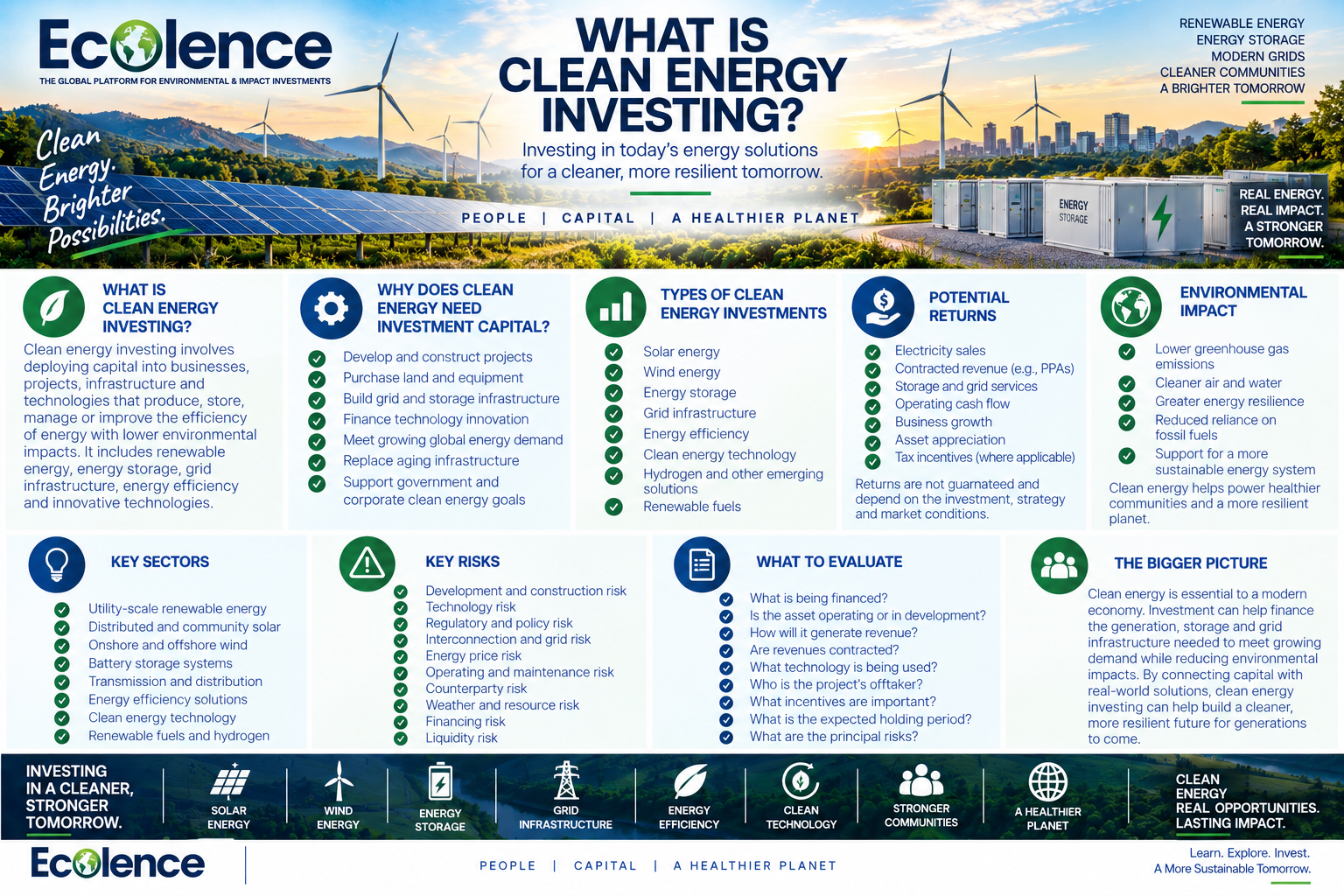
Clean energy investing involves deploying capital into businesses, projects, infrastructure and technologies involved in producing, storing, managing or improving the efficiency of energy with lower environmental impacts.
The investment universe extends well beyond solar panels and wind turbines.
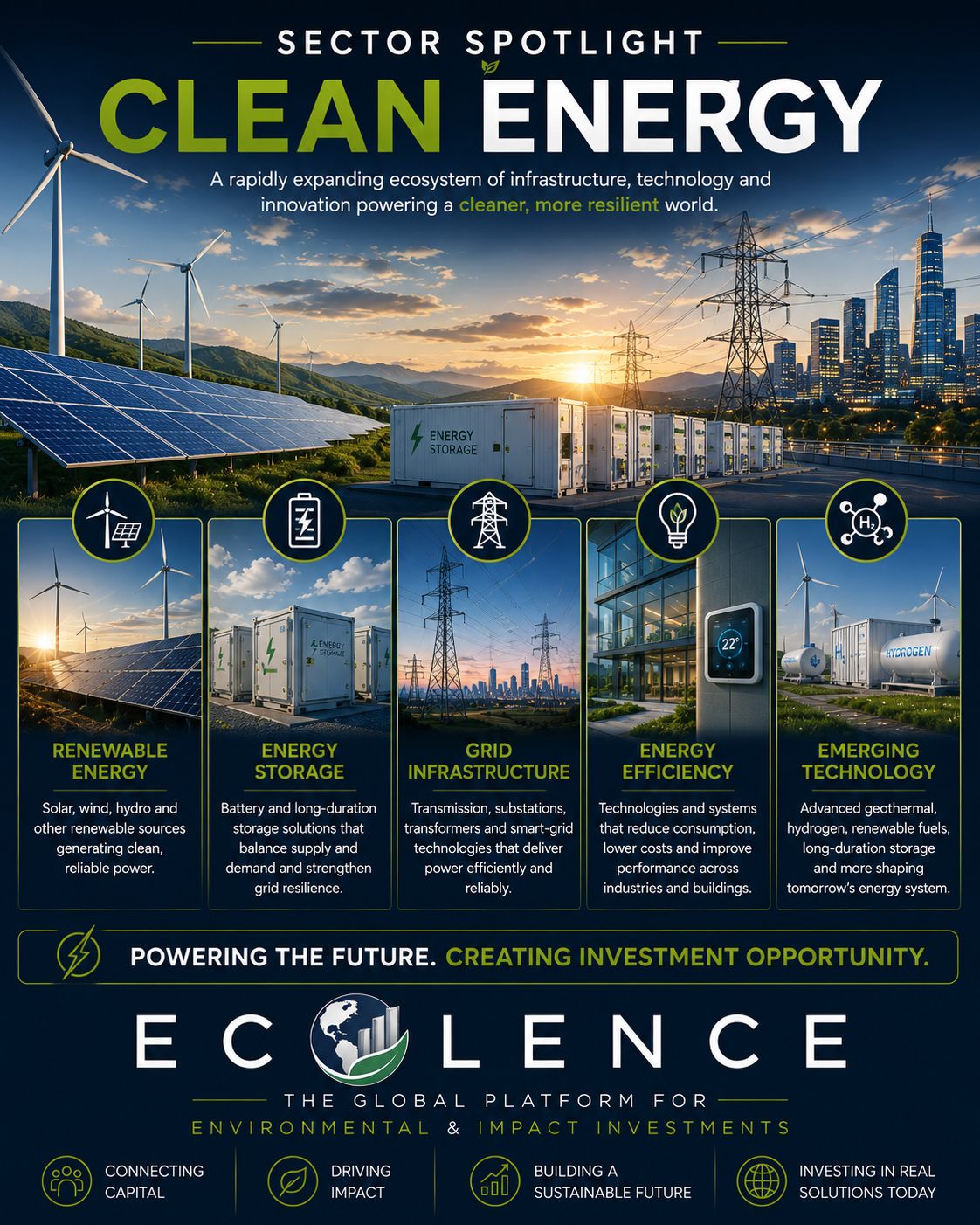
It can include large-scale renewable-energy projects, battery storage, distributed energy systems, electrical-grid infrastructure, energy-efficiency technologies and companies developing new ways to produce and manage energy.
For investors, clean energy therefore represents both a technology sector and a real-asset infrastructure market.
WHY DOES CLEAN ENERGY NEED INVESTMENT CAPITAL?
Energy infrastructure is capital intensive.
Developing a solar facility, constructing a wind project, installing battery storage or modernizing electrical infrastructure can require significant amounts of capital before the asset begins generating revenue.
Capital may be needed for:
Project development
Land acquisition or leasing
Engineering and design
Equipment
Construction
Grid connections
Battery storage
Transmission infrastructure
Technology development
Operations and maintenance
This creates opportunities for multiple forms of private capital.
WHAT TYPES OF CLEAN ENERGY INVESTMENTS EXIST?
Clean energy encompasses several major areas.
SOLAR ENERGY
Capital can finance utility-scale solar farms, commercial installations, community solar and distributed solar systems.
WIND ENERGY
Investment may support onshore and offshore wind projects as well as companies supplying equipment, technology and services to the industry.
ENERGY STORAGE
Battery systems can store electricity for later use and help balance differences between energy production and demand.
GRID INFRASTRUCTURE
Modern energy systems require transmission, distribution, monitoring and control infrastructure.
ENERGY EFFICIENCY
Investment can finance technologies and projects intended to reduce the amount of energy required by buildings, industrial operations and other systems.
CLEAN ENERGY TECHNOLOGY
Private companies may develop software, equipment, materials and other technologies supporting the energy economy.
These opportunities can have very different economics and risk profiles.
HOW CAN INVESTORS PARTICIPATE?
Investors can gain exposure to clean energy through several investment structures.
INFRASTRUCTURE FUNDS
Funds may acquire or develop portfolios of renewable-energy and energy-related infrastructure.
DIRECT PROJECT INVESTMENTS
Capital may be invested directly into a particular solar, wind, storage or other energy project.
PRIVATE EQUITY
Private-equity investors may finance established clean-energy businesses.
VENTURE CAPITAL
Venture investors may provide capital to earlier-stage companies developing new energy technologies.
PRIVATE CREDIT
Lenders may finance projects, equipment or clean-energy businesses.
REAL ASSETS
Investors may own physical energy assets that generate operating revenue.
Understanding both the clean-energy asset and the investment structure is essential.
HOW CAN CLEAN ENERGY INVESTMENTS GENERATE RETURNS?
The answer depends on the investment.
ENERGY SALES
A renewable-energy facility may generate revenue by selling the electricity it produces.
CONTRACTED REVENUE
Some projects operate under agreements that establish how electricity or other services will be purchased.
STORAGE SERVICES
Battery systems may potentially generate revenue by providing storage, capacity or other grid-related services.
OPERATING CASH FLOW
Infrastructure assets may produce ongoing cash flow after operating expenses and financing costs.
BUSINESS GROWTH
Investments in clean-energy companies may generate returns if those businesses expand and become more valuable.
ASSET APPRECIATION
Operating projects or portfolios may increase or decrease in value depending on their economics and market conditions.
Ultimately, the source of return should be understood at the individual investment level.
WHAT IS A POWER PURCHASE AGREEMENT?
Investors in renewable-energy projects may encounter a Power Purchase Agreement, commonly called a PPA.
A PPA generally establishes terms under which electricity generated by a project will be purchased by another party.
Depending on the agreement, it may address matters such as:
Electricity pricing
Contract duration
Delivery obligations
Performance requirements
Payment terms
Long-term contracts can potentially provide greater visibility into project revenue.
But they do not eliminate risk.
Investors still need to evaluate the financial strength of the buyer, the terms of the agreement and the project’s ability to deliver the expected electricity.
WHY IS ENERGY STORAGE IMPORTANT?
Renewable-energy production and electricity demand do not always occur at the same time.
Solar facilities generate electricity when sunlight is available.
Wind generation depends on wind conditions.
Battery storage can allow electricity to be stored and used later.
Storage can therefore become an important part of a modern energy system by helping manage the timing of electricity supply and demand.
From an investment perspective, storage represents both an infrastructure opportunity and a technology opportunity.
WHY DOES THE ELECTRICAL GRID MATTER?
Generating electricity is only part of the energy system.
Electricity must also be transmitted, distributed, monitored and managed.
As new generation and storage assets are added, additional investment may be required in:
Transmission lines
Distribution networks
Substations
Grid-management technology
Smart meters
Monitoring systems
Interconnection infrastructure
The modernization of the electrical grid can therefore represent a substantial investment area of its own.
WHAT ROLE DOES TECHNOLOGY PLAY?
Technology is increasingly important throughout the energy system.
Investment opportunities may involve:
Battery technology
Energy-management software
Artificial intelligence
Grid optimization
Advanced materials
Power electronics
Energy monitoring
Predictive maintenance
Distributed-energy management
Some of these businesses may be established companies, while others may be early-stage ventures with substantially greater technology and commercialization risk.
WHAT IS PROJECT DEVELOPMENT RISK?
Not every clean-energy investment involves an operating asset.
Some projects are still being developed.
Before construction can begin, a project may need to secure:
Land rights
Permits
Financing
Equipment
Grid interconnection
Construction agreements
Customers or energy purchasers
A project that has been proposed is therefore very different from a facility that has already been constructed and is generating revenue.
Development-stage investments may offer potential opportunities, but they can also involve substantially greater uncertainty.
WHAT ARE THE MAJOR RISKS?
Clean-energy investments can involve numerous risks.
DEVELOPMENT RISK
A project may fail to reach construction or commercial operation.
CONSTRUCTION RISK
Projects may experience delays or cost overruns.
TECHNOLOGY RISK
Equipment or technology may fail to perform as expected or become obsolete.
ENERGY-PRICE RISK
Market electricity prices can affect project economics.
COUNTERPARTY RISK
A purchaser or contractual partner may fail to meet its obligations.
REGULATORY RISK
Changes in laws, permitting requirements, incentives or energy regulations can affect an investment.
INTERCONNECTION RISK
Projects may encounter delays or costs connecting to the electrical grid.
FINANCING RISK
Changes in interest rates or capital availability may affect project economics.
OPERATING RISK
Equipment can fail, maintenance costs can rise and energy production can differ from projections.
WEATHER AND RESOURCE RISK
Actual sunlight, wind or other natural conditions may differ from assumptions.
Investors can lose some or all of their invested capital.
CLEAN ENERGY DOES NOT AUTOMATICALLY MEAN A GOOD INVESTMENT
This is another principle we should reinforce throughout Ecolence.
A project can produce renewable energy and still be a poor investment.
The environmental purpose of an asset does not replace financial analysis.
Investors should still examine:
Development costs
Construction costs
Expected energy production
Revenue contracts
Operating expenses
Debt
Interest rates
Technology
Management
Project life
Exit assumptions
The environmental story and the investment economics should be evaluated separately—and then considered together.
WHAT SHOULD AN INVESTOR EVALUATE?
Before considering a clean-energy investment, investors should understand:
What exactly is being financed?
Is the asset operating, under construction or still being developed?
How will it generate revenue?
Are revenues contracted or dependent on market prices?
Who purchases the energy?
How long do the contracts last?
What technology is being used?
Who constructs and operates the project?
Has grid interconnection been secured?
How much debt is being used?
What assumptions are being made about energy production?
Are government incentives important to the economics?
What is the expected holding period?
How is the investment expected to exit?
What are the principal risks?
These questions help investors move beyond the label clean energy and understand the actual investment.
THE BIGGER PICTURE
Energy is fundamental to nearly every part of the economy.
Homes need electricity.
Businesses need power.
Factories need energy.
Transportation increasingly interacts with the electrical system.
Data centers and digital infrastructure require enormous amounts of electricity.
At the same time, the systems used to produce, store and deliver energy continue to evolve.
That evolution requires capital.
For Ecolence, clean energy represents one of the clearest examples of how environmental investing can connect private capital with real-world infrastructure and technological innovation.
Investment can help finance the generation facilities, storage systems, grid infrastructure and technologies that make the energy system function.
The opportunity is not simply about investing in something labeled “green.”
It is about understanding where capital is needed, how an energy asset or business creates economic value, what risks investors are taking and how that investment participates in the changing energy economy.