WHAT IS ENVIRONMENTAL INFRASTRUCTURE?
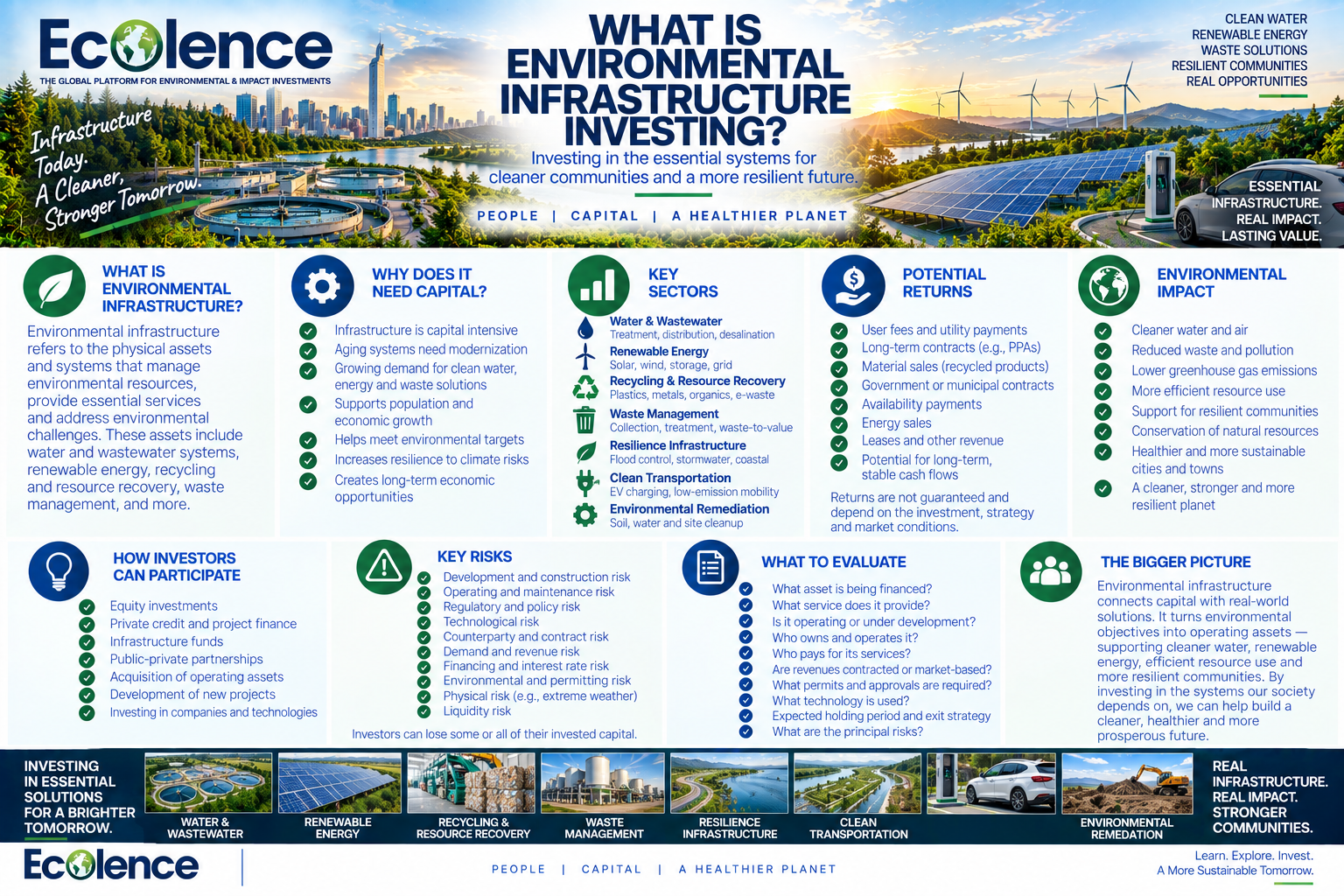
Environmental infrastructure refers to the physical assets and systems used to manage environmental resources, provide essential services and address environmental challenges.
These assets can include:
Water-treatment facilities
Wastewater systems
Renewable-energy infrastructure
Battery storage
Recycling and resource-recovery facilities
Waste-management infrastructure
Irrigation systems
Environmental remediation facilities
Grid infrastructure
Stormwater-management systems
Electric-vehicle charging networks
Environmental infrastructure is where environmental objectives often become physical, operating assets.
A policy may encourage cleaner water.
A technology may make water treatment more efficient.
But ultimately, treatment plants, pipes, pumps and other infrastructure must actually be financed, constructed and operated.
That is where infrastructure capital enters the picture.
WHY DOES ENVIRONMENTAL INFRASTRUCTURE NEED CAPITAL?
Infrastructure is typically capital intensive.
Building a water-treatment facility, renewable-energy project or recycling plant can require substantial investment before the asset begins generating revenue.
Capital may be needed for:
Planning and engineering
Land
Permitting
Equipment
Construction
Technology
Financing
Grid or utility connections
Operations
Maintenance
Expansion and modernization
Some infrastructure can operate for decades, making today’s investment decisions relevant far into the future.
WHERE ARE THE INVESTMENT OPPORTUNITIES?
Environmental infrastructure spans several major markets.
WATER INFRASTRUCTURE
Investment can support:
Drinking-water treatment
Wastewater treatment
Water distribution
Desalination
Water recycling
Irrigation
Stormwater management
Leak detection and system modernization
Water infrastructure is essential regardless of whether the underlying investment has an explicitly environmental label.
ENERGY INFRASTRUCTURE
Environmental energy infrastructure can include:
Solar facilities
Wind projects
Battery storage
Transmission
Grid modernization
Distributed energy
Charging infrastructure
These assets help produce, store and move energy through the economy.
RECYCLING & RESOURCE RECOVERY
Capital can finance facilities that collect, sort, process and recover materials.
Potential areas include:
Metals
Plastics
Paper
Glass
Electronic waste
Construction materials
Organic waste
Battery materials
The investment thesis may depend on turning material traditionally treated as waste into something with recoverable economic value.
WASTE INFRASTRUCTURE
Waste-management systems require substantial physical infrastructure.
This can include:
Collection systems
Transfer facilities
Sorting facilities
Treatment facilities
Composting
Anaerobic digestion
Landfill-gas systems
Waste-to-value technologies
Environmental outcomes can vary significantly among different technologies and projects.
RESILIENCE INFRASTRUCTURE
Some infrastructure is designed to help communities and assets manage physical environmental risks.
Examples can include:
Flood-control systems
Stormwater infrastructure
Coastal protection
Water-storage systems
Wildfire-related infrastructure
Distributed and resilient energy systems
These projects can overlap with traditional public infrastructure.
WHO OWNS ENVIRONMENTAL INFRASTRUCTURE?
Ownership structures vary.
Assets may be owned by:
Governments
Municipalities
Utilities
Private companies
Infrastructure funds
Public-private partnerships
Special-purpose project entities
The ownership structure can materially affect how an investment generates revenue and what risks investors assume.
HOW CAN PRIVATE CAPITAL PARTICIPATE?
Private capital can participate in several ways.
EQUITY
Investors may own part of an infrastructure project or company.
PRIVATE CREDIT
Investors may lend money to finance construction, acquisition or operation.
INFRASTRUCTURE FUNDS
Funds may pool investor capital and acquire portfolios of infrastructure assets.
PROJECT FINANCE
Capital may be raised specifically for an individual project.
PRIVATE EQUITY
Investors may acquire businesses that own, develop or operate environmental infrastructure.
PUBLIC-PRIVATE PARTNERSHIPS
Private capital and government entities may participate together in certain infrastructure projects.
Each structure creates different rights, risks and potential sources of return.
HOW CAN ENVIRONMENTAL INFRASTRUCTURE GENERATE REVENUE?
One attractive characteristic of some infrastructure assets is that they provide services people and businesses continually need.
Potential revenue models include:
User fees
Utility payments
Long-term contracts
Energy sales
Waste-processing fees
Water-service charges
Material sales
Availability payments
Leases
Government or municipal contracts
An asset’s environmental importance does not itself create revenue.
Investors need to understand who pays, what they pay for and why those payments are expected to continue.
WHAT IS PROJECT FINANCE?
Large infrastructure projects are often financed at the project level.
A separate project entity may own the asset and enter into contracts related to construction, financing, operations and revenue.
Debt may then be repaid primarily from the project’s cash flow.
Investors should understand:
How much equity is invested
How much debt is used
What revenue supports the project
Who the counterparties are
What happens if revenues fall short
Project finance can allow substantial assets to be developed, but it can also create complex financial structures.
WHY DO CONTRACTS MATTER?
Infrastructure often depends heavily on long-term contracts.
For example, a project may have agreements governing:
Energy purchases
Water services
Waste processing
Equipment supply
Construction
Operations
Land use
Long-term agreements can potentially provide greater visibility into future revenue or expenses.
But a contract is only as reliable as its terms and the ability of the parties to perform.
Investors should understand the financial strength of important counterparties.
WHAT ROLE DOES TECHNOLOGY PLAY?
Environmental infrastructure is becoming increasingly connected to technology.
Modern assets may use:
Artificial intelligence
Sensors
Satellite data
Automation
Smart meters
Predictive maintenance
Remote monitoring
Advanced filtration
Digital control systems
Environmental measurement
Technology can potentially improve efficiency and provide better information about how infrastructure performs.
It can also introduce additional technology and cybersecurity risks.
WHAT IS INFRASTRUCTURE MODERNIZATION?
Not every infrastructure investment involves building something new.
Many opportunities involve improving existing assets.
An aging water system might need new pumps, monitoring equipment or leak-detection technology.
An electrical system might require storage or grid upgrades.
A recycling facility might install more advanced sorting equipment.
Modernization can therefore represent a significant investment opportunity alongside new construction.
WHAT ARE THE MAJOR RISKS?
Environmental infrastructure can involve substantial risks.
DEVELOPMENT RISK
Projects may fail to obtain necessary approvals or financing.
CONSTRUCTION RISK
Costs may exceed budgets or projects may be delayed.
OPERATING RISK
Assets may not perform as expected.
TECHNOLOGY RISK
Technology may fail, underperform or become obsolete.
COUNTERPARTY RISK
Customers, contractors or other parties may fail to meet their obligations.
REGULATORY RISK
Environmental, utility and infrastructure regulations can change.
FINANCING RISK
Interest rates and capital availability can affect project economics.
DEMAND RISK
Usage or demand may be lower than projected.
COMMODITY RISK
Some projects depend on energy or recovered-material prices.
PHYSICAL RISK
Flooding, storms, fire and other events can damage infrastructure.
LIQUIDITY RISK
Private infrastructure assets can be difficult to sell.
Investors can lose some or all of their invested capital.
ENVIRONMENTAL INFRASTRUCTURE DOES NOT AUTOMATICALLY MEAN ENVIRONMENTAL IMPACT
This distinction remains important for Ecolence.
An asset can fall within an environmental sector without necessarily producing the environmental results investors expect.
Investors should ask:
What problem does the infrastructure address?
What environmental outcome is expected?
How is that outcome measured?
Compared with what baseline or alternative?
Who reports the results?
Financial performance and environmental performance should both be evaluated.
WHAT SHOULD AN INVESTOR EVALUATE?
Before considering an environmental-infrastructure investment, investors should understand:
What physical asset is being financed?
What environmental service does it provide?
Is the asset operating, under construction or still being developed?
Who owns it?
Who operates it?
Who pays for its services?
Are revenues contracted or market-based?
What permits and approvals are required?
What technology does it use?
How much debt is involved?
Who are the important counterparties?
What capital expenditures will be required?
How long is the expected operating life?
What is the investor’s expected holding period?
How could the investment eventually be sold or refinanced?
What are the principal risks?
These questions help investors look beyond the infrastructure itself and understand the economic system supporting the asset.
THE BIGGER PICTURE
Environmental challenges often sound abstract until they become physical.
Clean water requires treatment plants and distribution systems.
Renewable electricity requires generation, storage and grid infrastructure.
Recycling requires facilities capable of processing materials.
Electric transportation requires charging networks.
More efficient agriculture requires irrigation and water-management systems.
Environmental resilience requires physical assets capable of protecting communities and economic activity.
All of that requires capital.
That is why environmental infrastructure is such an important part of the Ecolence investment universe.
It represents the point where capital becomes physical assets—and environmental objectives become operating systems in the real economy.