WHAT IS ENVIRONMENTAL INVESTING?
Environmental investing is the deployment of capital into businesses, assets, infrastructure, technologies and projects connected to environmental needs and the management of natural resources.
For many investors, the first thought may be publicly traded renewable-energy or clean-technology companies. But the environmental investment universe extends much further.
It can include farmland, renewable-energy infrastructure, water systems, forests, recycling facilities, environmental technologies, carbon projects and other real-world assets and businesses.
In other words, environmental investing is not a single investment strategy or asset class.
It is a broad investment universe.
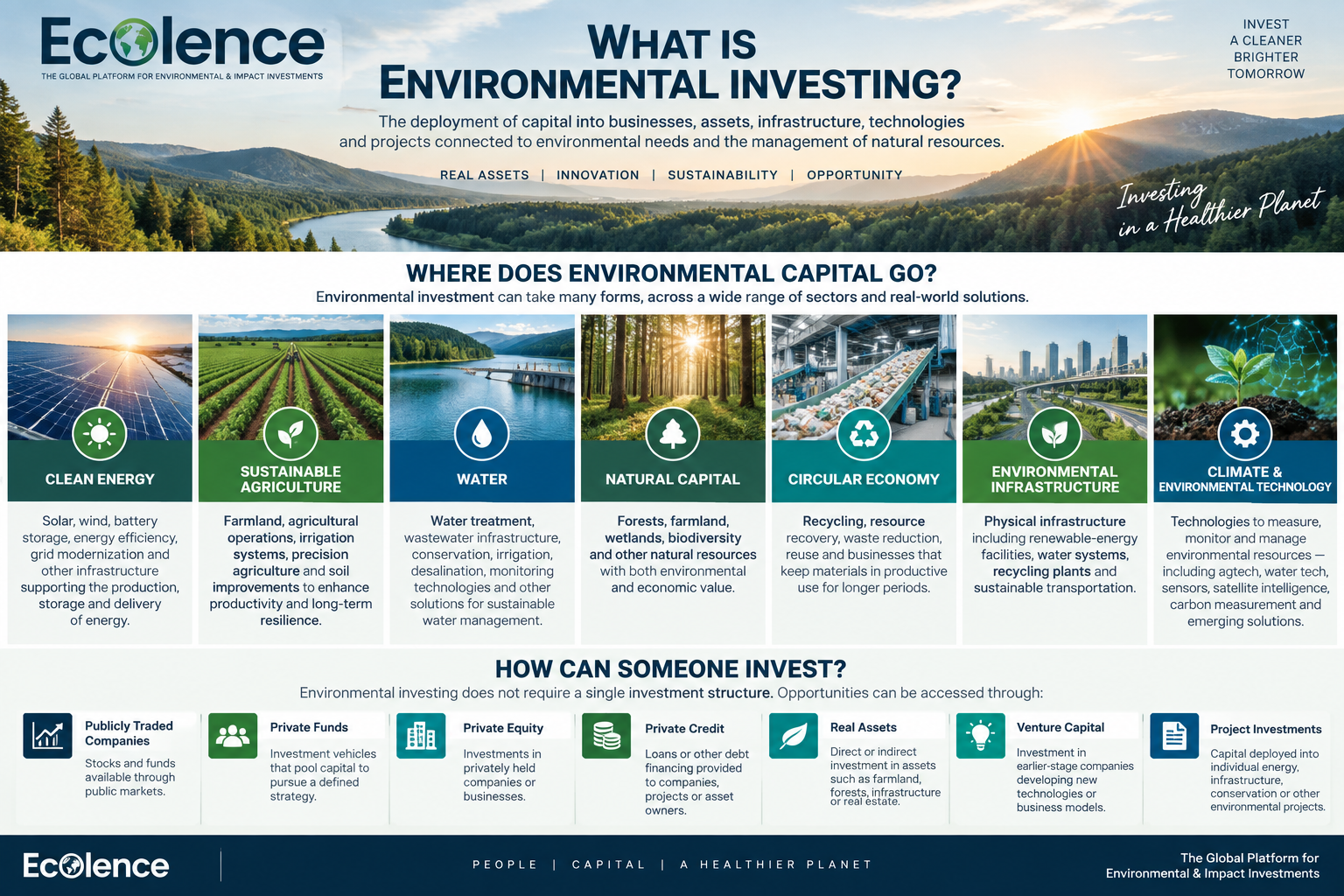
WHERE DOES ENVIRONMENTAL CAPITAL GO?
Environmental investment can take many forms.
CLEAN ENERGY
Capital can support solar, wind, battery storage, energy efficiency, grid modernization and other infrastructure involved in the production, storage and delivery of energy.
SUSTAINABLE AGRICULTURE
Investment can finance farmland, agricultural operations, irrigation systems, precision agriculture, soil improvements and technologies designed to improve the productivity and long-term resilience of food production.
WATER
Water-related investment can include treatment systems, wastewater infrastructure, conservation, irrigation, desalination, monitoring technologies and other solutions addressing how water is supplied, used and managed.
NATURAL CAPITAL
Forests, farmland, wetlands, biodiversity and other natural resources can have both environmental and economic value. Investment strategies may seek to preserve, restore or sustainably manage these assets while pursuing financial returns.
CIRCULAR ECONOMY
Capital can also finance recycling, resource recovery, waste reduction, reuse and businesses that seek to keep materials in productive use for longer periods.
ENVIRONMENTAL INFRASTRUCTURE
Many environmental solutions require physical infrastructure—from renewable-energy facilities and water systems to recycling plants and sustainable transportation infrastructure.
CLIMATE & ENVIRONMENTAL TECHNOLOGY
Technology is increasingly being used to measure, monitor and manage environmental resources. This can include agricultural technology, water technology, environmental data, sensors, satellite intelligence, carbon measurement and other emerging solutions.
HOW CAN SOMEONE INVEST?
Environmental investing does not require a single investment structure.
Investors may encounter opportunities through:
Publicly traded companies — Stocks and funds available through public markets.
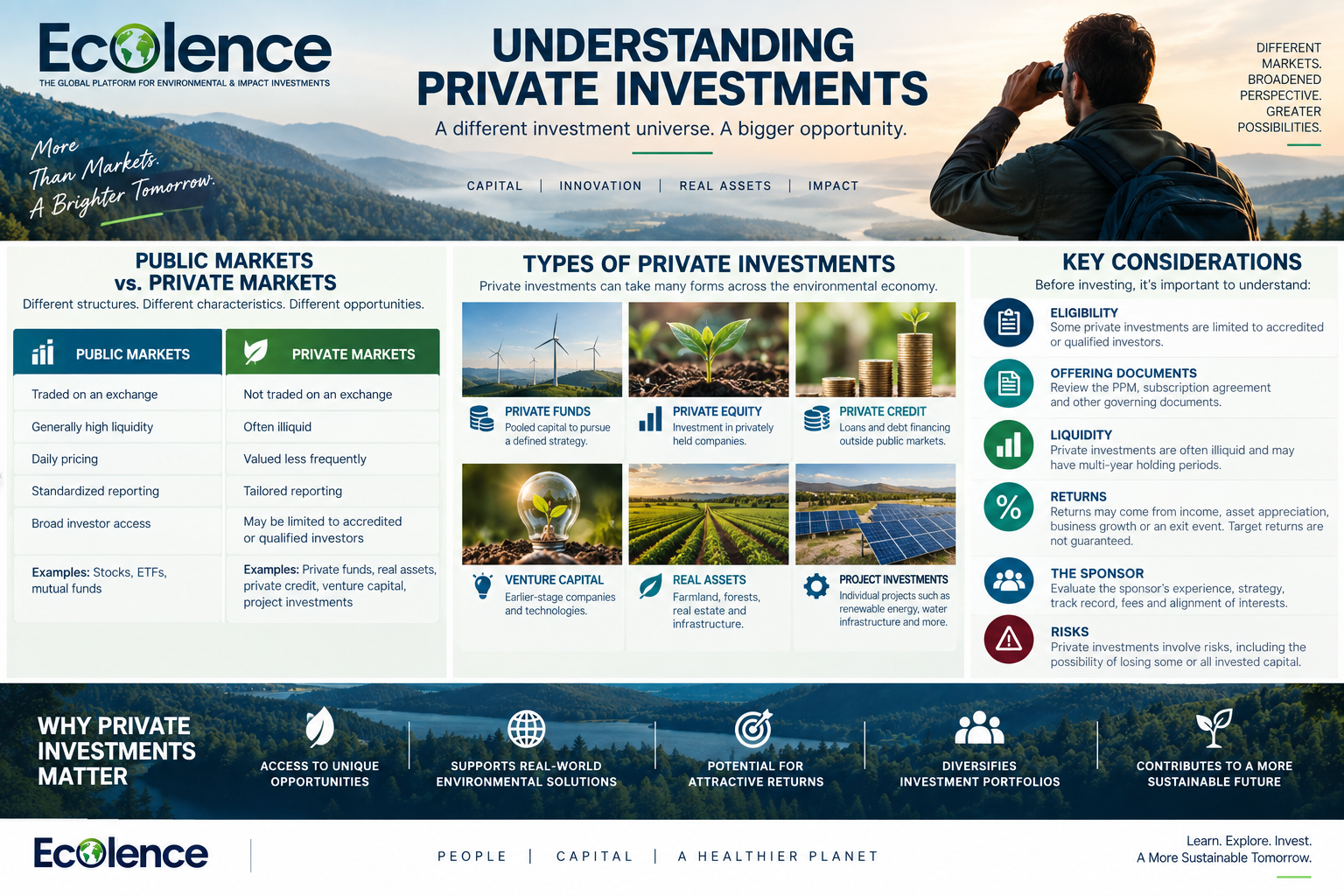
Private funds — Investment vehicles that pool investor capital to pursue a defined strategy.
Private equity — Investments in privately held companies or businesses.
Private credit — Loans or other debt financing provided to companies, projects or asset owners.
Real assets — Direct or indirect investment in assets such as farmland, forests, infrastructure or real estate.
Venture capital — Investment in earlier-stage companies developing new technologies or business models.
Project investments — Capital deployed into individual energy, infrastructure, conservation or other environmental projects.
The investment structure can be just as important as the environmental sector itself because it can affect liquidity, risk, income, holding period and how an investor may ultimately realize a return.
ENVIRONMENTAL INVESTING, ESG AND IMPACT INVESTING ARE NOT THE SAME THING
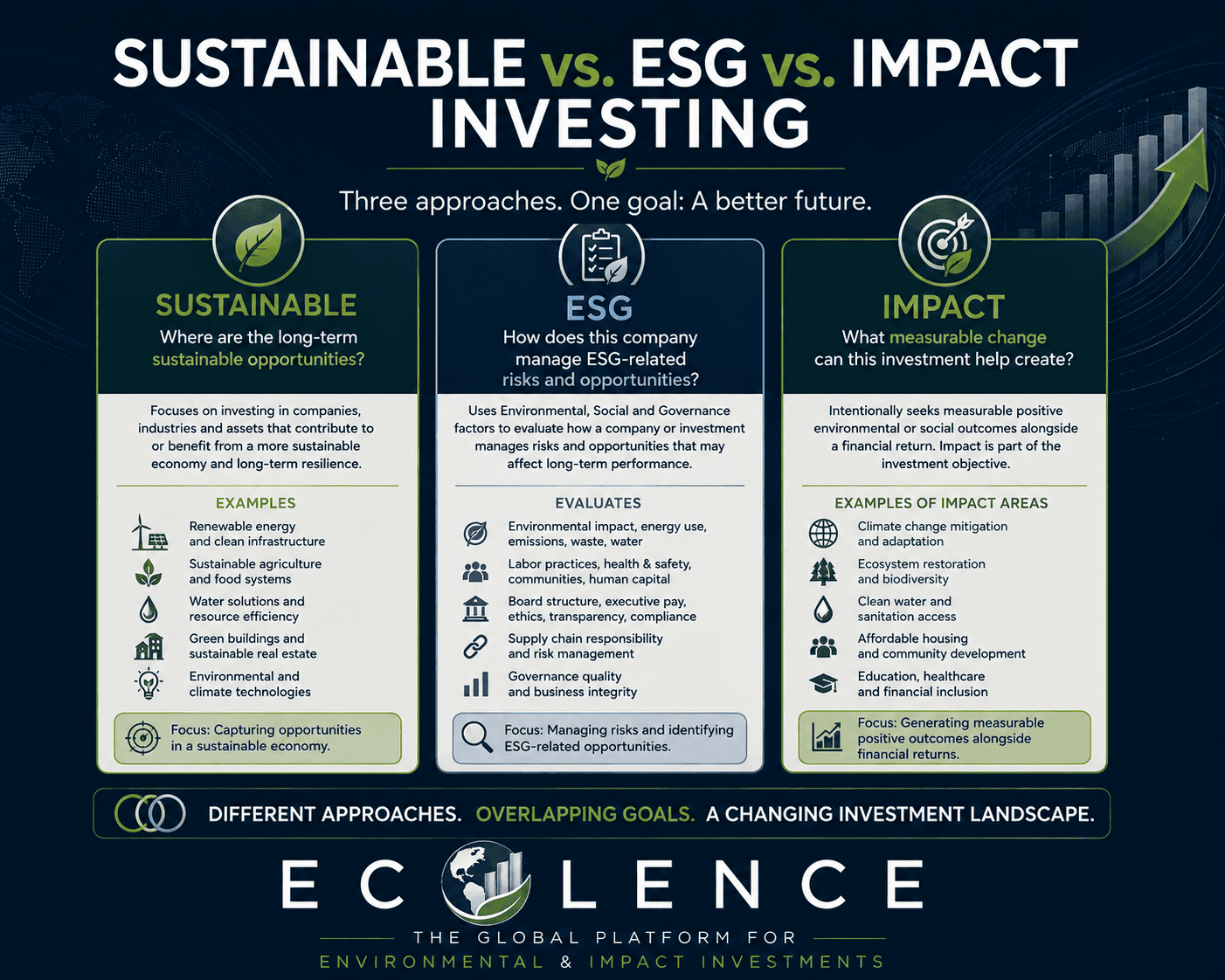
These terms are sometimes used interchangeably, but they describe different concepts.
Environmental investing focuses on investments connected to environmental sectors, assets, infrastructure and solutions.
ESG investing uses environmental, social and governance factors as part of evaluating companies or investments.
Impact investing intentionally seeks measurable positive environmental or social outcomes alongside a financial return.
An investment can potentially fall into more than one of these categories.
For example, an investment in renewable-energy infrastructure may be considered an environmental investment, evaluated using ESG factors and structured with specific measurable impact objectives.
DOES ENVIRONMENTAL INVESTING STILL INVOLVE RISK?
Yes.
An environmental objective does not make an investment safe.
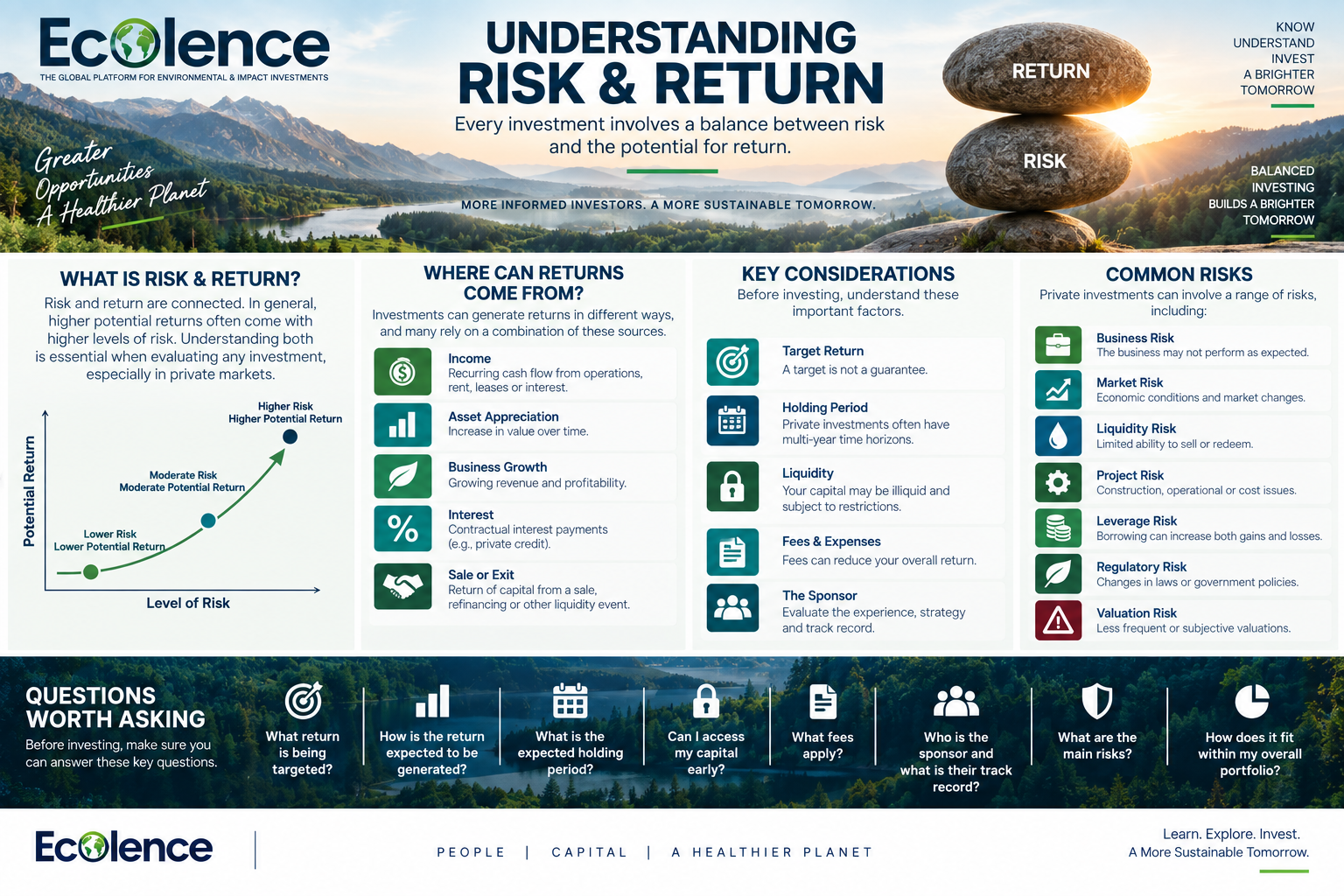
Environmental investments can carry many of the same risks as other investments, including business risk, market risk, project risk, technology risk, regulatory risk, liquidity risk and the potential loss of capital.
Private environmental investments may involve additional considerations because they are often illiquid, may have extended holding periods and may provide less frequent pricing or financial information than publicly traded securities.
A compelling environmental opportunity is not automatically a compelling investment.
Investors still need to understand the economics, structure, management, risks and terms of the opportunity.
WHY IS ENVIRONMENTAL INVESTING EXPANDING?
Many environmental challenges require significant amounts of capital.
Energy systems need infrastructure. Agriculture requires productive land and technology. Water systems require modernization. New environmental technologies require funding. Natural resources require management and restoration.
Governments and public markets can provide part of that capital, but private investment can also play an important role.
This is creating a growing universe of opportunities across companies, projects, infrastructure and real-world assets.
For investors, the result is a broader way to think about environmental investing—one that extends far beyond simply buying shares in a publicly traded “green” company.
THE BIGGER PICTURE
Environmental investing sits at the intersection of capital, the physical economy and the environment.
It can involve financing a solar facility.
Acquiring productive farmland.
Modernizing a water system.
Backing an environmental technology company.
Restoring or managing natural resources.
Building infrastructure.
The opportunities can look very different from one another, but they share a common idea:
Capital can be deployed into assets, businesses and projects that participate in the environmental economy.
Understanding that universe is the first step.
Understanding how private investments work is the next.