WHAT IS INFRASTRUCTURE INVESTING?
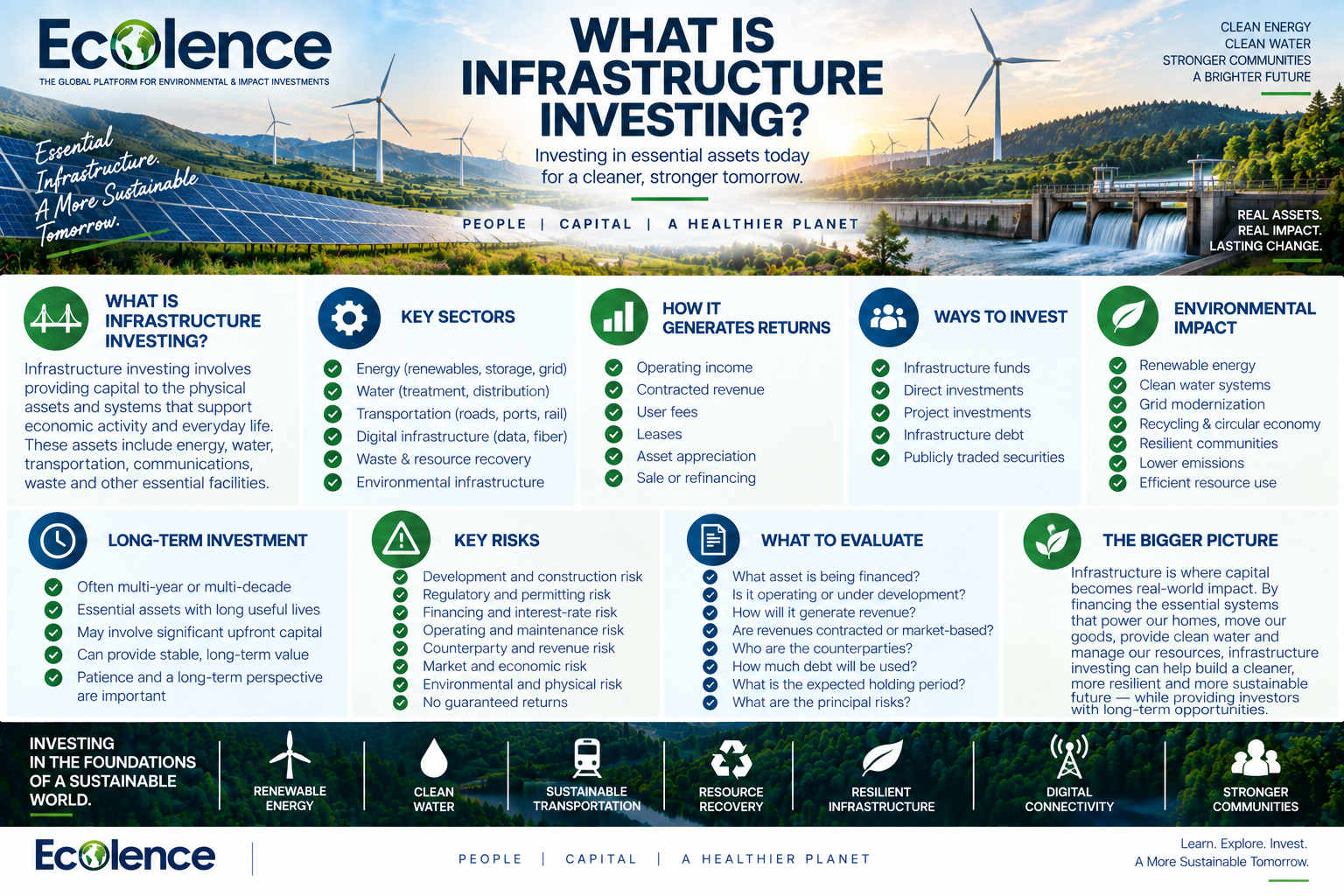
Infrastructure investing involves providing capital to the physical assets and systems that support economic activity and everyday life.
These assets can include energy systems, water infrastructure, transportation networks, communications systems, waste facilities and other essential facilities.
Unlike an investment focused primarily on a company’s products or services, an infrastructure investment is often tied to a long-lived physical asset that provides an ongoing service.
Infrastructure can therefore sit at the intersection of real assets, private markets and long-term investment.
WHAT TYPES OF ASSETS ARE INFRASTRUCTURE?
Infrastructure covers a broad range of assets.
ENERGY
Power generation, transmission, distribution, renewable-energy facilities and energy storage.
WATER
Drinking-water systems, wastewater treatment, desalination, irrigation and water-management infrastructure.
TRANSPORTATION
Roads, bridges, ports, rail systems, airports and other transportation assets.
DIGITAL INFRASTRUCTURE
Data centers, fiber networks, telecommunications towers and related systems.
WASTE & RESOURCE RECOVERY
Recycling facilities, waste-management systems and infrastructure that converts discarded materials into reusable resources.
ENVIRONMENTAL INFRASTRUCTURE
Assets specifically designed to manage environmental resources, improve efficiency or provide environmental services.
Infrastructure is therefore much broader than roads and bridges.
HOW CAN INVESTORS PARTICIPATE?
Investors can gain exposure to infrastructure in several ways.
INFRASTRUCTURE FUNDS
Funds may pool investor capital to acquire or develop a portfolio of infrastructure assets.
DIRECT INVESTMENTS
Large investors may invest directly in an individual infrastructure asset or project.
PROJECT INVESTMENTS
Capital may be raised specifically to develop, construct or operate a particular project.
INFRASTRUCTURE DEBT
Investors may provide loans or other debt financing rather than owning the underlying asset.
PUBLICLY TRADED SECURITIES
Some infrastructure companies and investment vehicles trade on public markets.
For Ecolence, the focus is particularly relevant to private infrastructure opportunities.
HOW CAN INFRASTRUCTURE GENERATE RETURNS?
Infrastructure assets can potentially generate returns in several ways.
OPERATING INCOME
An asset may generate revenue from customers who use its services.
CONTRACTED REVENUE
Some infrastructure projects operate under long-term agreements that establish how services will be purchased or paid for.
USER FEES
Certain assets generate revenue through tolls, usage fees or other charges.
LEASES
Infrastructure assets may be leased to operators or users.
ASSET APPRECIATION
The value of an infrastructure asset may increase over time.
SALE OR REFINANCING
Investors may ultimately realize value through a sale, refinancing or other transaction.
The revenue model depends heavily on the particular asset.
WHY CAN INFRASTRUCTURE BE LONG TERM?
Infrastructure assets are often built to operate for many years or even decades.
A solar facility, water-treatment plant or energy-storage installation generally requires substantial upfront capital before it can begin producing revenue.
That means infrastructure investing frequently involves:
Large initial capital requirements
Long development periods
Long operating lives
Multi-year investment horizons
Investors should understand that the life of the physical asset and the holding period of the investment are not necessarily the same.
A fund may sell an infrastructure asset long before the asset reaches the end of its useful life.
WHAT IS PROJECT DEVELOPMENT RISK?
Some infrastructure investments involve assets that are already operating.
Others involve assets that still need to be developed or constructed.
Development-stage projects can face additional risks, including:
Permitting delays
Construction delays
Cost overruns
Financing problems
Supply-chain issues
Contractor performance
Technology problems
Failure to reach commercial operation
An operating infrastructure asset and a proposed infrastructure project can therefore have very different risk profiles.
WHAT IS A CONTRACTED INFRASTRUCTURE ASSET?
Some infrastructure projects have long-term agreements with customers or counterparties.
For example, an energy project may have an agreement governing the sale of the electricity it generates.
Contracted revenue can potentially provide greater visibility into future cash flows.
But contracts do not eliminate risk.
Investors still need to evaluate:
Who is obligated to make the payments?
How long does the contract last?
What happens when it expires?
Can the counterparty meet its obligations?
Under what circumstances can the contract be changed or terminated?
The quality of the contract is only as meaningful as the economics and parties behind it.
WHAT ROLE DOES DEBT PLAY?
Infrastructure projects frequently use a combination of equity and debt financing.
Because infrastructure can require substantial amounts of capital, borrowing may be an important part of the financing structure.
Debt can potentially enhance equity returns when an asset performs well.
It can also increase financial risk.
If project revenue falls below expectations, debt payments generally still need to be made.
Understanding the amount, cost and terms of leverage is therefore an important part of evaluating an infrastructure investment.
WHAT ARE SOME OF THE RISKS?
Infrastructure investing can involve numerous risks.
DEVELOPMENT RISK
A project may fail to reach construction or operation as planned.
CONSTRUCTION RISK
Costs or timelines may exceed expectations.
OPERATING RISK
Equipment or systems may not perform as expected.
FINANCING RISK
Debt may become more expensive or unavailable.
REGULATORY RISK
Changes in laws, permits, regulations or government programs may affect an asset.
COUNTERPARTY RISK
A customer or contractual partner may fail to meet its obligations.
TECHNOLOGY RISK
Technology may underperform or become obsolete.
MARKET RISK
Energy prices, demand or other economic factors may change.
LIQUIDITY RISK
Private infrastructure investments may be difficult to sell.
ENVIRONMENTAL AND PHYSICAL RISK
Weather events, natural hazards and environmental conditions can affect physical assets.
Investors can lose some or all of their invested capital.
INFRASTRUCTURE AND THE ENVIRONMENTAL ECONOMY
Infrastructure is one of the most important areas of environmental investment because many environmental solutions cannot exist without physical assets.
Consider the transition from an idea to something that actually operates.
Renewable energy requires generation facilities.
Energy storage requires batteries and related systems.
Water treatment requires plants, pipes and equipment.
Recycling requires collection and processing facilities.
Electric transportation requires charging infrastructure.
More efficient electricity systems require grid modernization.
Environmental goals frequently become real-world economic activity only after capital finances the infrastructure necessary to implement them.
EXAMPLES OF ENVIRONMENTAL INFRASTRUCTURE
Environmental infrastructure can include:
Solar farms
Wind facilities
Battery storage
Grid modernization
Electric-vehicle charging
Water-treatment facilities
Wastewater systems
Desalination
Recycling facilities
Resource-recovery facilities
Efficient irrigation systems
Environmental monitoring infrastructure
These assets demonstrate why environmental investing extends well beyond publicly traded companies.
Capital is also needed to build the physical systems themselves.
HOW IS INFRASTRUCTURE DIFFERENT FROM REAL ESTATE?
Both are real assets, but their economic purposes can differ.
REAL ESTATE
Generally derives value from land and buildings used for residential, commercial, industrial or other property purposes.
INFRASTRUCTURE
Generally provides an essential service or system—such as energy, water, transportation or communications.
There can be overlap.
For example, certain specialized facilities may have characteristics of both real estate and infrastructure.
The important point is to understand the underlying economics rather than relying solely on the label.
WHAT SHOULD AN INVESTOR EVALUATE?
Before considering a private infrastructure investment, investors should understand:
What physical asset is being financed?
Is it operating, under construction or still being developed?
How will the asset generate revenue?
Are revenues contracted or market-based?
Who are the customers or counterparties?
What permits and approvals are required?
How much debt will be used?
Who will operate the asset?
What technology does it rely upon?
What is the expected holding period?
What fees and expenses apply?
How does the sponsor expect to exit?
What are the principal risks?
The environmental purpose of an infrastructure project should not replace analysis of its economics.
THE BIGGER PICTURE
Infrastructure is where capital becomes physical.
It can turn financing into a solar facility producing electricity.
A water-treatment system supplying clean water.
A battery installation supporting the electrical grid.
A recycling facility recovering materials.
Or an irrigation system improving agricultural productivity.
That makes infrastructure particularly important to Ecolence’s view of the environmental investment universe.
Many environmental challenges ultimately require more than policies, ideas or technologies.
They require assets to be built, financed and operated.
Infrastructure investing provides one of the mechanisms through which private capital can help make that happen—while investors pursue a financial return and accept the risks associated with developing and owning real-world assets.