WHAT IS PRIVATE REAL ESTATE INVESTING?
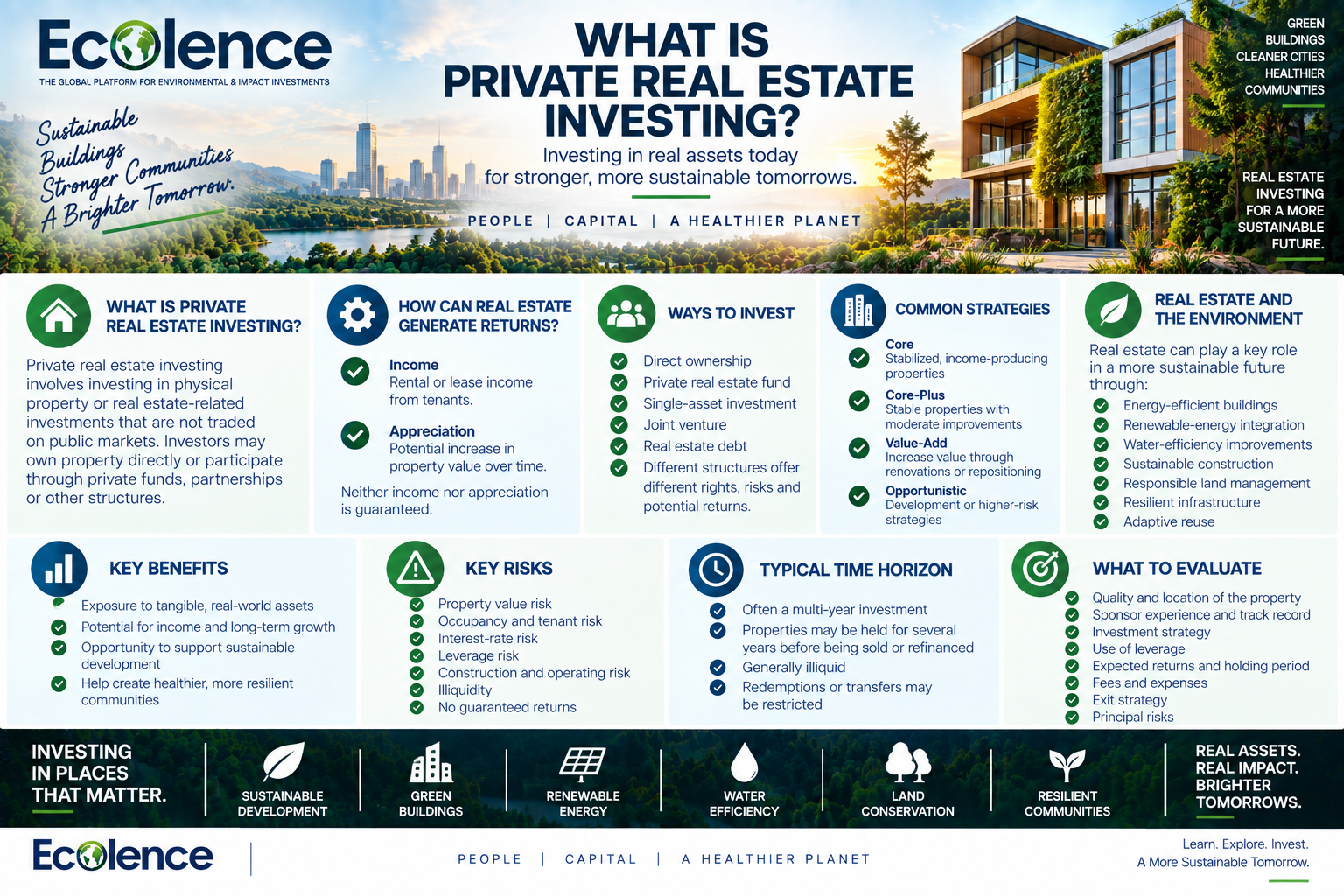
Private real estate investing involves putting capital into property or real-estate-related investments that are not traded like publicly listed stocks or REITs.
The underlying assets may include:
Residential properties
Apartment communities
Office buildings
Industrial facilities
Warehouses and logistics properties
Retail properties
Hospitality properties
Land
Specialized real estate
Investors may own property directly or participate indirectly through a private fund, partnership, limited liability company or other investment structure.
At its core, private real estate investing connects investor capital with physical property.
HOW CAN REAL ESTATE GENERATE RETURNS?
Private real estate generally seeks returns from one or both of two primary sources:
INCOME
Properties may generate rental or lease income from tenants.
After operating expenses, financing costs and other obligations are paid, some of that cash flow may potentially be distributed to investors.
APPRECIATION
A property’s value may increase over time.
That appreciation may result from market conditions, improvements to the property, increased rental income, redevelopment or other factors.
When the property is eventually sold, investors may participate in any remaining value after applicable debts and expenses are satisfied.
Neither income nor appreciation is guaranteed.
HOW DO INVESTORS PARTICIPATE?
Private real estate can be structured in several ways.
DIRECT OWNERSHIP
An investor purchases and owns property directly.
PRIVATE REAL ESTATE FUND
Investors pool their capital into a fund that owns or finances multiple properties.
SINGLE-ASSET INVESTMENT
Investors participate in an entity created to acquire or develop a particular property.
JOINT VENTURE
Multiple parties contribute capital or expertise to a real estate investment.
PRIVATE REAL ESTATE DEBT
Instead of owning the property, investors may provide loans secured by real estate.
The structure matters because it determines an investor’s rights, risks, potential returns and position in the capital structure.
WHAT DOES THE SPONSOR DO?
Many private real estate investments are organized by a real estate sponsor or manager.
The sponsor may be responsible for:
Finding properties
Negotiating acquisitions
Arranging financing
Managing renovations
Selecting property managers
Leasing space
Overseeing operations
Managing budgets
Determining when to refinance or sell
Because the sponsor can have substantial control over the investment, evaluating its experience and track record is an important part of due diligence.
WHAT ARE COMMON REAL ESTATE STRATEGIES?
Private real estate strategies can have very different risk and return profiles.
CORE
Generally focuses on stabilized, income-producing properties and tends to involve relatively limited redevelopment.
CORE-PLUS
May involve stable properties with opportunities for moderate improvements or operational changes.
VALUE-ADD
Typically seeks to increase a property’s value through renovations, improved management, increased occupancy or repositioning.
OPPORTUNISTIC
May involve development, significant redevelopment, distressed properties or other strategies involving greater uncertainty.
These categories are not guarantees of a particular risk level, but they can help investors understand the manager’s overall approach.
WHAT IS LEVERAGE?
Real estate investments frequently use debt, also known as leverage.
For example, an investment entity might purchase a property using a combination of investor equity and borrowed money.
Leverage can increase the amount of property controlled with a given amount of equity capital.
It can also amplify investment results.
If the property performs well, leverage may enhance equity returns.
If the property performs poorly, debt obligations can magnify losses.
Investors should understand how much debt an investment uses and the terms of that financing.
WHAT IS CASH FLOW?
A property’s revenue may come from rents, leases and other operating income.
From that revenue, the investment may need to pay:
Property operating expenses
Maintenance
Insurance
Taxes
Management expenses
Debt payments
Capital improvements
The amount remaining after applicable expenses can contribute to the property’s cash flow.
Investors should therefore look beyond gross rental income and understand the property’s net economics.
WHAT IS A CAPITALIZATION RATE?
Investors may encounter the term capitalization rate, or cap rate, when evaluating income-producing real estate.
A cap rate generally compares a property’s annual net operating income with its value or purchase price.
It can help investors understand how the market is valuing a property’s income stream.
However, a cap rate is only one valuation measure.
Property condition, location, tenant quality, lease terms, interest rates, expected growth and other factors can materially affect value.
HOW LONG ARE PRIVATE REAL ESTATE INVESTMENTS HELD?
Private real estate investments often have multi-year holding periods.
A sponsor may acquire a property, operate or improve it for several years and eventually sell or refinance it.
The expected holding period is generally an estimate.
Market conditions may cause the sponsor to hold a property longer or sell earlier than originally planned.
IS PRIVATE REAL ESTATE LIQUID?
Generally, private real estate should be considered illiquid.
A building cannot typically be sold instantly, and an investor’s interest in a private real estate entity may not have an active secondary market.
Transfers or redemptions may also be restricted.
Investors should therefore understand how and when they may be able to receive their capital back.
WHAT ARE SOME OF THE RISKS?
Real estate involves numerous risks.
PROPERTY VALUE RISK
The property’s market value may decline.
OCCUPANCY RISK
Vacancies can reduce rental income.
TENANT RISK
Tenants may fail to pay rent or renew leases.
INTEREST-RATE RISK
Higher borrowing costs can affect financing and property valuations.
LEVERAGE RISK
Debt can magnify losses.
CONSTRUCTION RISK
Development or renovation projects may experience delays or cost overruns.
OPERATING RISK
Maintenance, insurance, taxes and other expenses may exceed expectations.
LIQUIDITY RISK
Properties and private investment interests can take substantial time to sell.
MARKET RISK
Local and broader economic conditions can affect demand and value.
Investors can lose some or all of their invested capital.
REAL ESTATE AND ENVIRONMENTAL INVESTING
Real estate has a significant connection to the environmental economy because buildings and land interact directly with energy, water, materials and natural resources.
Environmental real estate strategies might involve:
Energy-efficient buildings
Renewable-energy integration
Water-efficiency improvements
Sustainable construction
Building retrofits
Efficient heating and cooling systems
Green building technologies
Responsible land management
Adaptive reuse
Resilient infrastructure
For example, an older commercial property might be upgraded with more efficient building systems, renewable-energy generation or water-management technology.
Those improvements may seek both environmental benefits and economic benefits through reduced operating costs, stronger tenant demand or increased property value.
But environmental improvements do not guarantee investment performance.
The underlying property economics still matter.
WHAT SHOULD AN INVESTOR EVALUATE?
Before considering a private real estate investment, investors should understand:
What property is being acquired?
Where is it located?
What is the investment strategy?
Who is the sponsor?
How much leverage will be used?
How is income expected to be generated?
Are renovations or development required?
What fees does the sponsor receive?
What distributions are targeted?
What is the expected holding period?
How will the property eventually be sold or refinanced?
What are the principal risks?
The building itself is only one part of the investment.
The purchase price, financing, operations, management and exit strategy all matter.
THE BIGGER PICTURE
Real estate is one of the clearest examples of investing in the physical economy.
Investor capital can acquire, finance, improve and operate tangible assets that people use every day.
Within the environmental economy, that creates another opportunity:
Making the built environment more efficient, resilient and sustainable while pursuing an economic return.
But owning a physical asset does not eliminate investment risk.
A successful private real estate investment still depends on acquiring the right property at an appropriate price, managing it effectively, controlling costs, financing it responsibly and ultimately executing an effective exit.