
UNDERSTANDING PRIVATE INVESTMENTS
Most investors are familiar with public markets.
Stocks, exchange-traded funds and other publicly traded securities can generally be bought and sold through an exchange, often with readily available pricing and financial information.
Private investments work differently.
Rather than purchasing a security that trades on a public exchange, investors may provide capital directly or indirectly to a private company, fund, project, real asset or other investment opportunity.
Understanding those differences is important before considering any private investment.
WHAT IS A PRIVATE INVESTMENT?
A private investment is generally an investment that is not publicly traded on a securities exchange.
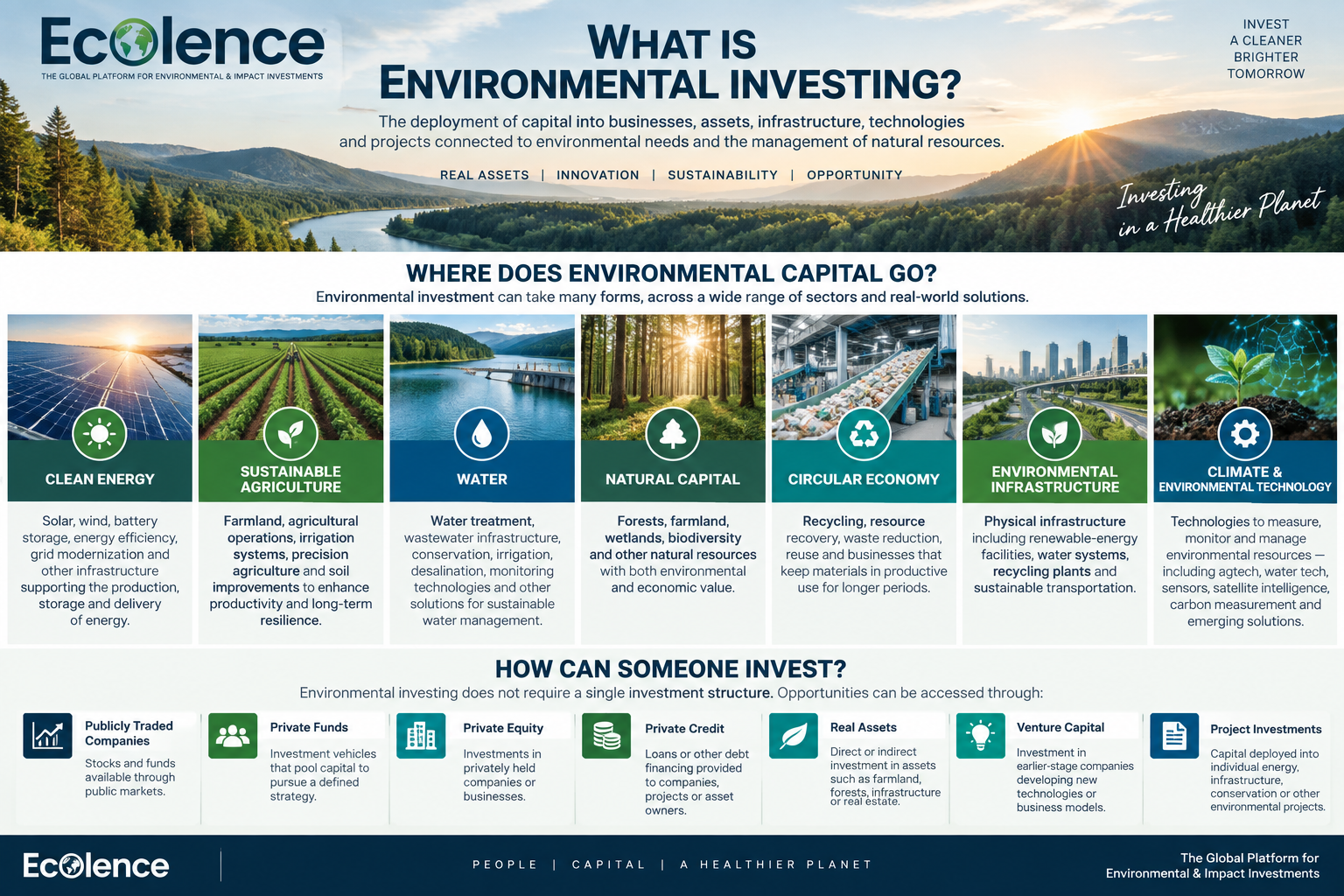
Private investments can take many forms, including:
PRIVATE FUNDS
Investment vehicles that pool capital from multiple investors to pursue a defined strategy. These may invest in companies, real estate, farmland, infrastructure, credit or other assets.
PRIVATE EQUITY
Capital invested in privately held companies or businesses, often with the objective of increasing their value over time.
PRIVATE CREDIT
Loans, debt securities or other financing provided outside traditional public debt markets.
VENTURE CAPITAL
Investment in earlier-stage companies developing new technologies, products or business models.
REAL ASSETS
Investments involving physical assets such as farmland, forests, real estate or infrastructure.
PROJECT INVESTMENTS
Capital invested into individual projects such as renewable-energy facilities, water infrastructure or other environmental projects.
The structure, economics and risks can vary significantly from one private investment to another.
PUBLIC MARKETS vs. PRIVATE MARKETS
One of the easiest ways to understand private investments is to compare them with publicly traded investments.
PUBLIC INVESTMENTS
Public securities generally have established markets where investors can buy and sell them. Market prices may change continuously throughout the trading day, and public companies are generally subject to standardized reporting and disclosure requirements.
PRIVATE INVESTMENTS
Private investments generally do not trade on a public exchange. Transfers may be restricted, valuations may occur less frequently, and investors may be expected to hold the investment for an extended period.
That difference has important consequences.
LIQUIDITY
Liquidity describes how readily an investment can be converted into cash.
A publicly traded stock may generally be sold during market hours.
A private investment may not have an active secondary market at all.
An investor might be required to hold a private investment for several years, wait for a specific liquidity event or comply with restrictions before transferring or redeeming an investment.
This is why the expected holding period is an important consideration when evaluating a private investment.
HOW ARE PRIVATE INVESTMENTS OFFERED?
Private investments can be offered under different securities-law structures.
In the United States, investors may encounter offerings conducted under exemptions such as:
Regulation D — Commonly used for private securities offerings. Certain Regulation D offerings are limited to accredited investors.
Regulation A — Allows qualifying companies to offer securities to a broader investor audience, subject to applicable requirements and offering limits.
Regulation Crowdfunding — Allows eligible companies to raise capital from investors through registered intermediaries, subject to regulatory requirements and investment limits.
The offering structure can affect who is eligible to invest, how the investment may be marketed and what disclosures or limitations apply.
WHAT IS AN ACCREDITED INVESTOR?
Some private investments are available only to accredited investors.
Accredited investor status is determined under securities regulations and can be based on financial thresholds or certain professional qualifications.
Investors should not assume that every opportunity displayed in the private markets is available to everyone.
Eligibility requirements should be clearly reviewed before considering an investment.
WHAT DOCUMENTS SHOULD AN INVESTOR REVIEW?
Private investments are often accompanied by important legal and financial documents.
Depending on the offering, these may include:
Private Placement Memorandum (PPM) — Describes the investment, strategy, terms, risks, conflicts and other important information.
Subscription Agreement — The agreement through which an investor subscribes for the investment and makes required representations.
Operating Agreement or Limited Partnership Agreement — Establishes the governance and economic terms of an LLC or partnership.
Offering Circular — Used in certain securities offerings to provide investors with required information about the issuer and offering.
Investors should understand that marketing materials, websites and presentations are not substitutes for the governing offering documents.
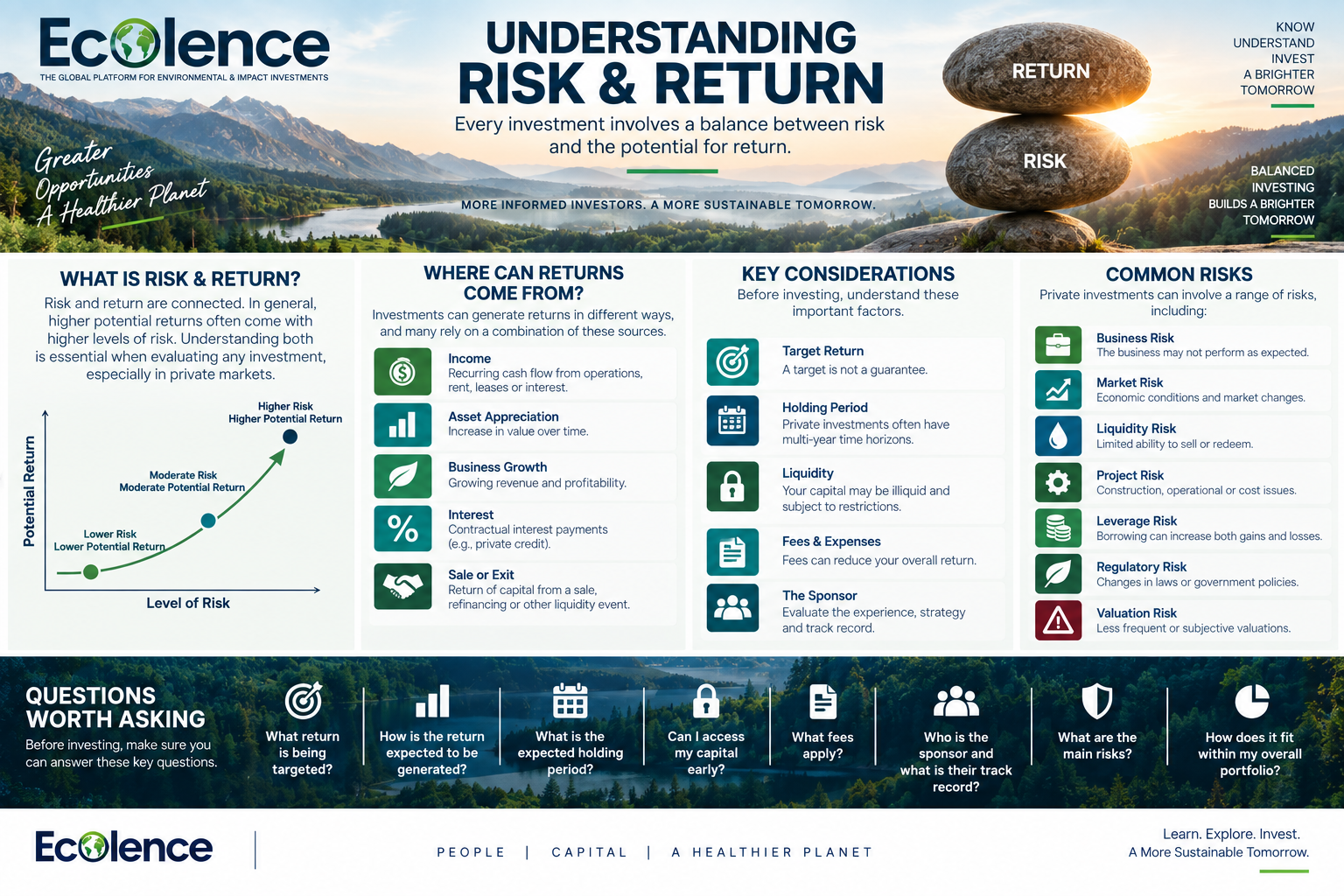
HOW DO PRIVATE INVESTMENTS GENERATE RETURNS?
There is no single return model for private investments.
Potential returns may come from:
Income or distributions generated by the underlying assets or businesses.
Interest payments from private-credit investments.
Asset appreciation if an underlying asset increases in value.
Business growth if a private company becomes more valuable.
Sale or refinancing proceeds when an asset or business is sold or refinanced.
Exit events such as an acquisition, recapitalization or other liquidity transaction.
Importantly, a target return is not a guaranteed return.
Targets generally reflect the sponsor’s objectives or assumptions. Actual results can differ materially.
WHAT ROLE DOES THE SPONSOR PLAY?
Many private investments are managed by a sponsor, fund manager, general partner, asset manager or project developer.
The sponsor may be responsible for identifying investments, deploying capital, managing assets, overseeing operations, arranging financing and ultimately executing the investment strategy.
This makes evaluating the sponsor an important part of due diligence.
Investors may want to understand the sponsor’s:
Experience
Investment strategy
Track record
Management team
Fees
Conflicts of interest
Financial commitment to the investment
Reporting practices
The quality of the underlying opportunity matters, but so does the organization responsible for executing the strategy.
FEES AND EXPENSES
Private investments can include multiple types of fees and expenses.
Depending on the structure, these might include management fees, acquisition fees, organizational expenses, performance-based compensation or other costs.
Fees can reduce the amount of capital actually invested or the return ultimately received by investors.
They should therefore be understood as part of the investment’s overall economics.
PRIVATE INVESTMENTS CAN BE ILLIQUID
This point deserves particular attention.
Private investments are often designed around multi-year strategies.
There may be no guarantee that an investor can exit when desired.
Even when redemption provisions exist, they may be subject to notice periods, limitations, available liquidity or the discretion of the manager.
An investor should therefore understand both:
How long the investment is expected to last
and
How the investor may ultimately receive their capital back.
PRIVATE DOES NOT MEAN LOWER RISK
An investment being private does not inherently make it safer—or riskier—than a public investment.
The risks are simply different and depend on the specific opportunity.
Private investments may involve business risk, market risk, liquidity risk, leverage, project risk, regulatory risk, valuation uncertainty and the possibility of losing some or all invested capital.
The absence of daily price movements does not mean the underlying investment’s value is not changing.
THE BIGGER PICTURE
Private markets can provide investors access to companies, assets, projects and strategies that may not be available through public exchanges.
That can include many areas of the environmental economy—from farmland and renewable-energy infrastructure to private credit, natural capital and emerging environmental technologies.
But accessing a different investment universe also means understanding a different set of rules.
Before considering a private investment, an investor should understand:
What they are investing in.
Who is managing it.
How returns are expected to be generated.
What fees are being charged.
How long their capital may be committed.
How they may eventually exit.
And what could go wrong.
Understanding the structure is an essential part of understanding the investment.
The next step is understanding risk and return—and how to evaluate the relationship between the two.