UNDERSTANDING RISK & RETURN
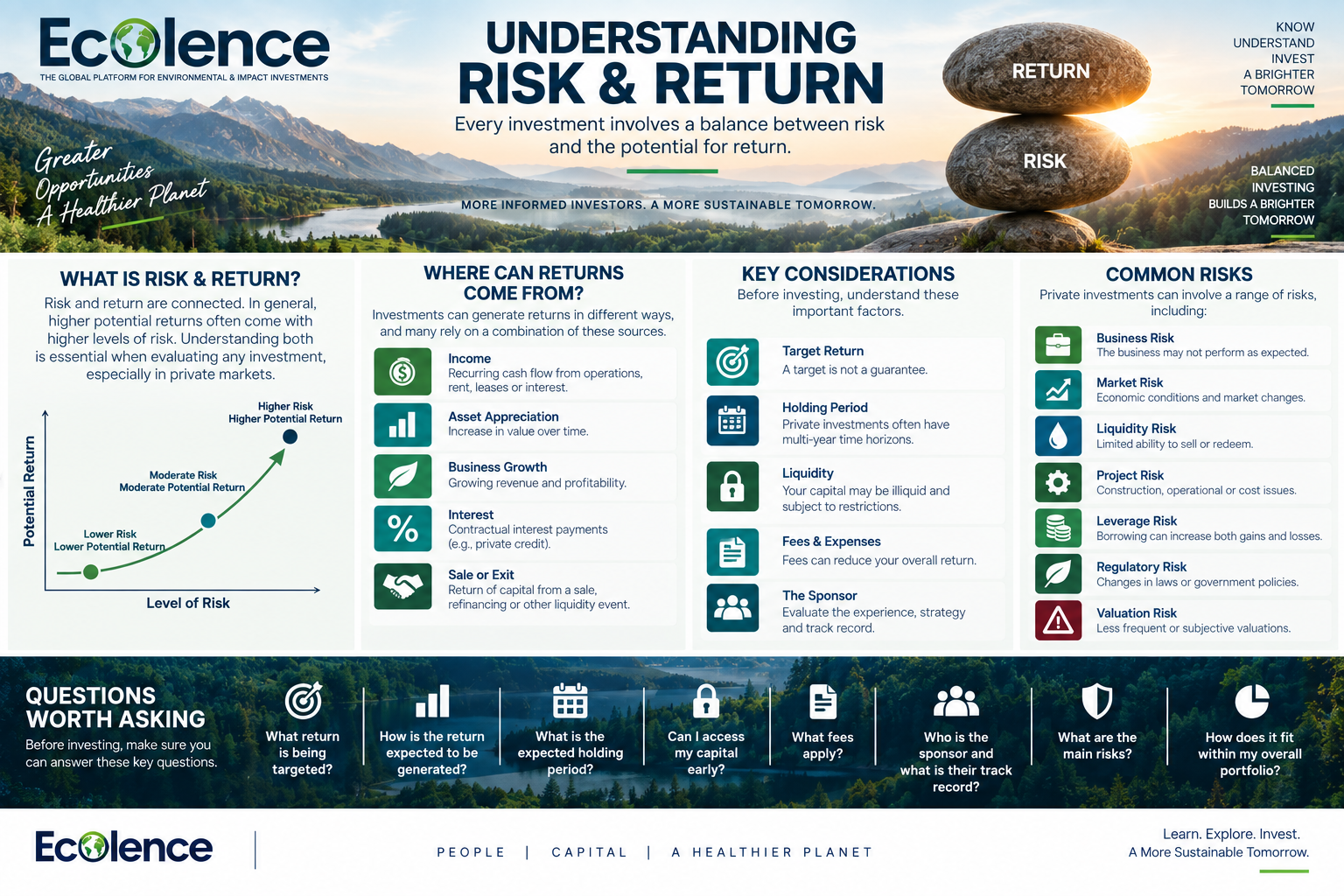
Every investment involves a relationship between risk and potential return.
Investors naturally want to understand what an investment may earn. But evaluating an opportunity requires looking beyond a target return and understanding what must happen for that return to be achieved—and what could prevent it from happening.
This is particularly important in private markets, where investments may be illiquid, valuations may occur less frequently and capital may be committed for several years.
A return target tells only part of the story.
Understanding the risks behind that target is equally important.
WHAT IS A TARGET RETURN?
A target return is the investment return a sponsor or manager aims to achieve based on the investment strategy and its underlying assumptions.
For example, an investment might state that it is targeting a particular annual return over a specified holding period.
The important word is target.
A target return is not a guaranteed return.
Actual results may be higher or lower, and investors may lose some or all of their invested capital.
When reviewing a target return, investors should consider how the sponsor expects to generate it.
WHERE CAN RETURNS COME FROM?
Different investments generate returns in different ways.
INCOME
An investment may generate recurring income from rent, leases, interest, business operations or other cash flows.
ASSET APPRECIATION
Farmland, real estate, infrastructure or other assets may potentially increase in value over time.
BUSINESS GROWTH
A private company’s value may increase as its revenue, profitability or market position develops.
INTEREST
Private-credit investments may generate returns through contractual interest payments.
SALE OR EXIT
An investment may ultimately generate a return when a company, project or asset is sold.
Many investments rely on a combination of these sources.
Understanding where the expected return comes from can help an investor better understand the investment itself.
INCOME IS NOT THE SAME AS TOTAL RETURN
This distinction is important.
An investment may provide periodic distributions while also seeking appreciation of the underlying asset.
For example, an investment could target annual cash distributions while expecting additional value to be realized when an asset is eventually sold.
The distributions alone do not necessarily represent the investment’s total return.
Likewise, a stated target return does not necessarily mean that amount will be distributed to investors each year.
Investors should understand the difference between:
Target return
Distribution yield
Income
Asset appreciation
Total return
They are related concepts, but they are not interchangeable.
WHAT IS A HOLDING PERIOD?
The holding period is the amount of time an investment is expected to remain invested before capital is returned or an exit occurs.
Private investments frequently have multi-year holding periods.
A fund might target five, seven or ten years, for example.
But an expected holding period is generally an estimate—not necessarily a guaranteed exit date.
Market conditions, asset performance, financing conditions or other factors may cause an investment to last longer or shorter than originally anticipated.
WHAT DOES ILLIQUID MEAN?
An investment is illiquid when it cannot readily be converted into cash.
Publicly traded securities generally have active markets where investors can sell their holdings.
Private investments may not.
There may be:
No established secondary market
Restrictions on transfers
Redemption limitations
Required notice periods
Multi-year lockups
or simply no opportunity to exit until the sponsor sells or liquidates the underlying investment.
Investors should therefore consider whether they may need access to the invested capital before the expected exit.
WHAT TYPES OF RISK SHOULD INVESTORS CONSIDER?
Risk can take many forms.
Depending on the investment, these may include:
BUSINESS RISK
The underlying business may not perform as expected.
MARKET RISK
Changes in economic conditions, interest rates, commodity prices or investor demand may affect value.
LIQUIDITY RISK
An investor may not be able to sell or redeem the investment when desired.
PROJECT RISK
Construction delays, operating problems, cost overruns or other issues may affect a project.
LEVERAGE RISK
Borrowing can potentially increase returns, but it can also magnify losses.
TECHNOLOGY RISK
A technology may fail to perform as expected or may be displaced by competing solutions.
REGULATORY RISK
Changes in laws, regulations, incentives or government policies may affect an investment.
MANAGEMENT RISK
Investment results may depend significantly on the decisions and capabilities of the sponsor or management team.
VALUATION RISK
Private assets may not have continuously observable market prices, making valuation less frequent or more subjective.
Environmental investments may also face risks specific to their underlying assets, industries or projects.
HIGHER TARGET RETURNS REQUIRE CONTEXT
It can be tempting to compare investments based simply on which one advertises the highest target return.
That can be misleading.
Two investments targeting different returns may have very different:
Strategies
Leverage
Holding periods
Liquidity
Underlying assets
Cash-flow profiles
Management teams
and risk exposures.
A higher target return should therefore be understood in the context of how the return is expected to be generated and what risks are being taken to pursue it.
DIVERSIFICATION AND RISK
Diversification involves spreading investments across different assets, sectors, strategies or other exposures rather than relying entirely on one investment.
Diversification can help reduce concentration risk.
However, diversification does not eliminate investment risk or guarantee against losses.
Investors should consider how an individual opportunity fits within their broader financial circumstances and investment portfolio.
QUESTIONS WORTH ASKING
Before evaluating a private investment, an investor should be able to answer several fundamental questions:
What return is being targeted?
How is that return expected to be generated?
Are distributions expected, and are they guaranteed?
How long is the expected holding period?
Can the investment be sold or redeemed early?
What fees and expenses apply?
What are the principal risks?
What assumptions does the strategy depend upon?
What could cause the investment to underperform?
How and when is invested capital expected to be returned?
These questions help put the advertised opportunity into context.
RISK AND RETURN BELONG TOGETHER
The potential return of an investment should never be considered in isolation.
An investor evaluating a private environmental investment should understand both sides of the equation:
What could I potentially earn?
and
What risks am I taking to pursue that return?
Neither question should be considered without the other.
Understanding environmental investing tells you where capital can be deployed.
Understanding private investments tells you how those opportunities may be structured.
Understanding risk and return helps you begin evaluating what those opportunities actually mean for an investor.