WHAT IS REGULATION CROWDFUNDING?
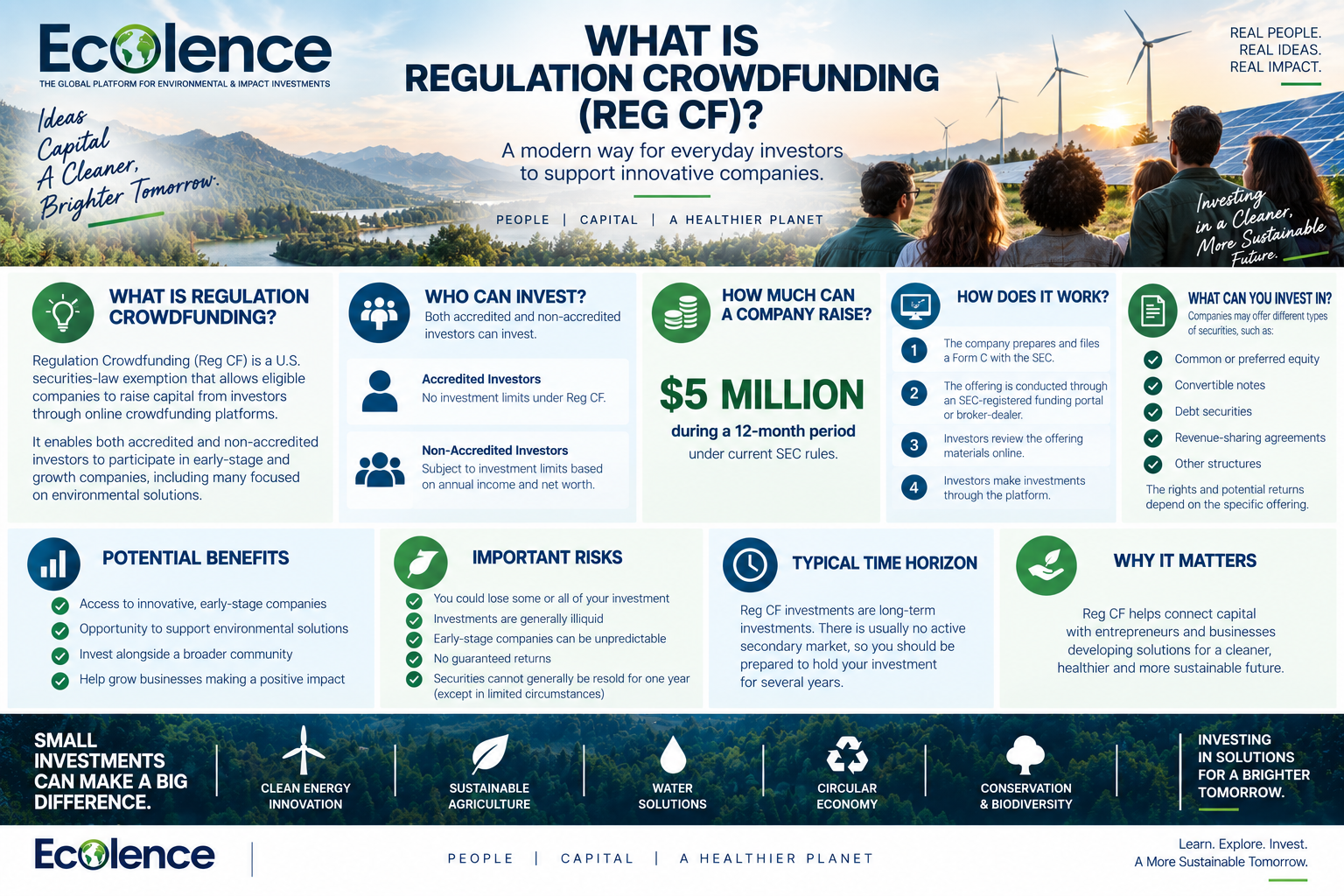
Regulation Crowdfunding—commonly called Reg CF—is a U.S. securities-law exemption that allows eligible companies to raise capital from investors through online crowdfunding offerings.
Unlike some private offerings that are generally limited to accredited investors, Regulation CF can provide investment access to both accredited and non-accredited investors.
For companies, it provides another pathway for raising private capital.
For investors, it can provide access to businesses and investment opportunities that might otherwise be difficult to participate in through traditional public markets.
HOW DOES REG CF WORK?
A company using Regulation CF does not simply place an investment opportunity on its own website and begin accepting investments.
A Reg CF offering must be conducted through an online platform operated by an intermediary registered with the SEC—either a broker-dealer or funding portal. The intermediary must also be registered with FINRA. SEC
The intermediary provides the platform through which investors review the offering and make investment commitments.
This is an important distinction when thinking about investment marketplaces such as Ecolence:
Discovering an investment opportunity and conducting the securities transaction are not necessarily the same thing.
HOW MUCH CAN A COMPANY RAISE?
Under the current Regulation CF rules, an eligible company can raise an aggregate maximum of:
$5 million during a 12-month period
through Regulation Crowdfunding offerings. SEC
That makes Reg CF potentially useful for companies seeking anything from relatively small amounts of growth capital to multimillion-dollar raises.
WHO CAN INVEST?
Both accredited and non-accredited investors can participate in Regulation CF offerings.
However, the rules treat them differently.
Accredited investors are not subject to Regulation CF’s investment limits.
Non-accredited investors are subject to limits on the aggregate amount they may invest across Regulation CF offerings during a 12-month period. Those limits are calculated using the investor’s annual income and net worth under formulas established by the SEC. SEC
This is one of the significant differences between Regulation CF and certain Regulation D offerings.
WHAT CAN AN INVESTOR ACTUALLY BUY?
Regulation CF is an offering exemption—not a particular type of investment.
Companies may offer different forms of securities depending on the particular offering.
The rights associated with those securities can differ substantially.
An investor should therefore understand not only that an opportunity is being offered under Regulation CF, but also:
What security is actually being purchased?
What rights does it provide?
How could it potentially generate a return?
When might the investor receive their capital back?
The offering structure matters.
WHAT INFORMATION DOES THE COMPANY PROVIDE?
A company conducting a Regulation CF offering generally files a Form C with the SEC and provides required information to investors and the intermediary.
Required disclosures address matters such as the company, its business, the offering, use of proceeds, ownership and capital structure, certain related-party transactions, risks and financial information. SEC
The amount being raised can affect the financial-statement requirements applicable to the offering.
Investors should review these materials carefully rather than relying solely on advertisements, social-media posts or summaries of the opportunity.
IS A REG CF INVESTMENT LIQUID?
Generally, investors should approach Regulation CF as a private and potentially illiquid investment.
Securities purchased in a Regulation CF transaction generally cannot be resold for one year, although the rules provide certain exceptions. SEC
Even after that restriction expires, there may not be an active market for the securities.
An investor should not assume that purchasing a private company’s securities means those securities can later be sold as easily as shares listed on a stock exchange.
HOW CAN RETURNS BE GENERATED?
That depends entirely on the investment.
Potential returns could arise through:
Business growth
Distributions
Interest payments
Asset appreciation
A future acquisition
A sale of the company or assets
Another liquidity event
Some companies may never provide a liquidity event.
A company successfully raising capital through Regulation CF does not mean that investors will earn a return.
WHAT ARE SOME OF THE RISKS?
Regulation CF investments can involve substantial risk.
Depending upon the particular offering, those risks can include:
Loss of invested capital
Illiquidity
Early-stage business risk
Limited operating history
Dilution from future fundraising
Management risk
Technology or execution risk
Difficulty valuing the investment
No guaranteed exit
Environmental businesses and projects may also face sector-specific risks involving regulation, technology, construction, commodity prices, environmental markets or project execution.
REG CF vs. REGULATION D
Both can be used to raise private capital, but they operate differently.
A Regulation CF offering can include non-accredited investors, subject to applicable investment limits.
A Rule 506(c) Regulation D offering, by comparison, permits general solicitation but requires purchasers to be accredited investors and requires the issuer to take reasonable steps to verify accredited status.
Regulation CF also requires the transaction to occur through the registered intermediary’s online platform.
These differences make the exemptions useful for different capital-raising strategies.
REG CF vs. REGULATION A
Regulation A can permit substantially larger offerings. The SEC currently describes Tier 2 Regulation A offerings as allowing up to $75 million during a 12-month period, whereas Regulation CF is currently capped at $5 million. SEC
The regulatory, disclosure and qualification processes are also different.
An issuer deciding among Regulation CF, Regulation A and Regulation D therefore has to consider much more than simply how much money it wants to raise.
WHY REG CF MATTERS FOR ENVIRONMENTAL INVESTING
Many environmental businesses and projects begin relatively small.
An agricultural technology company may need growth capital.
A clean-energy business may need financing to expand.
A water-technology company may need capital to commercialize its technology.
An environmental entrepreneur may want to build a community of investors around the business.
Regulation CF can provide eligible companies with another mechanism for connecting those capital needs with investors.
It can also allow individual investors to discover private environmental businesses at stages that historically may have been accessible primarily to professional or larger private investors.
But broader access does not eliminate investment risk.
QUESTIONS INVESTORS SHOULD UNDERSTAND
Before investing in a Regulation CF offering, investors should understand:
What security am I purchasing?
How will the company use the capital?
What are the principal risks?
What is the company’s financial condition?
Who is managing the company?
Could future fundraising dilute my ownership?
How could the investment potentially generate a return?
Is there any expected path to liquidity?
Am I prepared to hold the investment for an extended period?
The answers will differ from one offering to another.
THE BIGGER PICTURE
Regulation Crowdfunding helped create another bridge between private companies and individual investors.
It allows eligible businesses to raise securities-based capital online within a regulated framework while giving a broader population of investors access to certain private-market opportunities.
For Ecolence, that makes Reg CF particularly relevant to the future environmental investment universe.
But the regulatory exemption itself does not determine whether an investment is attractive or appropriate.
Reg CF explains how an investment can be offered. Investors still need to understand what they are investing in, the terms of the security, the organization behind it and the risks involved.