
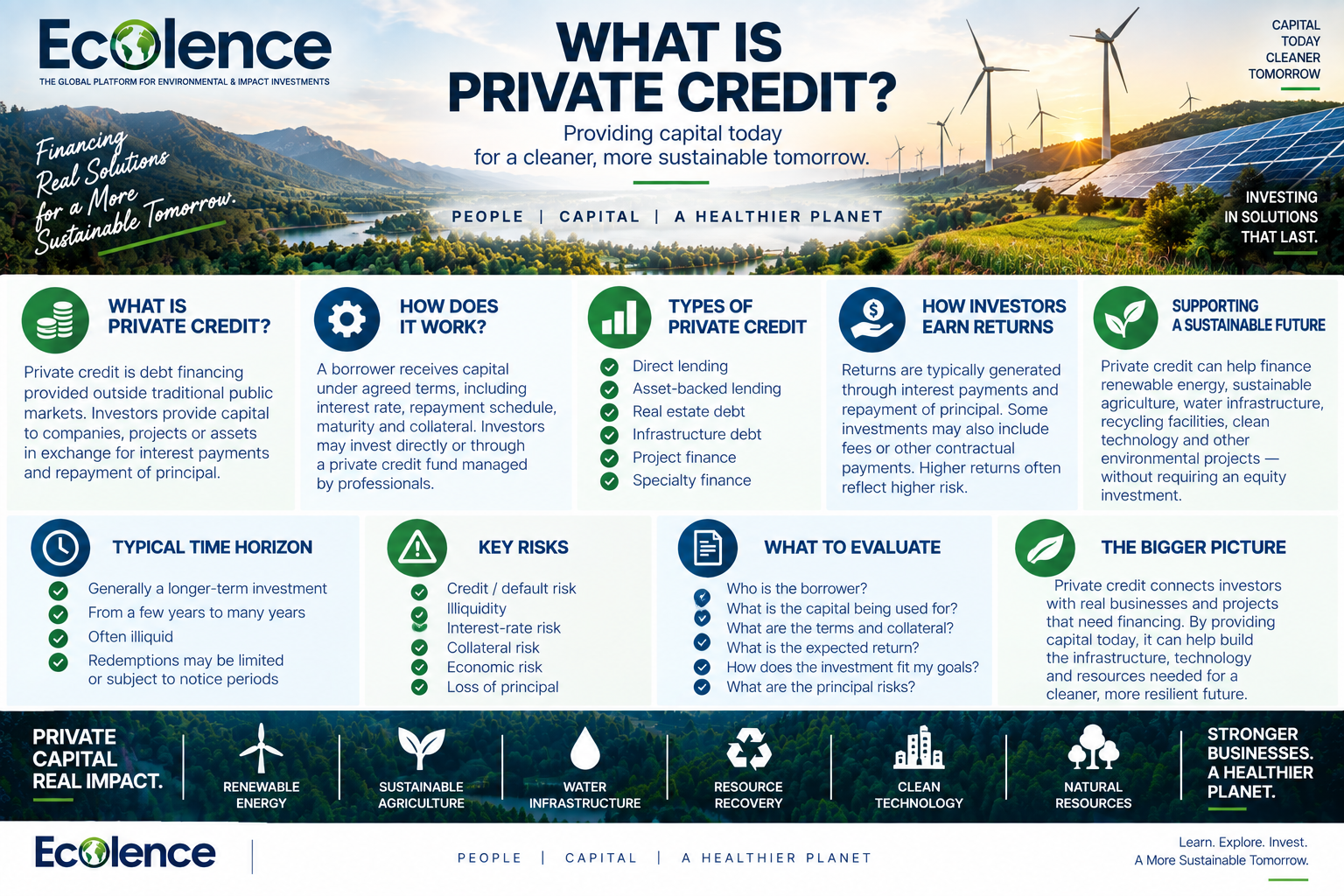
WHAT IS PRIVATE CREDIT?
Private credit is debt financing provided outside traditional public bond markets.
Instead of purchasing ownership in a company, private-credit investors generally provide capital that a borrower is obligated to repay according to agreed terms.
The borrower might be a private company, project, real-estate owner, infrastructure operator or other organization seeking financing.
In exchange for providing capital, investors typically seek to earn a return primarily through interest payments and repayment of principal.
This creates an important distinction:
Private equity provides ownership capital. Private credit provides borrowed capital.
HOW DOES PRIVATE CREDIT WORK?
A borrower needs capital.
Rather than obtaining all of that financing from a traditional bank or issuing publicly traded bonds, the borrower may obtain financing from a private-credit fund or other private lender.
The financing agreement establishes terms that may include:
Amount borrowed
Interest rate
Payment schedule
Maturity date
Collateral
Financial covenants
Default provisions
Repayment requirements
The exact structure depends on the borrower, lender and transaction.
WHAT IS A PRIVATE CREDIT FUND?
A private-credit fund pools investor capital and uses that capital to make loans or other debt investments.
A professional manager generally identifies borrowers, evaluates their financial condition, structures financing, negotiates terms and monitors the loans.
Investors participate indirectly through the fund rather than making each loan themselves.
Private-credit funds can pursue very different strategies, so investors should understand what types of borrowers and loans a particular fund targets.
WHAT TYPES OF PRIVATE CREDIT EXIST?
Private credit is a broad category.
Strategies can include:
DIRECT LENDING
Loans made directly to private businesses.
ASSET-BACKED LENDING
Financing supported by specific assets or pools of assets.
REAL-ESTATE DEBT
Loans secured by real estate or real-estate projects.
INFRASTRUCTURE DEBT
Financing for infrastructure assets and projects.
PROJECT FINANCE
Debt used to finance specific projects where repayment may depend significantly on project cash flows.
SPECIALTY FINANCE
Financing designed around particular industries, assets or borrower needs.
Different strategies can carry very different levels of risk.
HOW CAN INVESTORS EARN A RETURN?
The primary source of return in many private-credit investments is interest.
A borrower receives capital and agrees to pay interest according to the financing terms.
Investors may therefore receive periodic distributions generated from interest collected by the fund.
Some loans may also include additional economic features, such as fees or other contractual payments.
However, an advertised distribution rate or target yield is not necessarily guaranteed.
The borrower must ultimately have the financial ability to meet its obligations.
WHAT HAPPENS TO THE PRINCIPAL?
Principal is the amount originally lent.
Depending on the structure, principal may be repaid gradually over the life of a loan or primarily when the loan reaches maturity.
A private-credit fund may continually make and repay multiple loans over its life.
Investors should understand the distinction between:
Interest income
and
Return of principal
Receiving your original capital back is not itself an investment profit.
FIXED vs. FLOATING INTEREST RATES
Private loans can have different interest-rate structures.
A fixed-rate loan generally maintains an established interest rate according to its terms.
A floating-rate loan may have an interest rate tied to a benchmark plus an additional spread.
This means the amount of interest generated by some private-credit investments can change as market interest rates change.
The interest-rate structure should therefore be understood when evaluating expected cash flows.
WHAT IS COLLATERAL?
Some private loans are secured by collateral.
Collateral may include real estate, equipment, financial assets or other property.
If the borrower defaults, the lender may have rights against that collateral.
But collateral does not eliminate risk.
The asset may decline in value, be difficult to sell or fail to generate enough proceeds to repay the entire outstanding loan.
Investors should not assume that the word secured means the investment cannot lose money.
WHAT IS SENIORITY?
Different lenders can have different priorities in a borrower’s capital structure.
Senior debt generally has a higher repayment priority than subordinated debt or equity.
Subordinated debt generally ranks behind senior obligations.
Equity usually absorbs losses before debt but may also have greater upside if the business becomes significantly more valuable.
Where an investment sits in the capital structure can materially affect both its risk and potential return.
HOW IS PRIVATE CREDIT DIFFERENT FROM PRIVATE EQUITY?
The biggest difference is the investor’s economic position.
With private equity, investors own an interest in the business or asset and generally participate in changes in its value.
With private credit, investors are lenders and generally have contractual rights to interest and repayment.
Private-credit returns may therefore be more heavily dependent on:
Interest rates
Borrower cash flow
Creditworthiness
Collateral
and
Repayment
rather than appreciation in the value of a company.
WHAT IS DEFAULT RISK?
The central risk in lending is that the borrower may not make payments as required.
This is known as credit or default risk.
If a borrower experiences financial difficulty, the lender may face:
Late payments
Reduced interest
Restructuring
Extension of the loan
Foreclosure or enforcement
Loss of principal
The existence of a loan agreement does not guarantee that the borrower will be able to comply with it.
WHAT OTHER RISKS SHOULD INVESTORS CONSIDER?
Private credit can involve several important risks.
CREDIT RISK
The borrower may fail to repay the loan.
LIQUIDITY RISK
Private loans may not have an active secondary market.
INTEREST-RATE RISK
Changes in market rates can affect loan economics and valuations.
COLLATERAL RISK
Assets securing a loan may be worth less than expected.
CONCENTRATION RISK
A fund may have significant exposure to particular borrowers, sectors or assets.
MANAGEMENT RISK
Results depend partly on the manager’s ability to underwrite and monitor loans.
VALUATION RISK
Private loans may not have continuously observable market prices.
ECONOMIC RISK
A weaker economy can affect borrowers’ ability to service debt.
Investors can lose some or all of their invested capital.
IS PRIVATE CREDIT LIQUID?
Generally, private credit should be considered a longer-term and potentially illiquid investment.
The underlying loans may have multi-year maturities, and interests in private-credit funds may have restrictions on withdrawals or transfers.
Some funds provide periodic redemption opportunities, but those redemptions may be subject to notice periods, limits or available liquidity.
Investors should understand the specific liquidity terms rather than assuming capital can be withdrawn whenever desired.
PRIVATE CREDIT AND ENVIRONMENTAL INVESTING
Private credit can play an important role in financing the environmental economy.
Many environmental assets and businesses require capital but do not necessarily need—or want—to sell ownership.
Debt financing can potentially support:
Renewable-energy projects
Sustainable agriculture
Farmland improvements
Water infrastructure
Energy-efficiency projects
Recycling facilities
Environmental equipment
Clean-technology businesses
Natural-resource projects
For example, a renewable-energy project may borrow capital to construct infrastructure and use future project revenue to service the debt.
An agricultural operation might finance irrigation, equipment or other improvements.
A growing environmental business might borrow capital to expand without issuing additional equity.
WHAT SHOULD AN INVESTOR EVALUATE?
Before considering a private-credit investment, investors should understand:
Who is borrowing the money?
What will the capital be used for?
What interest rate is being charged?
Is the rate fixed or floating?
What is the maturity?
What collateral secures the loan?
Where does the debt rank in the capital structure?
What cash flow supports repayment?
How much leverage does the borrower already have?
What happens if the borrower defaults?
How diversified is the portfolio?
What fees does the fund charge?
When can investors access their capital?
The stated yield is only one part of the analysis.
THE BIGGER PICTURE
Private credit connects investors who can provide capital with businesses, assets and projects that need financing.
Unlike private equity, the objective is generally not to own the borrower.
It is to lend capital under defined terms and receive compensation for taking credit risk.
That distinction makes private credit an important part of the private-market investment universe—and potentially an important source of capital for the environmental economy.
But a higher interest rate generally exists for a reason.
Understanding who owes the money, what supports repayment, where the loan sits in the capital structure and what happens if things go wrong is fundamental to understanding a private-credit investment.