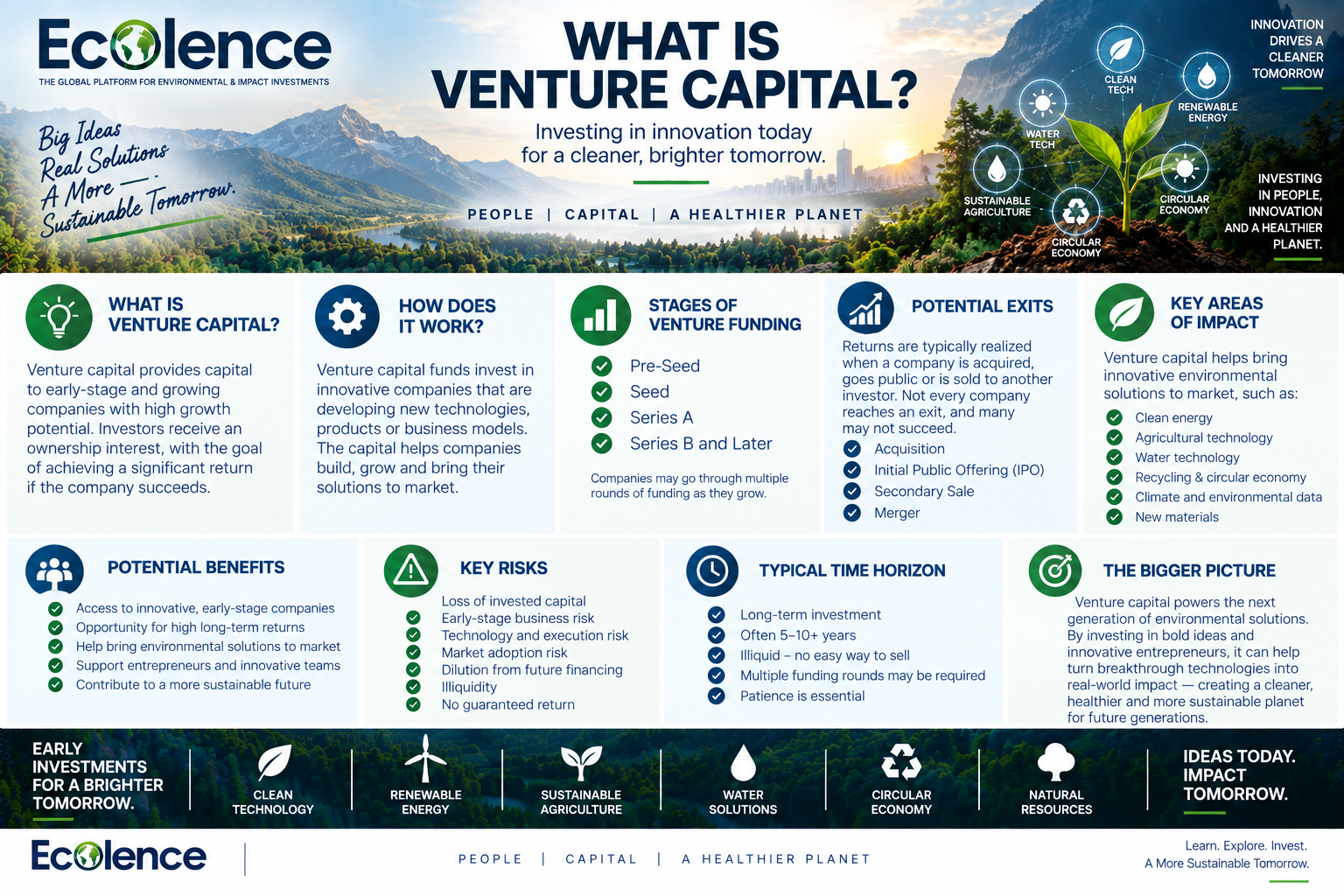
WHAT IS VENTURE CAPITAL?
Venture capital is a form of private investment that provides capital to early-stage and growing companies with the potential for significant expansion.
Unlike traditional lending, venture-capital investors generally receive an ownership interest in the company rather than relying primarily on interest payments.
The basic idea is straightforward:
Invest capital into a young company today in the hope that the company becomes substantially more valuable in the future.
That potential can be significant—but so can the risk.
Many early-stage businesses never achieve their original objectives, and venture investors must be prepared for the possibility of losing some or all of their investment.
HOW DOES VENTURE CAPITAL WORK?
A young company may have an innovative technology, product or business model but lack the capital necessary to develop and expand it.
Venture capital can provide funding for activities such as:
Product development
Research and development
Hiring
Manufacturing
Marketing
Technology development
Commercialization
Entering new markets
Expanding operations
In exchange, investors generally receive equity or another security that may ultimately convert into equity.
WHAT IS A VENTURE CAPITAL FUND?
Many investors gain exposure to venture capital through a professionally managed venture capital fund.
The fund pools capital from investors and uses that capital to invest in a portfolio of private companies.
The venture manager is generally responsible for:
Finding potential investments
Conducting due diligence
Negotiating investment terms
Monitoring portfolio companies
Working with founders and management
Participating in subsequent financing rounds
Helping companies develop strategic relationships
Pursuing eventual exits
A fund may invest in many companies because venture investing inherently involves uncertainty.
WHAT DOES “EARLY STAGE” MEAN?
Private companies can raise capital at different stages of development.
Terminology varies, but investors may encounter:
PRE-SEED
Very early financing used to develop an idea, prototype or initial business.
SEED
Capital used to develop products, test markets, hire employees or begin commercialization.
SERIES A
Financing generally intended to help a company demonstrate and expand a viable business model.
SERIES B AND LATER
Additional financing rounds that may help successful companies scale operations, expand geographically or accelerate growth.
Companies can raise multiple rounds before an investor ultimately receives liquidity.
HOW CAN VENTURE CAPITAL GENERATE RETURNS?
Venture capital typically does not depend primarily on regular income or interest payments.
Instead, returns are generally driven by increases in the value of the underlying companies.
Suppose a venture fund invests in a young environmental-technology company.
If that company successfully develops its technology, attracts customers, increases revenue and grows, its value may increase.
The venture investor may eventually realize that increased value through an exit.
However, until an exit actually occurs, much of that value may exist only as an estimated private-company valuation.
WHAT IS AN EXIT?
An exit is an event that potentially allows venture investors to convert their ownership interest into cash or another liquid investment.
Possible exits include:
Acquisition by another company
Sale to another investor
Merger
Secondary transaction
Initial public offering (IPO)
Not every company reaches an exit.
Some businesses fail.
Others remain private for many years.
And some may survive without ever achieving the valuation investors originally expected.
WHY CAN ONE SUCCESSFUL COMPANY MATTER SO MUCH?
Venture-capital portfolios can behave differently from more traditional investment portfolios.
Some portfolio companies may fail or generate disappointing returns.
Others may produce moderate results.
A relatively small number of highly successful companies can sometimes account for a significant portion of a venture fund’s overall performance.
This is one reason venture funds often invest across a portfolio of companies rather than relying on a single business.
Diversification, however, does not eliminate the possibility of substantial losses.
WHAT IS DILUTION?
Dilution is an important venture-capital concept.
Young companies often need multiple rounds of financing.
When a company issues additional shares to new investors, existing investors’ percentage ownership may decrease unless they participate in the new financing or have applicable contractual protections.
A smaller percentage ownership does not automatically mean an investor has lost economic value—the company itself may have become more valuable—but investors should understand how future financing can affect their ownership.
HOW IS VENTURE CAPITAL DIFFERENT FROM PRIVATE EQUITY?
Both involve privately held companies, but their strategies often differ.
VENTURE CAPITAL
Typically focuses on younger companies, emerging technologies and businesses pursuing rapid growth.
PRIVATE EQUITY
Often focuses on more established businesses with longer operating histories, existing revenues and more developed business models.
Venture capital generally accepts substantial business uncertainty in pursuit of potentially significant growth.
The boundaries between the two can overlap, particularly as companies mature.
HOW IS VENTURE CAPITAL DIFFERENT FROM PRIVATE CREDIT?
The economic relationship is very different.
A venture-capital investor generally owns an equity interest and participates in changes in the company’s value.
A private-credit investor generally lends capital and seeks contractual interest payments and repayment of principal.
Equity may provide greater participation in a company’s potential upside, but equity investors generally stand behind creditors in the capital structure if the company fails.
IS VENTURE CAPITAL LIQUID?
Generally, no.
Venture capital should normally be considered a long-term, illiquid investment.
Private-company shares may not have an established secondary market, and transfer restrictions may apply.
Investors may have to wait many years before a company is acquired, goes public or otherwise provides liquidity.
There may never be a successful liquidity event.
WHAT ARE THE MAJOR RISKS?
Venture capital can involve substantial risk.
BUSINESS RISK
The company may fail to develop a viable business.
TECHNOLOGY RISK
A technology may not work as expected or may become obsolete.
EXECUTION RISK
Management may fail to execute the company’s strategy.
MARKET RISK
Customers may not adopt the company’s product or service.
FINANCING RISK
The company may require additional capital and may be unable to obtain it.
DILUTION RISK
Additional financing rounds may reduce existing investors’ percentage ownership.
VALUATION RISK
Private-company valuations may be uncertain and may change substantially between financing rounds.
LIQUIDITY RISK
There may be no readily available market for the investment.
LOSS OF CAPITAL
Some venture-backed companies fail completely.
Investors should be prepared for the possibility of losing their entire investment in an individual company.
VENTURE CAPITAL AND ENVIRONMENTAL TECHNOLOGY
Venture capital can be especially important to the environmental economy because many environmental solutions begin with innovation.
Potential areas include:
Energy storage
Agricultural technology
Water technology
Advanced recycling
Environmental monitoring
Carbon measurement
Satellite and environmental data
New materials
Energy efficiency
Grid technology
Resource-management software
These businesses may require substantial capital to move from an idea or prototype to commercial-scale operations.
Venture capital can help bridge that gap.
WHAT SHOULD AN INVESTOR EVALUATE?
Before considering a venture-capital investment, investors should understand:
What problem is the company solving?
Does the technology or product work?
Is there a market for it?
Who are the competitors?
Who are the founders and management team?
How does the company generate revenue?
How much additional capital might be required?
What valuation is being placed on the company?
What security is the investor purchasing?
What rights come with that security?
How could future financing affect ownership?
What is the potential exit strategy?
What happens if the company fails?
For a venture fund, investors should also evaluate the manager’s strategy, experience, portfolio construction, fees and approach to follow-on investments.
THE BIGGER PICTURE
Some of tomorrow’s environmental businesses may begin with little more than an idea, a technology and a team trying to solve a problem.
Moving from that idea to a commercially viable business requires capital.
Venture capital can provide that capital.
For investors, this creates an opportunity to participate in the growth of emerging businesses before they reach the public markets.
But early access comes with substantial uncertainty.
The technology must work. Customers must want it. Management must execute. Capital must be available. And ultimately, the company must create enough value for investors to realize a return.
That combination of high uncertainty and potentially significant growth is at the heart of venture capital.