WHAT IS A PRIVATE INVESTMENT FUND?
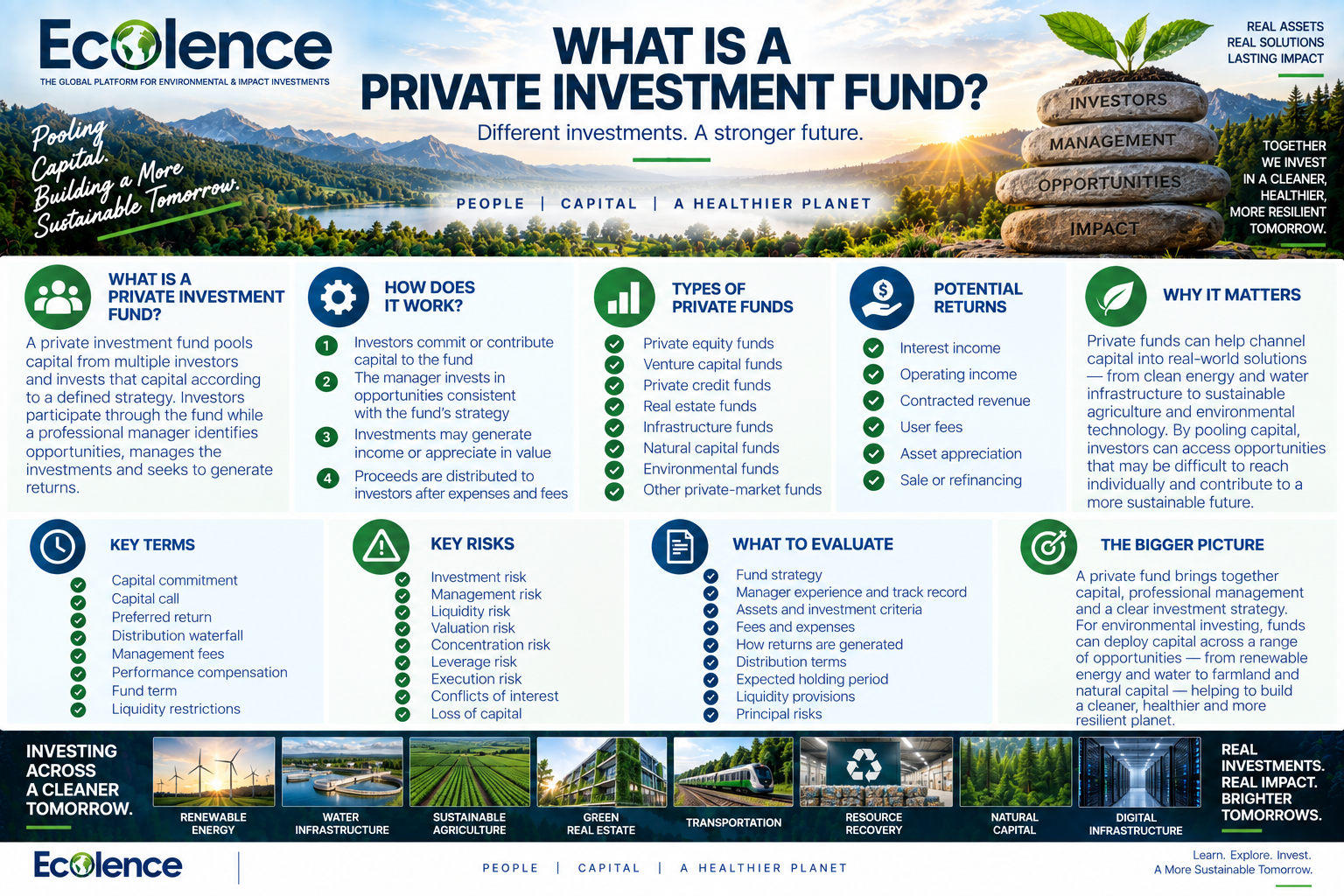
A private investment fund is an investment vehicle that pools capital from multiple investors and invests that capital according to a defined strategy.
Rather than each investor individually purchasing and managing the underlying assets, investors participate through the fund.
A professional manager is generally responsible for identifying opportunities, making investment decisions, managing the portfolio and ultimately seeking to generate returns for the fund’s investors.
Private funds can invest in almost anything permitted by their strategy, including:
Private companies
Private credit
Real estate
Infrastructure
Farmland
Natural resources
Environmental projects
Venture capital
Other private-market assets
The term private fund describes the investment vehicle—not a particular investment strategy.
HOW DOES A PRIVATE FUND WORK?
The basic structure is relatively straightforward.
Investors contribute or commit capital to the fund.
The fund manager uses that capital to make investments consistent with the fund’s stated strategy.
Those investments may generate income, appreciate in value or eventually be sold.
After applicable expenses and fees, proceeds may be distributed to investors according to the fund’s governing documents.
The details, however, can vary substantially from one fund to another.
WHO MANAGES THE FUND?
Private funds are generally managed by a fund manager, general partner, investment manager or similar organization.
The manager may be responsible for:
Finding investment opportunities
Conducting due diligence
Making investment decisions
Negotiating transactions
Monitoring investments
Managing risks
Arranging financing
Reporting to investors
Making distributions
Determining when investments should be sold
Because investors delegate significant responsibility to the manager, evaluating the manager is an important part of evaluating the fund.
WHAT TYPES OF PRIVATE FUNDS EXIST?
Private funds can pursue many different strategies.
PRIVATE EQUITY FUNDS
Invest primarily in privately held companies.
VENTURE CAPITAL FUNDS
Invest primarily in early-stage and growing private businesses.
PRIVATE CREDIT FUNDS
Provide loans and other forms of private debt financing.
REAL ESTATE FUNDS
Acquire, develop, finance or operate real estate.
INFRASTRUCTURE FUNDS
Invest in physical infrastructure assets and projects.
NATURAL CAPITAL FUNDS
May invest in farmland, forestry, conservation or other natural-resource assets.
A fund can also combine multiple investment approaches.
The name of the fund alone does not tell investors exactly what they own.
The underlying strategy matters.
WHAT IS A FUND’S INVESTMENT STRATEGY?
The investment strategy explains what the fund intends to do with investor capital.
For example, one environmental fund might acquire farmland and partner with agricultural operators.
Another might provide debt financing to renewable-energy projects.
Another could invest in early-stage environmental technology companies.
Another might acquire operating solar, water or infrastructure assets.
Understanding the strategy means understanding:
What the fund can invest in
How investments are selected
How returns are expected to be generated
How much risk the manager may take
How long investments may be held
A clearly defined strategy gives investors a framework for understanding what their capital is intended to accomplish.
CAPITAL COMMITMENT vs. CAPITAL CONTRIBUTION
Some private funds require investors to provide their entire investment when they subscribe.
Others use a capital commitment structure.
Under a commitment structure, an investor agrees to provide a certain amount of capital, but the manager may request that capital over time as investment opportunities arise.
Those requests are commonly known as capital calls.
For example, an investor might commit $100,000 to a fund but initially contribute only a portion of that amount.
The remaining commitment could be called later.
Investors should understand whether their obligation is limited to the amount already contributed or includes additional committed capital.
HOW CAN A PRIVATE FUND GENERATE RETURNS?
The answer depends on its strategy.
Potential sources include:
INTEREST INCOME
Private-credit funds may earn interest from borrowers.
OPERATING INCOME
Real estate, infrastructure or other real assets may produce ongoing cash flow.
BUSINESS GROWTH
Private-equity and venture investments may become more valuable as portfolio companies grow.
ASSET APPRECIATION
Farmland, real estate or other assets may increase in value.
SALE OF INVESTMENTS
The fund may realize gains when portfolio assets or companies are sold.
A fund may use several of these sources simultaneously.
WHAT ARE DISTRIBUTIONS?
A distribution is money or property paid by the fund to its investors.
Distributions may come from:
Investment income
Interest
Operating cash flow
Sale proceeds
Refinancing proceeds
Return of investor capital
This distinction is important.
Not every distribution represents investment profit.
Part of a distribution may represent a return of the investor’s own capital.
Investors should understand the source and character of distributions rather than evaluating a fund solely by how much cash it distributes.
WHAT IS A PREFERRED RETURN?
Some private funds use a preferred return.
A preferred return generally establishes an economic threshold that determines how profits are allocated between investors and the manager.
The exact calculation can vary substantially among funds.
A preferred return should therefore not automatically be interpreted as a guaranteed annual payment.
Investors should review the fund’s governing documents to understand how the preferred return is calculated, whether it accrues, and how it interacts with other provisions of the distribution waterfall.
WHAT IS A DISTRIBUTION WATERFALL?
A distribution waterfall establishes the order in which investment proceeds are allocated.
A simplified waterfall might provide for:
Return of investor capital
then
Payment of a preferred return
then
Allocation of additional profits between investors and the manager
Actual waterfalls can be considerably more complicated.
Investors should understand how profits are divided before investing.
WHAT FEES CAN PRIVATE FUNDS CHARGE?
Private funds can have several layers of fees and expenses.
Depending on the fund, these may include:
Management fees
Performance-based compensation
Organizational expenses
Administrative expenses
Transaction expenses
Acquisition fees
Financing expenses
Fund operating expenses
Fees vary considerably among strategies and managers.
Investors should understand both what the fund charges and how those charges affect their potential net return.
WHAT IS PERFORMANCE-BASED COMPENSATION?
Some private-fund managers receive a portion of investment profits.
Depending on the fund structure, this may be described using terms such as carried interest, incentive allocation or performance fee.
For example, after certain conditions are satisfied, profits might be divided between investors and the manager according to an agreed formula.
This can align the manager’s compensation with investment performance, but investors still need to understand exactly how the calculation works.
HOW LONG DO PRIVATE FUNDS LAST?
Private funds can have very different time horizons.
Some are designed to operate for a defined number of years.
Others may have longer or potentially indefinite lives.
Investors may encounter:
Investment periods
Lockup periods
Fund terms
Redemption periods
Notice requirements
Extension provisions
A stated fund term does not necessarily mean an investor can withdraw capital at any point during that period.
ARE PRIVATE FUNDS LIQUID?
Many private funds should be considered illiquid investments.
Investors may be unable to sell or redeem their interests whenever they choose.
Transfers may require approval.
Redemptions may be limited.
Some funds may not offer redemptions at all during significant portions of their life.
Investors should understand the liquidity provisions before committing capital.
WHAT DOCUMENTS GOVERN A PRIVATE FUND?
Depending on the structure and offering, investors may receive documents such as:
Private Placement Memorandum
Limited Partnership Agreement
Operating Agreement
Subscription Agreement
Financial statements
Investor reports
These documents can contain important information concerning the fund’s strategy, risks, fees, conflicts, governance, liquidity and investor rights.
Marketing materials should not replace review of the governing documents.
WHAT ARE THE MAJOR RISKS?
Private funds can involve substantial risk.
INVESTMENT RISK
Underlying investments may lose value.
MANAGEMENT RISK
Results depend significantly on the manager’s decisions.
LIQUIDITY RISK
Investors may be unable to access their capital for extended periods.
VALUATION RISK
Private assets may not have readily observable market prices.
CONCENTRATION RISK
A fund may have significant exposure to particular assets, sectors or regions.
LEVERAGE RISK
Borrowing can amplify losses.
EXECUTION RISK
The manager may fail to execute the intended strategy successfully.
CONFLICTS OF INTEREST
The manager or its affiliates may have interests that differ from those of investors.
Investors can lose some or all of their invested capital.
PRIVATE FUNDS AND ENVIRONMENTAL INVESTING
Private funds can be particularly useful for environmental investing because many environmental opportunities involve specialized, long-term or real-world assets.
A private environmental fund might invest in:
Sustainable farmland
Renewable-energy infrastructure
Water projects
Forestry
Natural capital
Environmental technology
Private environmental companies
Private credit for environmental projects
Resource-recovery infrastructure
The fund structure allows multiple investors to pool capital while a specialized manager oversees the investments.
WHAT SHOULD AN INVESTOR EVALUATE?
Before considering a private fund, investors should understand:
What is the fund’s strategy?
Who manages it?
What experience does the manager have?
What assets can the fund purchase?
How are investments valued?
How will returns potentially be generated?
What fees and expenses apply?
Does the manager receive performance compensation?
How are distributions allocated?
What is the expected holding period?
Can investors redeem or transfer their interests?
Does the fund use leverage?
What conflicts of interest exist?
What are the principal risks?
The fund’s headline return objective is only one part of that analysis.
THE BIGGER PICTURE
A private fund is essentially a structure for bringing together capital, professional management and an investment strategy.
Investors provide capital.
The manager provides the strategy and execution.
The fund owns or finances the underlying investments.
Those investments ultimately determine whether value is created.
For environmental investing, private funds can provide a way to aggregate investor capital and deploy it across opportunities that may be difficult for individual investors to access or manage directly.
But the fund structure itself does not make an investment successful.
Investors still need to understand what the fund owns, who controls the capital, how the manager is compensated, how returns are expected to be generated, when capital can be returned and what could go wrong.