Private investment opportunities aren’t always limited to accredited investors.
That’s where Regulation A can come into the picture.
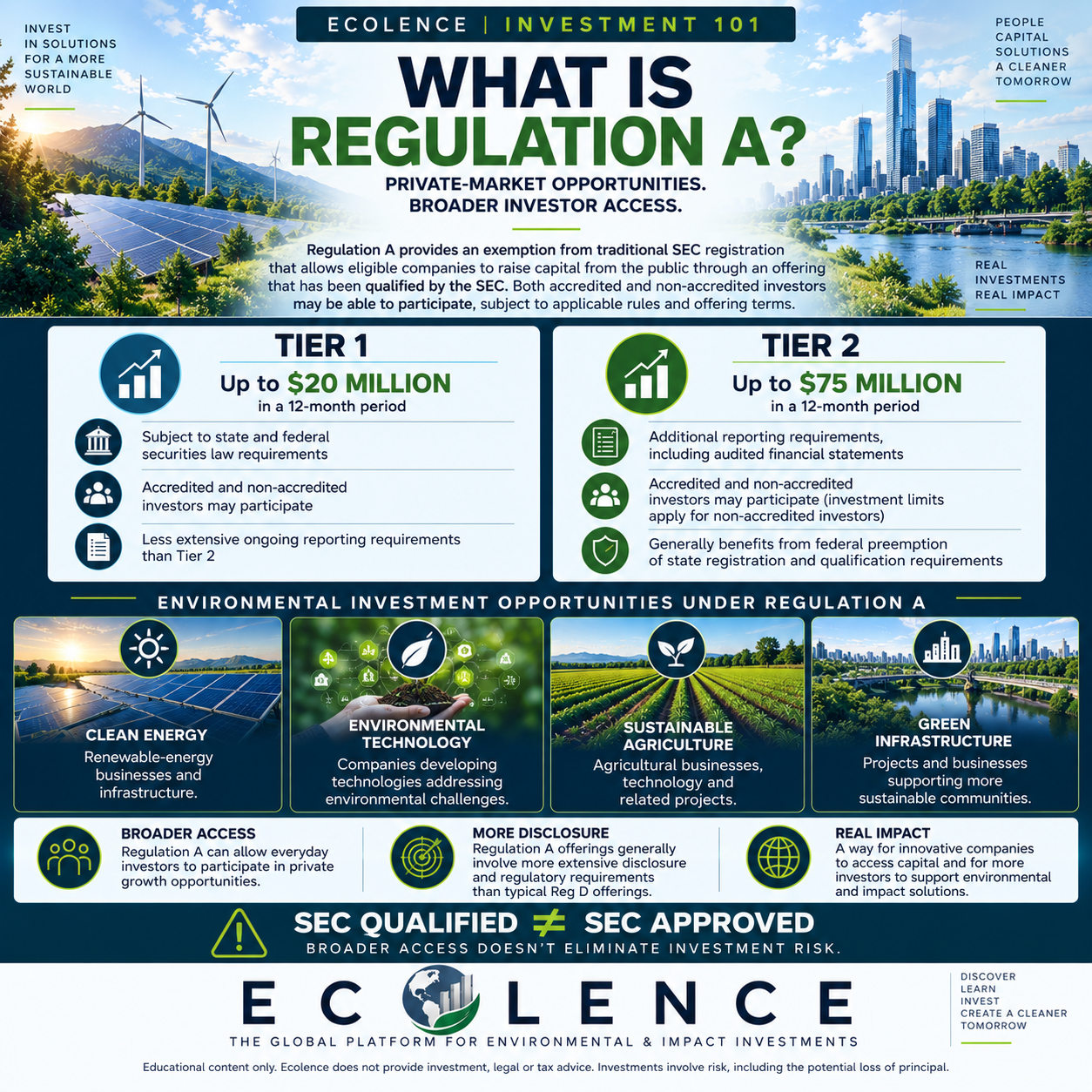
Often referred to informally as a “mini public offering,” Regulation A provides an exemption from traditional SEC registration that allows eligible companies to raise capital from the public through an offering that has been qualified by the SEC.
That means both accredited and non-accredited investors may be able to participate, subject to applicable rules and offering terms.
TWO TIERS OF REGULATION A
Regulation A is divided into two tiers:
TIER 1
Companies may offer up to $20 million of securities during a 12-month period.
Tier 1 offerings remain subject to applicable state securities-law review in addition to federal requirements.
TIER 2
Companies may offer up to $75 million during a 12-month period.
Tier 2 offerings have additional requirements, including audited financial statements and ongoing SEC reporting, but generally benefit from federal preemption of state registration and qualification requirements.
For non-accredited investors purchasing securities in a Tier 2 offering, investment limits can also apply.
WHY WOULD A COMPANY USE REGULATION A?
Regulation A can provide companies with an alternative way to access capital while allowing them to reach a much broader investor audience.
An issuer can publicly market its qualified offering and potentially raise capital from everyday investors—not just institutions and high-net-worth accredited investors.
That can make Regulation A particularly interesting for businesses and projects with strong consumer or community appeal.
Potential areas could include:
Clean Energy
Renewable-energy businesses and infrastructure.
Environmental Technology
Companies developing technologies addressing environmental challenges.
Sustainable Agriculture
Agricultural businesses, technology and related projects.
Circular Economy
Recycling, resource recovery and waste-to-value companies.
Green Infrastructure
Businesses and projects supporting more sustainable communities.
REGULATION A vs. REGULATION D
One of the biggest differences is who can potentially invest.
REG D
Often used for private offerings, with many publicly marketed Rule 506(c) opportunities restricted to verified accredited investors.
REGULATION A
Can potentially allow both accredited and non-accredited investors to participate.
But there is another important difference:
Regulation A offerings generally involve more extensive disclosure and regulatory requirements than typical Regulation D offerings.
“SEC QUALIFIED” DOES NOT MEAN “SEC APPROVED”
This distinction is critical.
The SEC qualifying an offering statement does not mean that the SEC has endorsed the investment, determined that it is a good investment, or guaranteed its future performance.
Investors still need to perform their own due diligence.
Private and alternative investments can involve substantial risks, including limited liquidity and the potential loss of principal.
WHY DOES REGULATION A MATTER TO ECOLENCE?
One of Ecolence’s goals is to make the environmental investment universe easier to discover and understand.
That universe can include different investment structures designed for different types of investors.
Regulation A represents one potential bridge between companies seeking growth capital and a much broader community of investors interested in environmental and impact opportunities.
Understanding the structure is the first step toward understanding the opportunity.
Discover. Learn. Evaluate.
Ecolence
The Global Platform for Environmental & Impact Investments
Educational content only. Ecolence does not provide investment, legal or tax advice. Investments involve risk, including the potential loss of principal.